
 Search Articles


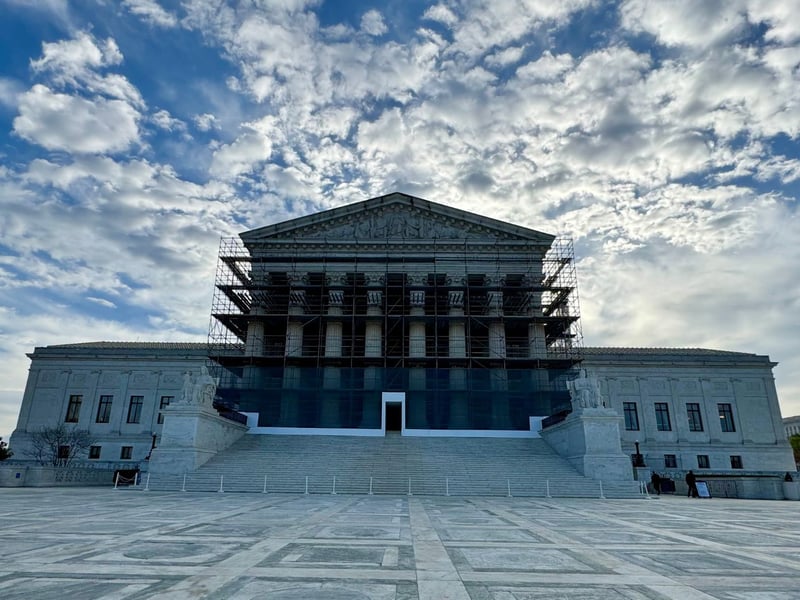
WASHINGTON (CN) — An Ohio woman’s “reverse discrimination” lawsuit was not given equal treatment, the Supreme Court ruled Thursday, rejecting a disparate weighing of employment discrimination claims brought by members of majority groups.
The high court ruled unanimously that Marlean Ames, a heterosexual woman, should have had her discrimination suit treated the same as any claim for discrimination, rather than face a heightened evidentiary standard because she is a member of a “majority group.”
Supreme Court Justice Ketanji Brown Jackson, a Joe Biden appointee, wrote the court’s opinion, rejecting the Sixth Circuit’s so-called “background circumstances” requirement to support a claim against the “unusual employer who discriminates against the majority.”
“We hold that this additional ‘background circumstances’ requirement is not consistent with Title VII’s text or our case law construing the statute,” Jackson wrote. “Accordingly, we vacate the judgment below and remand for application of the proper prima facie standard.”
She noted that Title VII’s disparate treatment section makes no distinction between plaintiffs of a majority or minority group, but on its face is meant to bar discrimination against any individual because of their identity.
“By establishing the same protections for every ‘individual’ — without regard to that individual’s membership in a minority or majority group — Congress left no room for courts to impose special requirements on majority-group plaintiffs alone,” Jackson wrote.
In the Sixth Circuit’s analysis, the appellate court found that the background circumstances rule effectively forced majority-group plaintiffs to produce specific types of evidence, such as statistical proof or information about an employer’s own “protected traits,” something a minority-group plaintiff would not have to do.
Ames claims that the Ohio Department of Youth Services passed her up for a promotion, instead hiring a lesbian who was “arguably less qualified.” She was later demoted and replaced with a gay man — who Ames says was similarly unqualified for the position.
The Sixth Circuit rejected Ames’ Title VII suit, finding that she didn’t meet the standard for majority-group plaintiffs challenging discrimination by minority groups.
For decades, appeals courts have evaluated Title VII claims using McDonnell Douglas Corp v. Green . The 1973 ruling implemented a three-part test for employer discriminatory claims. Under the first prong, individuals like Ames must establish the claimed discrimination, showing that an employer took adverse action against them in a way that implies a form of unlawful discrimination.
The Sixth Circuit said that because she is not a minority, Ames had to show “background circumstances” to move forward with her discrimination claims.
“The Sixth Circuit has implemented a rule that requires certain Title VII plaintiffs — those who are members of majority groups — to satisfy a heightened evidentiary standard in order to carry their burden under the first step of the McDonnell Douglas framework,” Jackson wrote. “We conclude that Title VII does not impose such a heightened standard on majority-group plaintiffs.”
Justice Clarence Thomas, a George H.W. Bush appointee, wrote a concurrence that Justice Neil Gorsuch, a Donald Trump appointee, joined.
Thomas noted that he fully agreed with the court’s opinion, but wanted to highlight “the problems that arise when judges create atextual legal rules and frameworks,” such as the background circumstances rule.
He further slammed the McDonnell Douglas framework as having no basis in Title VII and for being difficult for courts to apply.
“This case did not present a question whether the McDonnell Douglas framework is an appropriate tool for evaluating Title VII claims at summary judgment,” Thomas wrote. “In a case where that issue is squarely before us, I would consider whether the framework should be used for that purpose.”
Until then, he said litigants and courts were free to continue using the three-step test, but noted that courts have seemingly had an easier time using Rule 56, a civil procedure rule for summary judgment motions, to handle Title VII cases.
Employment lawyers warned that tossing the background circumstances rule could lead to a rise in reverse discrimination suits, which are already on the rise following the Supreme Court’s 2023 ruling in Students for Fair Admissions v. Harvard .
The blockbuster ruling gutted university affirmative action programs, prohibiting race-based diversity initiatives. Under the new standard, private companies have faced increased scrutiny of diversity programs writ large.
Trump added to those concerns immediately upon taking office, signing an executive order claiming to eliminate all diversity, equity, inclusion and accessibility programs across the government. The administration said it would also prosecute so-called discrimination based on these policies in the private sector.
 Follow @KelseyReichmann
 Follow @kelseyreichmann.bsky.social
Subscribe to our free newsletters
Our weekly newsletter Closing Arguments offers the latest about ongoing trials, major litigation and rulings in courthouses around the U.S. and the world, while the monthly Under the Lights dishes the legal dirt from Hollywood, sports, Big Tech and the arts.