
 Search Articles


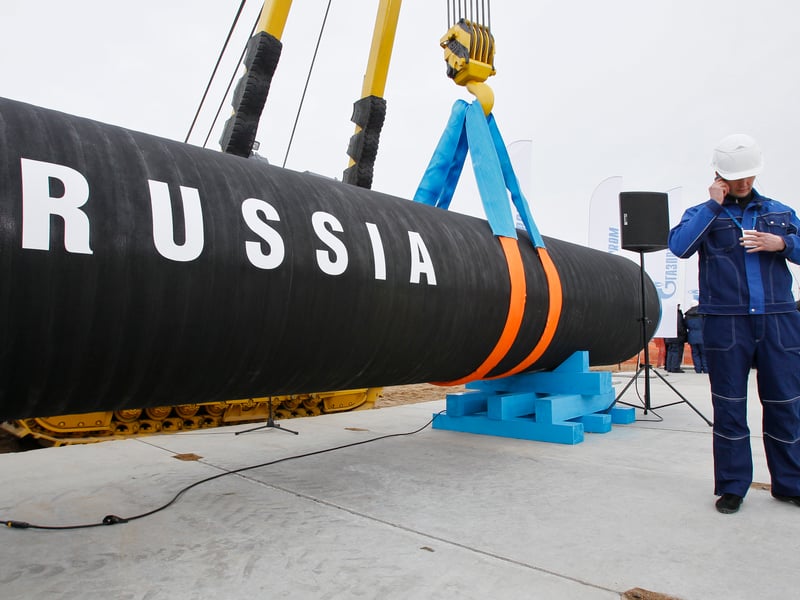
(CN) — Last summer as the war in Ukraine raged and peace talks went up in smoke, the European Union began in earnest a major geopolitical re-orientation away from Russia, the energy-rich next door neighbor whose bellicosity against Ukraine had made trade with Moscow morally impossible.
Cutting off Russia — the EU’s biggest supplier of energy at the time — has not been easy, and taking the high moral ground has exacted a high toll on the EU’s 447 million residents. The cost has been felt especially hard at the gas pump, on electricity bills and with inflation.
“We are facing a turning of events,” said Francesco Sassi, an expert on energy geopolitics and international relations at RIE, an Italian research firm. “We are in a new global energy crisis.”
Call it a new age of energy insecurity: A time of fierce global competition for energy.
“If 2022 were an earthquake for the global energy system, Europe was its epicenter,” said Jason Bordoff, a global energy expert at Columbia University, on a recent podcast.
Decreasing dependence
More than 18 months after the start of the Ukraine war and this new energy crisis, the EU can say it’s been successful in its main geopolitical goal: It has dramatically reduced its purchasing of Russian energy — and survived. Before the war, Russia supplied about 40% of the gas Europe consumed and up to 60% of the gas Germany used.
Today, gas pipeline imports from Russia have fallen by four-fifths. The sabotage of the Nord Stream pipelines across the Baltic Sea into Germany played a big part in ensuring most gas flows from Russia stopped. Also, Russian crude oil and coal imports have dried up almost completely.
During this shift away from Russia, Europeans didn’t experience the nightmare scenarios some predicted: There were no rolling blackouts, people didn’t freeze in their homes, endless lines at gas stations didn’t appear overnight, scores of stores didn’t close their shutters and European economies didn’t fall apart.
The EU, though, hasn’t entirely weaned itself off the Kremlin’s fossil fuels. Shipments of Russian liquefied natural gas (also known as LNG), mostly to the Iberian Peninsula, remain stable. Also, Russian gas continues to flow into Hungary and other countries in southeastern Europe through the TurkStream line across the Black Sea.
There is a history of economic ties to untangle. Europe’s reliance on Russia goes back 50 years and accelerated with fall of the Iron Curtain, when a newly-democratic Russia became a major supplier of energy to Western Europe. This relationship helped fuel a European economic boom in the 1990s and early 2000s. But as Russia turned into “Europe’s gas station,” the Kremlin also used the revenues from its lucrative energy empire to build up its military and aggressively assert itself.
The consequences of a new strategy
A year on from the worst of the crisis, the EU is breathing more easily with sharp energy price spikes mostly under control, storage facilities full and ready for winter, long-term energy contracts signed with non-Russian suppliers and new LNG ports getting built in lieu of Russian pipelines.
But the consequences of Europe’s shift away from Russia tell a complex and problematic story.
For one, Europe is now squeezing the world’s energy markets and forcing China, India and other developing nations to resort to dirty climate-damaging coal production, experts say.
At the same time, resource-poor Europe still faces an uncertain future where higher energy costs are curbing industrial activity and leaving Europeans poorer and anxious about where they’ll get their energy in the years to come.
“There’s still a huge amount of uncertainty about policy and policy delivery,” said Julian Bowden, a researcher and gas expert at the Oxford Institute for Energy Studies.
On the positive side, Europe’s energy crisis is compelling it to speed up its ambitious goals to harness renewable energy. In the past year, the EU has announced a slew of such projects, including plans for many new wind turbines in the North Sea.
But in the short term, the crisis is forcing Europe to backpedal on reducing emissions as it deepens its dependence on natural gas imports from the United States and elsewhere. Also, some countries — in particular Poland and Germany — are filling the vacuum left by the shutoff of Russian energy by going back to coal and nuclear power.
How did the EU manage the feat of surviving without Russian energy?
First, it spent a lot of money.
A recent analysis by Bruegel, a Brussels-based economic think tank, found that EU nations forked out 646 billion euros ($706 billion) to cushion households and businesses from the steep rise in energy costs.
The aid came in the form of price caps, fuel tax cuts, company bailouts and other measures. Germany, the EU’s economic engine, spent an eye-watering 265 billion euros ($289 billion) to keep afloat major energy companies, businesses and households.
Additionally, the United Kingdom, which is no longer part of the EU, spent 103 billion euros ($112 billion) to shield consumers, Bruegel found. These huge expenses rivaled the massive expenditures in European capitals to help people and businesses make it through the coronavirus pandemic.
The turn to liquefied natural gas
Last year, Europe also went on a mad scramble to find alternatives to Russian energy with its leaders visiting Egypt, Qatar, the United Arab Emirates, Azerbaijan, Algeria and Israel to secure imports. In the longer term, Europe is looking at building new pipelines from some of these regions.
But mostly Europe replaced Russian gas with expensive LNG shipments from the United States and other LNG providers, such as Qatar. LNG imports to Europe rose last year by 70%, making the EU a major importer, rivaling and even surpassing China and Japan, other resource-poor economic powerhouses. Before the war, LNG made up about 15% of the EU’s gas consumption; that figure has risen to about 25%.
“LNG is the solution for now,” Bowden said.
“[LNG] was important before the war; right now, it is fundamental to the European energy security,” Sassi said. He called the increase in LNG imports “once-in-a-lifetime changes.”
Meanwhile, the push by Europe to buy up LNG supplies is being “felt everywhere in the world,” Sassi said.
For example, he said India and Pakistan, both major LNG importers, have struggled to import spot LNG and have begun “looking more and more at coal.”
“The impossibility of importing LNG to Pakistan has furthered the economic crisis” there, Sassi said.
He said India “is importing more coal due to its inability to import LNG” and causing it and other developing nations to retreat from long-term plans to invest heavily in renewable energy.
The LNG crunch is playing a part in China’s recent decisions to rely on coal as well: The Asian powerhouse has begun building coal-powered plants at the highest rate since 2015.
Sassi added that the boom in LNG is being felt in the U.S. too. There are plans to build new LNG export terminals on the Gulf Coast, though investors are cautious because of high construction costs and uncertainty over the long-term demand for LNG.
In Europe, meanwhile, plans are moving forward to expand the number of LNG import facilities, including in Germany, the Netherlands, France, Poland, Spain and Italy.
Some 30 LNG terminals have been proposed in the EU. In order to ship natural gas long distances, it is frozen and condensed — what is known as LNG — but it then needs to be heated back up for its use as a fuel, a process that takes place at terminals.
Sassi said it is likely most of these expensive LNG terminals under consideration will be built “under political pressure from the industries in all the European countries which continue to still need natural gas.”
He said European companies likely will demand an increase in LNG imports to stay competitive with Asian and American rivals.
“They will push governments to build these terminals,” Sassi said.
The economic toll
New terminals will come at a big cost to European taxpayers, he added. He doubted private investors would be keen to pay for the LNG terminals and said governments will end up footing the costs to ensure future energy supplies.
He said estimates show that Germany will spend more than 10 billion euros ($11 billion) over the next 15 years building LNG terminals. However, the eventual cost will likely be much more due to inflation and rising construction prices.
“Taxpayers will pay for these LNG terminals in the form of higher energy bills, in the form of taxation,” he said. “The costs will be huge.”
He said Germany now views LNG as its main alternative to Russian gas but it remains unclear how much natural gas it will need over the next 15 years. With such uncertainty, German companies are reluctant to invest in expensive onshore LNG terminals that won’t yield profits any time soon, Sassi said.
That has left national governments taking the lead on securing energy supplies.
“You have to pay for security,” Sassi said.
But increased government involvement in energy markets will spawn its own political problems, he added.
“The [European] Commission has tried to increase its leverage on energy strategies and policies in the last two decades in Europe, but right now the balance has somehow slipped and it’s up to national governments to give enough money to energy companies in order to secure energy supplies,” Sassi said.
Europe did something else: It simply reduced energy consumption by literally turning off lights, heaters and air conditioners and shutting down industry. Consumption was cut by about 15%, a reduction attributable to higher costs but also to a mild winter.
“Turn the thermostat down: Lots of people did that,” Bowden said. “They didn’t do it necessarily voluntarily either. With the prices as they were, a lot of this was a personal reaction to high prices.”
To keep from slipping into darkness, some European countries, in particular Poland, also went back to burning coal and delayed plans to quit nuclear power.
“Priorities tend to be short term, don’t they?” Bowden said. “The issue is keeping your lights on today. If you’re a farmer, you need to do this year’s crop.”
Over the past year, Europeans also have paid record prices for energy: EU statistics show that on average Europeans paid 20% more on their household electricity bills and 31% more for natural gas. In some countries, power bills shot up by much more.
And the energy crisis is far from over, with recession besetting Germany and other European economies. The higher price for energy is seen as a leading cause for the slowdown. Germany slipped into a technical recession in the first quarter of this year and economic output remains sluggish.
An uncertain future
In general, Sassi said the crisis has left Europeans uncertain about how best to ensure their future supply of energy.
Surveys show that Europeans support the move away from paying for Russian energy — and by extension helping fund Russian President Vladimir Putin’s war machine.
But Sassi said Europe still faces the quandary of relying on supplies from other undemocratic countries.
“There’s not just Russia out there: There are many other countries which are not democracies, and they made a huge amount of money during 2022 exporting LNG to Europe,” Sassi said. “So, this problem, this geopolitical problem, could repeat itself in the next years.”
He said that while the crisis has prompted Europeans to accelerate the transition to renewable energy, the transition itself is being gummed up by the energy crisis.
“I think the interest in supporting the energy transition and looking at renewables has increased in Europe,” he said. “At the same time, the economic situation and the consequences of the energy crisis have lowered the spending capacity of many countries. Many energy companies are now really worried about investing in a specific energy market because they also understand that energy markets can be politicized; not just natural gas, all the energy markets can be politicized.”
He added: “This crisis is complicating the prospect of investing in all energy markets.”
Such thinking is hitting Europe, but also others. “China and India are looking at coal as a stable energy source for the next 20 years,” he said.
All of this, from the perspective of tackling global warming, is deeply troubling.
“It is very depressing because the consequences of the energy crisis are increasing protectionism all across the world,” Sassi said.
Courthouse News reporter Cain Burdeau is based in the European Union.
 Follow @cainburdeau
Subscribe to our free newsletters
Our weekly newsletter Closing Arguments offers the latest about ongoing trials, major litigation and rulings in courthouses around the U.S. and the world, while the monthly Under the Lights dishes the legal dirt from Hollywood, sports, Big Tech and the arts.