
 Search Articles


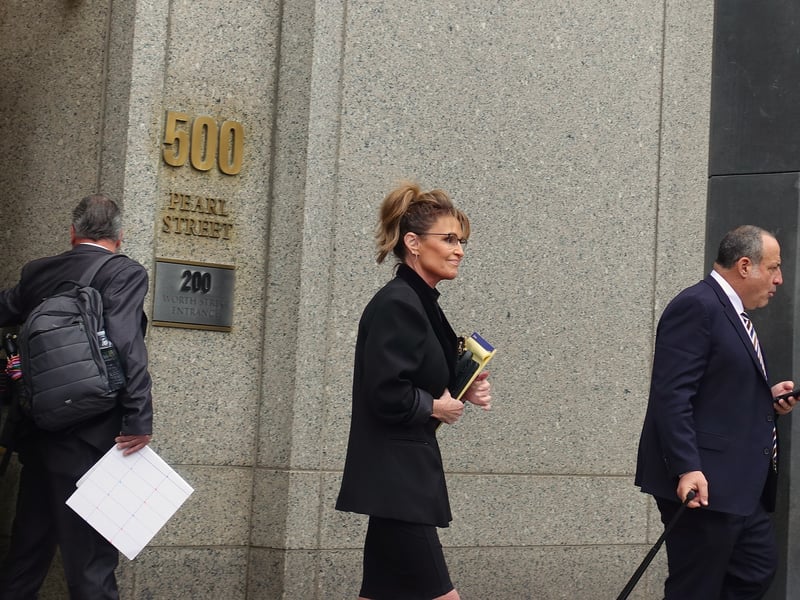
MANHATTAN (CN) — The retrial of former Alaska Governor Sarah Palin’s civil defamation case against the New York Times commenced Tuesday morning with opening arguments that largely reprised the claims made in her 2022 trial, where both a federal judge and a jury ultimately found the newspaper not liable over an editorial on American gun violence that briefly linked Palin’s campaign materials to a mass shooting in Tucson, Arizona.
Palin’s lawyers claim the New York Times “deliberately disregarded” the truth that there had not been clear link between a map released by Palin’s political action committee and the 2011 supermarket parking lot shooting that killed six and wounded a dozen more, including congresswoman Gabrielle Giffords. Palin, who became the first Republican woman to be nominated for vice president in 2008, is represented again by the pair of attorneys who won the massive $140 million judgment against the gossip website Gawker for publishing a video depicting famed wrestler Hulk Hogan having sex.
Tampa-based attorney Shane Vogt said the newspaper’s quick admission of error and overnight corrections to the editorial were insufficient because the New York Times did not mention Palin by name in the correction or ever publicly apologize to her.
“They kept her in name in the current version, but they take her name out of the correction,” he told jurors during opening arguments on Tuesday morning.
“It’s not just what was said, it was who said it,” Vogt said. “It’s the New York Times — it is the paper of record. Its voice is loud and far reaching.”
Vogt is again joined in the Palin case by Ken Turkel, who also served as co-counsel in the Hulk Hogan Gawker privacy lawsuit that was bankrolled by Silicon Valley billionaire Peter Thiel.
The defamation trial, remanded back to Manhattan federal court after a federal appeals court overturned the outcome of her 2022 trial, is Palin’s third chance to prove that the Times and former opinion editor James Bennet should be held liable for linking her words to inciting the 2011 mass shooting in a 2017 editorial titled “America’s Lethal Politics.”
A three-judge panel of the Second Circuit Court of Appeals ruled in August 2024 that the trial dismissal clearing the newspaper of liability should be vacated, and sent the case back to the lower court to be retried.
Palin sued the Times and former editorial page editor James Bennet in 2017 after her name appeared in a June 14 article by the Times editorial board on the day gunfire broke out at a congressional baseball practice.
The editorial, a version of which appeared in print on June 15, blamed overheated political rhetoric for inciting gun violence, focusing in particular on a map that a political action committee for Palin had released featuring the stylized crosshairs of a gun over several election districts controlled by Democrats.
Less than a year after the map was disseminated, Giffords, who represented one of those districts, was shot in the head at a “Congress on Your Corner” event in Tucson, Arizona.
Though the Times called the link from the 2011 shooting to a map circulated Palin’s political action committee “clear” and “direct,” within 14 hours it had published a correction saying there was no such link. No evidence has ever been shown that the Tucson shooter, Jared Lee Loughner, saw the Palin PAC’s map.
U.S. District Judge Jed Rakoff, a Bill Clinton appointee, initially dismissed Palin’s case for failing to identify anyone at the New York Times who had acted with actual malice, but in 2019 the Second Circuit revived her lawsuit.
Palin’s first redo in the lower court went to trial in early 2022 where she was ultimately dealt defeat, both by the jury’s verdict and by Rakoff’s mid-deliberation dismissal by Rule 50 judgment one day earlier.
Represented by David L. Axelrod from Ballard Spahr and Felicia Ellsworth from Wilmer Hale, the Times again argues that it took responsibility once it realized it made a mistake in the editorial, and corrected the record “as loudly, clearly, and quickly as possible.”
“The New York Times takes its reporting seriously; it takes the truth seriously and so does James Bennet,” Ellsworth told jurors during the defense’s opening argument on Tuesday morning.
Palin’s civil trial in the Southern District of New York, seeking damages for reputational harm, is a stress test of long-established legal protections that protect American media against defamation claims by public figures.
In New York Times v. Sullivan, the U.S. Supreme Court ruled in 1964 that the First Amendment protects statements about public figures, including false ones, unless officials can prove actual malice.
Last month, the Supreme Court declined to review a challenge by Trump megadonor and casino mogul Steve Wynn that aimed to overturn the core ruling on press freedom.
Wynn, a billionaire who oversaw the construction and operation of iconic Las Vegas casinos including The Mirage, Treasure Island and the Bellagio, petitioned the high court in an effort to lower the standard needed for public figures to sue over media reports.
 Follow @jruss_jruss
Subscribe to our free newsletters
Our weekly newsletter Closing Arguments offers the latest about ongoing trials, major litigation and rulings in courthouses around the U.S. and the world, while the monthly Under the Lights dishes the legal dirt from Hollywood, sports, Big Tech and the arts.