
 Search Articles


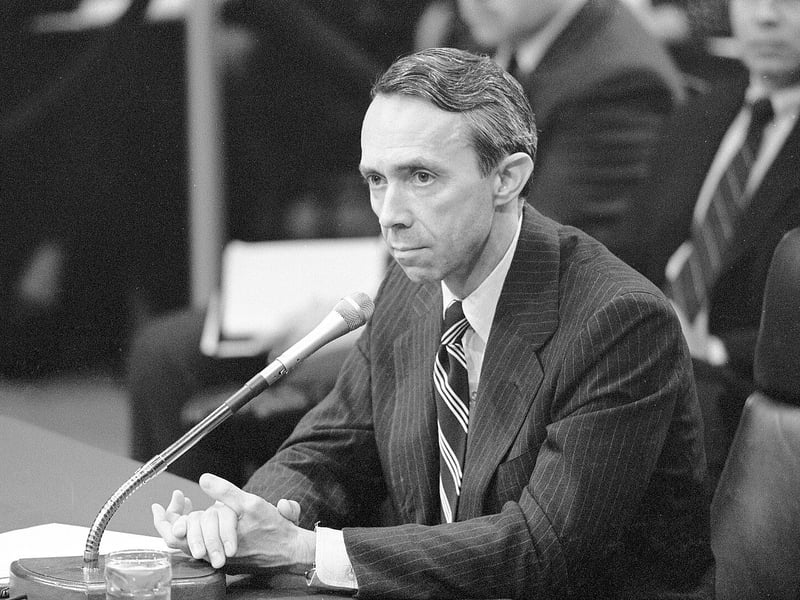
WASHINGTON (CN) — Justice David Souter died in his New Hampshire home Thursday, the Supreme Court announced on Friday.
“Justice David Souter served our Court with great distinction for nearly twenty years,” Chief Justice John Roberts wrote in a statement released by the court. “He brought uncommon wisdom and kindness to a lifetime of public service.”
Appointed by George H.W. Bush in 1990, Souter served over 19 years on the bench, stepping down in 2009. Souter didn’t stray far after retirement, however.
“After retiring to his beloved New Hampshire in 2009, he continued to render significant service to our branch by sitting regularly on the Court of Appeals for the First Circuit for more than a decade,” Roberts said. “He will be greatly missed.”
Despite being appointed by a Republican, he consistently voted with liberal justices John Paul Stevens and Ruth Bader Ginsburg.
Souter’s tenure included co-authoring an opinion with Justice Sandra Day O’Connor in Planned Parenthood v. Casey in 1992 to uphold Roe v. Wade , and agreeing with the dissent that the court didn’t have authority to terminate the recount process in 2000’s Bush v. Gore ruling.
He also joined his liberal colleagues on issues like the death penalty and LGBTQ rights. In 1995, he authored the court’s unanimous opinion in Hurley v. Irish-American Gay, Lesbian and Bisexual Group of Boston , finding that excluding LGBTQ groups from a parade was unconstitutional.
Souter’s decision to step down from the bench in 2009 allowed President Barack Obama to appoint Justice Sonia Sotomayor.
“Justice Souter was a person of great modesty and integrity,” Mark Jia, a Georgetown Law professor who clerked for both Souter and Ginsburg, said in a statement. “We will all miss him dearly.”
The low-key justice became known for his love of New Hampshire and preference for a simple lifestyle.
Souter kept a low profile during retirement, but comments he made during a 2012 appearance reemerged as what some saw as foreshadowing. Speaking in New Hampshire, Souter lamented that civic ignorance was creating discord in American politics.
He fretted about losing the republican government in the United States, but not through a foreign invasion or military coup.
“What I worry about is that when problems are not addressed, people will not know who is responsible,” Souter said during his remarks. “And when the problems get bad enough … some one person will come forward and say, ‘Give me total power and I will solve this problem.’ That is how the Roman republic fell.”
Souter said that if the American public understood their system of government, they could demand performance through the polls. If the public didn’t vote, he said a powerful figure could arise and take the power voters were ceding.
“That is the way democracy dies,” Souter said. “And if something is not done to improve the level of civic knowledge, that is what you should worry about at night.”
During his retirement, Souter participated in civics education curriculum reform in New Hampshire.
 Follow @KelseyReichmann
 Follow @kelseyreichmann.bsky.social
Subscribe to our free newsletters
Our weekly newsletter Closing Arguments offers the latest about ongoing trials, major litigation and rulings in courthouses around the U.S. and the world, while the monthly Under the Lights dishes the legal dirt from Hollywood, sports, Big Tech and the arts.