
 Search Articles


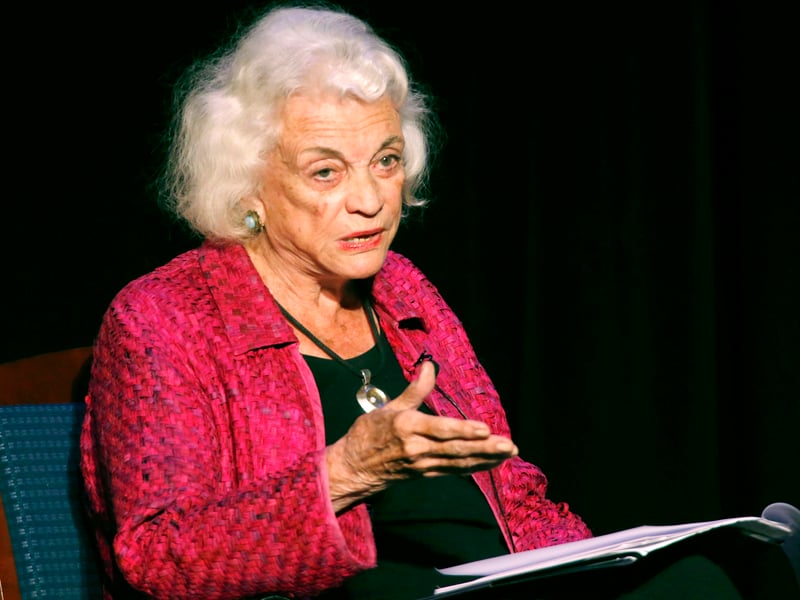
WASHINGTON (CN) — The first woman to serve on the Supreme Court, Justice Sandra Day O’Connor, died at the age of 93 on Friday morning, according to a court statement.
O’Connor retired in 2006 after sitting on the high court bench for over two decades. According to a statement from the court, her death was the result of complications associated with advanced dementia, probably Alzheimer’s disease, and a respiratory illness.
Chief Justice John Roberts said the court mourned the loss of its colleague, calling O’Connor a fiercely independent defender of the rule of law.
“A daughter of the American Southwest, Sandra Day O’Connor blazed a historic trail as our nation’s first female justice,” Roberts said in a statement. “She met that challenge with undaunted determination, indisputable ability, and engaging candor.”
O’Connor was born in El Paso, Texas, but spent most of her childhood on her family’s Arizona ranch. Her parents raised cattle on Lazy B, as the ranch was coined, but its remote location left O’Connor with few educational opportunities. At 14, she was sent back to El Paso to live with her grandmother and attend Radford School for Girls.
At only 16, O’Connor was admitted to Stanford University, after graduating high school two years early. At 20, she had a bachelor’s degree in economics and by 22 she had already passed the bar.
O’Connor moved to California to begin her career, working as a county attorney in San Mateo. She worked for the U.S. Army Quartermaster Corps in Germany for three years before returning to Arizona to start a private practice with her husband.
Gov. Jack Williams appointed O’Connor to a vacant Arizona Senate seat and she held on to the position for two elections, eventually serving as the first woman majority leader in any state Senate.
In 1975, O’Connor was elected as a superior court judge in Maricopa County, where she served for four years before moving on to Arizona’s high court.
O’Connor was appointed to the Supreme Court by President Ronald Reagan in 1981 after serving only two years on Arizona’s high court. Her nomination marked the first woman to be appointed to the Supreme Court. Her confirmation was unanimously approved by the Senate.
During her tenure, O’Connor was essential to upholding the right to abortion — recently overturned by the Supreme Court. She cast the swing vote in Planned Parenthood v. Casey in 1992, affirming Roe v. Wade . She also consistently voted in favor of women’s interests.
O’Connor’s focus on sexism likely stemmed from life experience. In a 2004 Stanford Law graduation address, she recounted how law firms refused to hire her, forcing O’Connor to turn to public service.
“Life as a public servant was more interesting,” O’Connor told the law school graduates. “The work was more challenging. The encouragement and guidance from good mentors was more genuine. And the opportunities to take initiative and to see real results were more frequent.”
When O’Connor was nominated to the high court, then-Senator Joe Biden of Delaware remarked that it was “high time” to appoint a woman to the bench.
As the high court’s critical swing vote, O’Connor served as a decider of major issues before the court like affirmative action, sex discrimination and voting rights. She was also known for her moderation, attempting to temper the reach of controversial rulings.
O’Connor’s jurisprudence was echoed by how she viewed her mark on history for women — as a stepping stone.
“A single generation of public servants cannot bridge all the gaps of inequality and injustice nor span the chasms of our nation’s critical needs,” she said at Stanford in 2004.
“But if we focus our energies on sharing ideas, finding solutions, and using what is right with America to remedy what is wrong with it, we can make a difference. Our nation needs bridges, and bridges are built by those who look to the future and dedicate themselves to helping others.”
O’Connor retired from the bench in 2006 to care for her husband, John O’Connor, who was suffering from Alzheimer’s disease. He died in 2009.
After stepping down, O’Connor founded a civics education platform, iCivics, focused on educating Americans on civics and government.
The Supreme Court did not provide details on the late justice’s funeral. She is survived by three sons and six grandchildren.
Brad Poole contributed to this report.
 Follow @KelseyReichmann
 Follow @kelseyreichmann.bsky.social
Subscribe to our free newsletters
Our weekly newsletter Closing Arguments offers the latest about ongoing trials, major litigation and rulings in courthouses around the U.S. and the world, while the monthly Under the Lights dishes the legal dirt from Hollywood, sports, Big Tech and the arts.