
 Search Articles


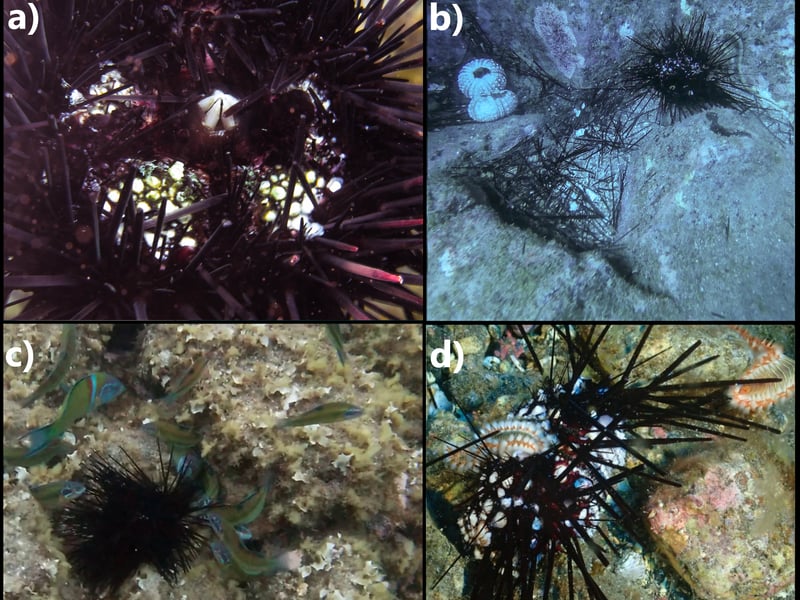
(CN) — A mysterious disease has quietly wiped out sea urchins across multiple oceans, and new research shows the Canary Islands are among the hardest hit.
Sea urchins help shape life on coral reefs much the way grazing animals shape grasslands on land. By feeding on seaweed and seagrass, they keep fast-growing algae in check and make room for corals and other slow-growing species to survive.
Now, scientists say a global die-off of these key reef grazers is reshaping underwater ecosystems in ways that are still unfolding.
The study, published Wednesday in Frontiers in Marine Science, shows that a mass die-off of the long-spined sea urchin Diadema africanum swept through the Canary Islands and neighboring Madeira in 2022 and 2023, driving some populations close to local extinction.
“Here we show the spread and impacts of a ‘mass mortality event’ which severely hit populations of the sea urchin Diadema africanum in the Canary Islands and Madeira through 2022 and 2023,” said Iván Cano, a doctoral student at the University of La Laguna in a press release. “At approximately the same time, the Diadema species have been observed to be dying off in the Caribbean, the Mediterranean, the Red Sea, the Sea of Oman, and the western Indian Ocean.”
The genus Diadema includes eight species found in warm waters worldwide. In the Canary Islands, D. africanum once boomed in number.
Since the mid-1960s, overfishing of predators and warming seas allowed the sea urchins to spread widely across rocky reefs, sometimes forming “urchin barrens” where little else could grow. That balance shifted abruptly in early 2022, when researchers first noticed D. africanum dying in large numbers off La Palma and Gomera.
Over the following months, the outbreak spread east across the archipelago. Affected urchins moved sluggishly, stopped responding to stimuli and eventually lost their spines and internal tissue.
Earlier die-offs struck the islands in 2008 and 2018, killing an estimated 90% or more of the urchins in some areas. This time, however, recovery never came. Instead, a second wave of mortality followed in 2023.
To measure the damage, Cano and colleagues surveyed 76 sites across the Canary Islands between the summer of 2022 and summer 2025. They compared their findings to past population records and also gathered reports from professional divers.
“Our analyses showed that the current abundance of D. africanum across the Canary Islands is at an all-time low, with several populations nearing local extinction,” said Cano. “Moreover, the 2022-2023 mass mortality event affected the entire population of the species across the archipelago. For example, since 2021 there has been a 74% decrease in La Palma and a 99.7 % decrease in Tenerife.”
The team also tracked reproduction. Larval traps set off eastern Tenerife in late 2023 caught almost no developing urchins. By early 2024, researchers found no young juveniles settling into shallow rocky habitats.
“Reports from elsewhere suggest that the 2022-2023 die-off in the Canary Islands was another step in a broader marine pandemic, with serious consequences for these key reef grazers,” Cano said.
What is killing the urchins remains uncertain. Similar mass die-offs elsewhere have been linked to single-celled parasites in the genus Philaster. In past outbreaks in the Canaries, amoebas were associated with the deaths following periods of intense wave activity.
“We don’t yet know for certain which pathogen is causing these die-offs. Mass mortality events of Diadema elsewhere in the world have been linked to scuticociliate ciliates in the genus Philaster, a kind of single-celled parasitic organisms,” said Cano. “Previous die-offs in the Canary Islands were associated with amoebae such as Neoparamoeba branchiphila and followed episodes of strong southern swells and unusual wave activity, similar to what we saw again in 2022. Without a confirmed identification, we cannot say whether the agent arrived from the Caribbean by currents or shipping, or whether climate change is to blame.”
For now, the spread appears limited to certain regions, but scientists say the uncertainty remains.
“We aren’t yet sure how this pandemic will evolve. So far, it seems to have not spared to other Diadema populations in Southeast Asia and Australia, which is good news — but we cannot rule out the possibility that the disease will reappear and potentially spread further,” Cano said.
Subscribe to our free newsletters
Our weekly newsletter Closing Arguments offers the latest about ongoing trials, major litigation and rulings in courthouses around the U.S. and the world, while the monthly Under the Lights dishes the legal dirt from Hollywood, sports, Big Tech and the arts.