
 Search Articles


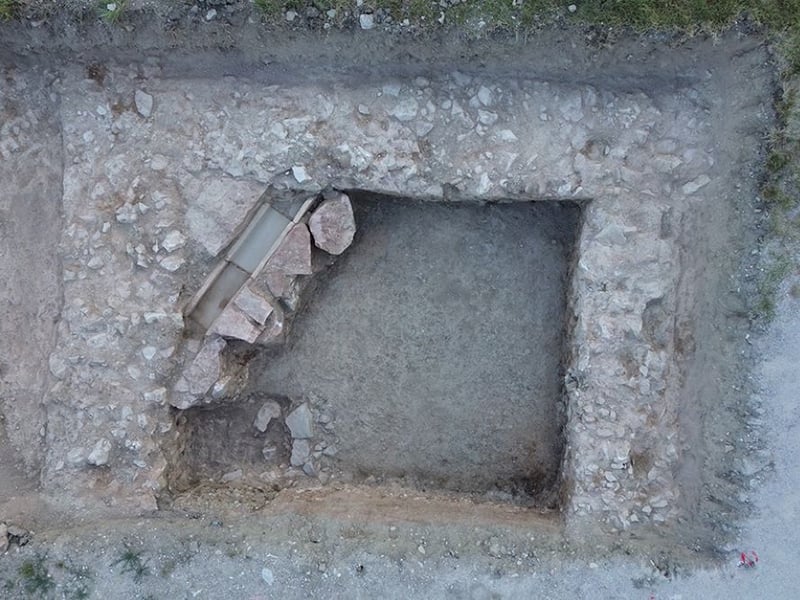
(CN) — New insight into how Italy’s culture shifted while switching from Roman imperial theology to Christianity emerged Friday with the announcement of an ancient Roman temple found under a parking lot in central Italy.
The announcement at this year’s meeting for the Archeological Institute of America in Chicago came from Saint Louis University history professor Douglas Boin, who led a team of excavators in finding remnants of an ancient pagan temple in Spello, Italy.
Seemingly by chance, Boin’s team unearthed three walls of the monumental structure last summer after searching the area with underground imaging. However, Boin’s work actually derives from his leadership for The Spello Project, an international effort to research the lost history of the ancient town once known as Hispellum.
Located roughly 20 minutes south of Assisi and over two hours north of Rome, the medieval hilltop city is famous for its art, flowers and Roman architecture. It’s also known for a concession Roman Emperor Constantine made in a letter during the fourth century, now inscribed in Spello’s Town Hall within the Hall of Zuccari.
The letter caught Boin’s attention, as it allowed the townspeople to celebrate a religious festival in Spello instead of traveling several hours, possibly even days, to another festival. To do so, Constantine instructed the town to erect a temple to worship the emperor’s alleged divine ancestors, the Flavian dynasty.
Boin explained in an interview that many Roman rulers like Constantine imagined fanciful ancestry lineage for themselves. He said the Flavian family made sense for someone of Constantine’s position because they were associated with building landmarks like the Coliseum and, for the time, represented good administration amid the empire’s growing multicultural population.
Yet, the concession is notable for Boin because Constantine was the first Roman emperor to convert to Christianity. Nearly everyone else followed the Roman imperial cult.
“For Constantine to embrace Christianity is a milestone in the history of the Roman Empire,” Boin said. “But what is also a milestone is that he inherited an empire that was not Christian. So, the fascinating historical window that his reign provides is how a ruler of one faith rules or governs an empire where the majority of citizens don’t necessarily subscribe to the same belief that he does.”
Based on Constantine’s mention of the temple, Boin and a team of excavators set out to find ruins using underground imaging. They found the structure beneath a parking lot.
“Our discovery sheds new light on what the land was beforehand,” Boin said. “There was a very ancient indigenous sanctuary space that belonged to the local Umbrian people — hundreds of years before Constantine — and it used to sit right across the modern road where our excavation was.”
Boin noted that the excavation not only revealed the temple but that the modern road likely runs through the historic sanctuary.
“What that tells us is that generations of scholarship that assumed the sanctuary boundary was co-terminus with the borders of the modern road were wrong,” Boin said. The temple, he added, was most likely part of the original sanctuary.
When it comes to how the temple wound up beneath a parking lot, Boin explained that people may have lost interest over time.
“You don’t lose a monumental temple unless you intentionally tell yourselves it’s not there,” Boin said, adding that, for much of modern history, scholars and investigators were not interested in gray spaces between paganism and Christianity.
The temple’s modern location, he said, “is as real as we can get to how complicated and messy life was in the fourth century.”
If Boin is correct about the temple’s Constantinian origin, he said it would be unlike any other landmark he knows of from the Mediterranean world of the fourth century Roman Empire.
“Any study of the imperial cult in the fourth century Roman Empire is now going to have to take account of this temple, which is an incredible discovery to make,” Boin said in an earlier statement.
The discovery would also allow Boin to show how slow-moving societal changes were at the time, especially given that it took nearly 70 years for Christianity to become the Roman Empire’s official religion under Emperor Theodosius.
“This changes everything about how we perceive the pace of social change and our impression of the impact of social and cultural change,” Boin said. “This building, in a very radical way on its own, shows us the staying power of the pagan traditions that had been on the ground for centuries prior to the rise of Christianity, and it shows us how the Roman emperors continued to negotiate their own values, their own hopes and dreams for the future of the emperor and the Empire without knocking down or burying the past.”
Boin’s team plans to return to Spello this summer to finish excavating the area and examine the entire temple. From there, he hopes to make even more significant discoveries, adding that the team is on the cusp of “giving people a very visible piece of evidence that really upends the neat and tidy ways people think about big moments of cultural change.”
“Cultural changes are never as big as we think they are when living through them, and there’s a lot of gray area in between people’s customs and the broader society and culture. And a lot of those can be left out of the story,” Boin said. “So, to have this temple potentially be a temple dedicated to Constantine’s divine ancestors as a way to worship the emperor in an increasingly Christian world at the time, it’s so weird and I love that we can bring it to light.”
 Follow @alannamayhampdx
Subscribe to our free newsletters
Our weekly newsletter Closing Arguments offers the latest about ongoing trials, major litigation and rulings in courthouses around the U.S. and the world, while the monthly Under the Lights dishes the legal dirt from Hollywood, sports, Big Tech and the arts.