
 Search Articles


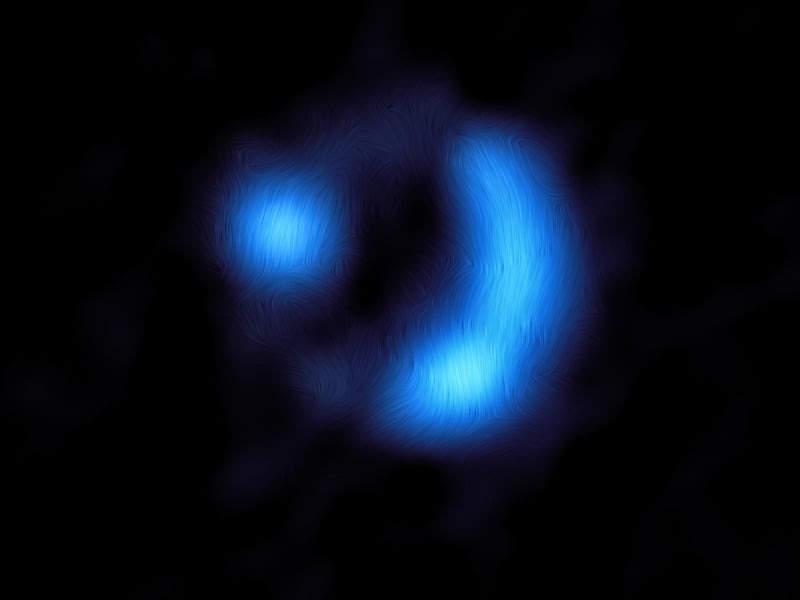
(CN) — Astronomers announced Wednesday the furthest detection of a magnetic field in a galaxy billions of light-years from Earth that could help reveal the genesis of galactic magnetic fields like that of the Milky Way.
Research published in Nature describes the discovery of the magnetic field of 9io9 or “9Spitch,” a luminous galaxy first detected in 2014 by a viewer of British BBC television’s Stargazing Live. The impressive discovery was part of the show’s underlying project, SpaceWarps, which recruits viewers to help detect certain astronomical phenomena like exoplanets, supernovae or, in this case, gravitational lenses.
As explained by British astrophysicist Chris Lintott, who worked on the show, gravitational lenses are distant galaxies that appear deformed as their light passes by other large systems, including nearby galaxies and clusters. When the gravity of those systems bends incoming light, he wrote, images of the galaxies appear as luminous rings or arcs.
One of the rings discovered was 9io9, prompting researchers to take a closer look.
“Many people might not be aware that our entire galaxy and other galaxies are laced with magnetic fields, spanning tens of thousands of light-years,” said lead study author James Geach, a professor of astrophysics at the University of Hertfordshire, in a statement.
Indeed, many planets, stars and galaxies possess magnetic fields, In the Earth’s case, a magnetic field protects the planet from radiation and charged particles from the sun. But while scientists understand what magnetic fields are and what they can do — including their fundamental role in star and galaxy formation or the astrophysics of the interstellar medium — it’s not yet known when magnetic fields first appeared in the universe or how quickly. So far, researchers have only mapped magnetic fields in galaxies near the Milky Way.
Utilizing the Atacama Large Millimeter/submillimeter Array or “ALMA” in Chile — the largest radio telescope in the world — Geach led a team of researchers in observing the distant galaxy in search of light emissions from dust grains, a feature indicative of a magnetic field as it causes sand grains to align and emit polarized light. From there, they laid eyes on the fully formed magnetic field of 9io9, finding that while its field is 1,000 times weaker than the Earth’s, it spans over 16,000 light years.
“No other telescope could have achieved this,” Geach said.
The discovery, he explained, provides new clues as to how galactic-scale magnetic fields form. That’s because observing a developed magnetic field that existed when the universe was only 2.5 billion years old suggests that large-scale magnetic fields can form quickly while young galaxies continue growing.
Additionally, the researchers believe that intense star formation at the time may have helped accelerate the creation of magnetic fields and, in turn, such fields influence how later generations of stars form.
According to co-author Rob Ivison, an astronomer for the European Southern Observatory, the study provides “a new window onto the inner workings of galaxies, because the magnetic fields are linked to the material that is forming new stars.”
 Follow @alannamayhampdx
Subscribe to our free newsletters
Our weekly newsletter Closing Arguments offers the latest about ongoing trials, major litigation and rulings in courthouses around the U.S. and the world, while the monthly Under the Lights dishes the legal dirt from Hollywood, sports, Big Tech and the arts.