
 Search Articles


(CN) — One of the largest biogeographic barriers on Earth, the Saharo-Arabian Desert currently limits animal movement and divides Africa and Eurasia. For 8 million years in its earlier history, however, the landscape teemed with green rivers and lakes that created a “Green Arabia,” according to an international research team’s study published Wednesday in Nature.
While other recent research suggests that the barrier set in place at least 11 million years ago, with hyperaridity in the northern Arabian margins starting about 9 million years ago, fossils and cave work indicate the existence of water for roughly 8 million years, per the team.
The team dated the fossils to both the late Miocene — a period between 11 million and five million years ago marked by an increase in global temperatures — and the Pleistocene — a period about 2 million years ago with multiple ice ages. Per the team, the fossils came from the primitive forms of water-dependent animals such as crocodiles, hippos and elephants. One example was the late Miocene sequence of sandstones and mudstones in the Baynunah Formation, United Arab Emirates, that contained savannah-adapted animal fossils like primitive giraffes and hippos.
Although study co-author Michael Petraglia said the team is unsure whether the humidity that lured in these animals came from increased precipitation in the Arabian interior or if it traveled from the continental margins, the presence of water in the area at all generated implications for ancient animal movements.
“These wetter conditions likely facilitated these mammalian dispersals between Africa and Eurasia, with Arabia acting as a key crossroads for continental-scale biogeographic exchanges,” said Petraglia, director of Griffith University’s Australian Research Centre for Human Evolution.
Furthermore, the team’s cave work indicated early human travel during this time.
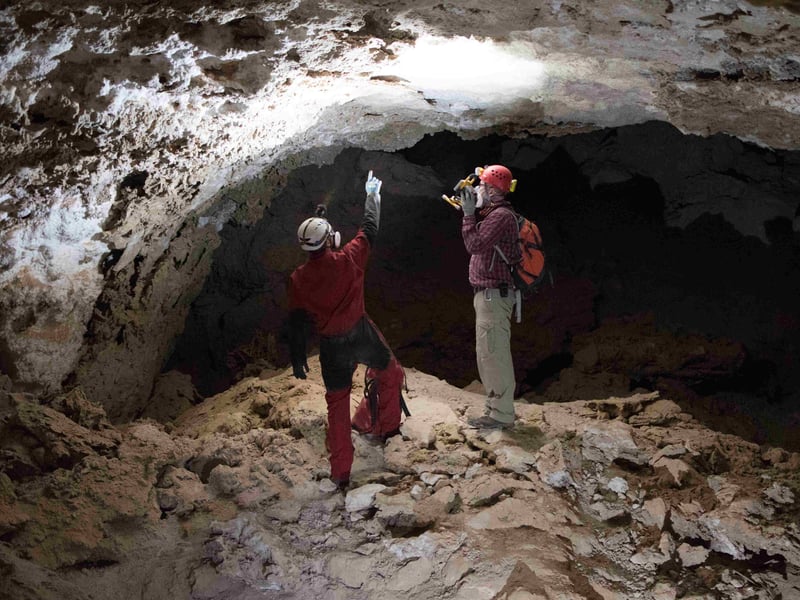
Lead study author Monika Markowska of Northumbria University, U.K., and co-author Hubert Vonhof of the Max Planck Institute for Chemistry, Germany, led the research on a set of cave speleothems — mineral deposits like stalagtites and stalagmites — from seven cave systems within a 10-kilometer radius in central Arabia. Petraglia explained that studying the desert speleothems helped the team find evidence of past humid climates.
“When you drill and cut the speleothems you can see variations in the amount of humidity in them, almost like rings in a tree,” said Petraglia via email. “You can date these humid episodes, and so we colloquially call them greening events.”
Through their work, the team reported that the region’s terrestrial hydroclimate record went back 8 million years with recurrent wetter intervals attractive to animals and humans.
“Increased rainfall would have led to the formation of rivers and lakes across the peninsula, and turned the arid landscapes into savannahs, which in turn would have attracted mammals and hominins — early humans — over time,” said Petraglia via email. “We are certain that hominins were attracted to such environments over the last 500,000 years based on our ongoing archaeological research in Saudi Arabia. What we do not yet know is if hominins were attracted to earlier environments. Our evidence suggests this would have been the case.”
Petraglia added that the team intends to continue its research on the Saharo-Arabian Desert’s wetter periods.
“Arabia would have been crossroads to continents as the fossil animals are representative of African and Asian species,” said Petraglia via email. “There are also primates in the UAE fossil deposits, indicating that there is no reason not to expect early human presence in the Arabian Peninsula. Right now, the oldest archaeological site in Arabia is only 500,000 years old, so we expect additional discoveries in the future. The search is on.”
 Follow @kndrleon
Subscribe to our free newsletters
Our weekly newsletter Closing Arguments offers the latest about ongoing trials, major litigation and rulings in courthouses around the U.S. and the world, while the monthly Under the Lights dishes the legal dirt from Hollywood, sports, Big Tech and the arts.