
 Search Articles


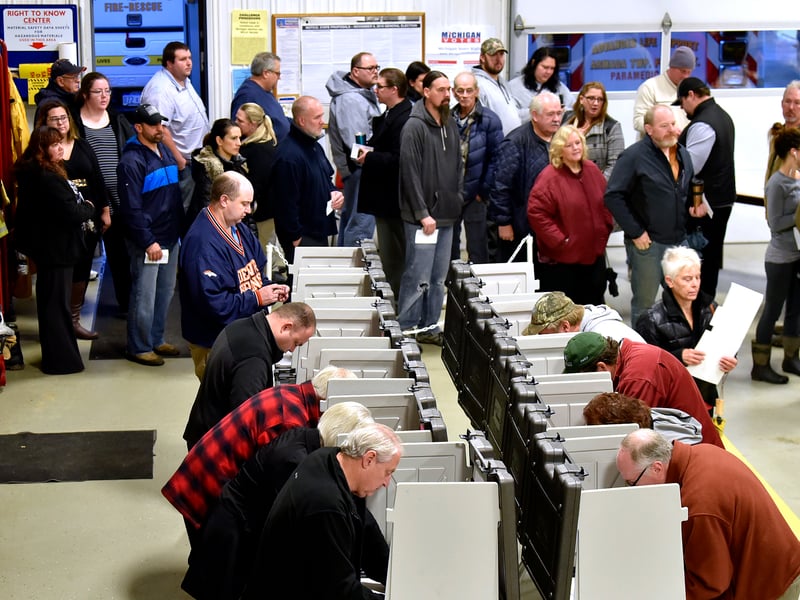
CINCINNATI (CN) — Michigan officials who refuse to correct “perennial” issues with their voter rolls must face a federal lawsuit filed by Republicans, conservatives argued Thursday before an appellate panel.
The Republican National Committee, or RNC, tried to convince the Sixth Circuit it has standing to pursue claims under the National Voter Registration Act because Michigan’s failure to purge ineligible voters affects its campaign strategies and ability to elect right-wing candidates.
“Michigan has some of the worst maintained voter rolls in the country,” attorney Conor Woodfin told the court.
Two Michigan voters filed suit alongside the RNC in 2024 and claimed at least 53 counties have more active voters than adults over the age of 18, but a federal judge found the parties failed to establish standing.
U.S. District Judge Jane Beckering, an appointee of Joe Biden, determined the RNC could not establish organizational standing and dismissed the case in October 2024.
The fact Republicans would spend money in Michigan based on voter registration numbers — figures they claim are inaccurate — is insufficient to establish standing under a “diversion of resources” theory, according to Beckering.
“These allegations merely describe activities in which the RNC normally engages,” she concluded.
Data provided by the RNC about the movement of voters to different districts was also inconclusive, according to Beckering, because states have two presidential election cycles to remove ineligible voters under the National Voter Registration Act.
Chief U.S. Circuit Judge Jeffrey Sutton was unconvinced by Woodfin’s arguments Thursday and peppered him with questions.
“You provide some striking statistics, but the act sets up procedures,” said Sutton, a George W. Bush appointee. “You have to wait two election cycles before you can purge voters, so there is going to be a lag.”
Woodfin, from the firm Consovoy McCarthy based in Arlington, Virginia, pointed out that several federal courts have found discrepancies in voter numbers qualify as violations of the act.
“The numbers here are far worse than in those other cases,” he told Sutton.
“You’re still stuck with a causation issue,” Sutton responded. “The act doesn’t directly regulate you. The secretary of state could be complying with the rule. And citing other cases is not going to resonate with too many people.”
The chief judge of the appeals court was also skeptical of the RNC’s theory of damages in the wake of the U.S. Supreme Court’s decision in* FDA v. Alliance for Hippocratic Medicine* , which limited an organization’s ability to establish standing through a “diversion of resources.”
“The RNC cannot make plans and strategies for core activities,” Woodfin said. “It’s about allocating staff and resources.”
“That sounds like classic diversion of resources,” Sutton countered.
Assistant Michigan Attorney General Erik Grill argued remotely on behalf of the state and called the RNC’s complaint “a flat misreading of what the voter data suggests.”
“They have stated no plausible violation of the NVRA,” he told the three-judge panel. “They don’t address what is wrong with the statute or state what they want us to do differently to make a ‘reasonable effort’ under the law. By many standards, we are running one of the best voter roll operations.”
Sutton took the RNC’s side for a moment and asked about the nature of its supposed injury.
“Isn’t it an injury that there are more registered voters than residents? If the RNC is sending out more mailers than there are people, aren’t they spending money on something that is useless?” he asked.
“I’m not sure it would be, based on this court’s recent ruling in Tennessee NAACP ,” Grill said. “A specific number of mailers or money spent would be a step in the right direction.”
The NAACP ruling cited by Grill involved a challenge to Tennessee’s re-enfranchisement procedures rebuffed by a Sixth Circuit panel that determined the organization’s failure to cite specific individuals it helped prevented it from establishing standing.
Senior U.S. Circuit Judge Helene White, another George W. Bush appointee, echoed Grill’s sentiments, further denting the RNC’s hopes of a favorable ruling.
“I don’t understand why this lawsuit is not complete speculation,” she said. “Right within the law is an explanation. It provides for a procedure, not an outcome.”
Sutton latched on to Grill’s point about the lack of specific data regarding the RNC’s expenditures and addressed Woodfin directly.
“I love your conviction — you seem like a nice guy,” he told the RNC’s attorney. “I don’t think you’re lying to me, but you have no statistical analysis.”
Woodfin told the panel such evidence would likely be produced during summary judgment proceedings. He also asked for an opportunity for his client to amend its complaint if the panel would remand the case for further proceedings.
Senior U.S. Circuit Judge Julia Smith Gibbons, another George W. Bush appointee, rounded out the panel.
No timetable has been set for the court’s decision.
 Follow @kkoeninger44
Subscribe to our free newsletters
Our weekly newsletter Closing Arguments offers the latest about ongoing trials, major litigation and rulings in courthouses around the U.S. and the world, while the monthly Under the Lights dishes the legal dirt from Hollywood, sports, Big Tech and the arts.