
 Search Articles


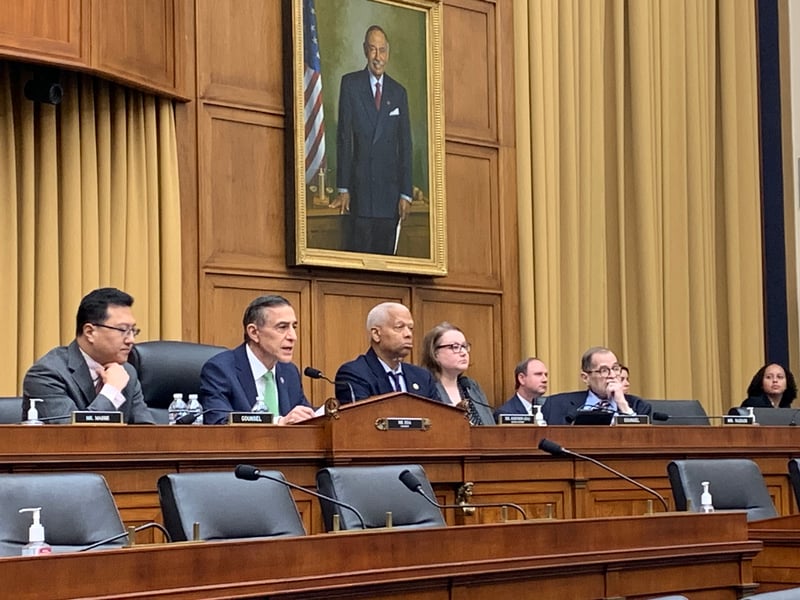
WASHINGTON (CN) — House Republicans said Tuesday that they are taking another crack at legislation which would add dozens of new federal judgeships to courts across the country, just months after a similar bill earned a presidential veto.
But this time around, what was once a broadly bipartisan bill aimed at addressing crushing caseloads across the federal judiciary has become a partisan campaign, as Democrats accuse their GOP colleagues of using concern for the courts as a fig leaf concealing a more sinister effort to install jurists loyal to President Donald Trump.
“This bill, and the way it has come forward, is nothing but politics,” Georgia Representative Hank Johnson said during a hearing Tuesday in the House Judiciary Committee.
Lawmakers came tantalizingly close last year to inking the Judicial Understaffing Delays Getting Emergencies Solved, or JUDGES, Act, which until November enjoyed support from both Democrats and Republicans in both chambers of Congress. If made law, the measure would have added more than 60 new judgeships to federal courts in a dozen states — consistent with recommendations made in 2023 by the U.S. Judicial Conference.
The measure would also have staggered new judicial appointments in six increments over a 12-year period, ensuring that as many as three presidential administrations would have the opportunity to appoint new judges.
While the JUDGES Act sailed through the Senate over the summer on a unanimous vote, it languished for months in the House, where leadership declined to debate it until after President Donald Trump was reelected in November. The lower chamber ultimately passed the bill, but without Democratic support.
Democrats argued at the time that the GOP’s move defeated the purpose of the measure — which they said should have been passed prior to the election, when the first president to get appointments under the bill was still unknown. They contended that Republicans only decided to take up the JUDGES Act after it was certain that Trump would retake the White House.
Lawmakers from the GOP, though, have said that the delay in taking up the measure was merely a product of a busy legislative schedule in the latter half of the year, which saw members of Congress negotiating federal spending in the weeks between their August recess and an October break ahead of the presidential election.
But Johnson argued Tuesday that last year’s version of the bill was based on a “good faith, bipartisan agreement” that the first round of judges would go to an unknown presidential administration, removing politics from the process entirely.
“The truth is, when they had a chance last year, they put politics first,” he said of Republicans.
Maryland Representative Jamie Raskin similarly accused the GOP of breaking their promise to pass the JUDGES Act ahead of November’s election and said that following Trump’s victory they were “itching” to appoint judges to the bench who are loyal to the president.
“They broke their deal,” said Raskin. “They’ve undermined justice in the courts. We were willing to enter into a fair deal because we believe in equal justice under the law — our friends seem to believe only in ‘heads I win, tails you lose.’”
But GOP lawmakers reintroducing the JUDGES Act countered Democrats’ claims, pointing out that while Trump would get the first round of appointments under the revamped bill, both parties would still have ample opportunity to install their own jurists over the next decade.
“It doesn’t reflect a massive change,” said California Representative Darrell Issa at Tuesday’s hearing. “Unless the Senate and the White House remain in one party’s hands for a decade … this in fact will be a piece of legislation that will reflect judges in both parties.”
Issa, who is sponsoring the revamped judgeships bill, also slammed the Biden administration for scuttling last year’s version of the JUDGES Act. He noted that he had never before seen a president veto a bill that secured bipartisan support in both chambers of Congress.
“I believe it was a shortsighted decision primarily made by staff or perhaps by a sense that one had to do it, because so much had been said in the past,” Issa said. “But it didn’t have to happen, and it shouldn’t happen.”
Biden vetoed the JUDGES Act in December, arguing at the time that lawmakers had failed to resolve “key questions” such as the allocation of new judgeships. The White House also claimed that the bill’s move to create new judgeships in states where senators had not filled existing court vacancies suggested that concerns about judicial caseloads were “not the true motivating force” behind the legislation.
As of Tuesday, Issa had yet to formally reintroduce the JUDGES Act and the bill’s text had yet to be published. But the measure is likely to be similar to last year’s iteration, though the lawmaker said that he could alter the number of proposed new judgeships based on new Judicial Conference recommendations expected in March.
A spokesperson for Issa’s office did not immediately respond to a request for comment.
Congress has not substantially increased the size of the federal judiciary since 1990. In that time, caseloads have ballooned — the current backlog stands at more than 700,000 pending cases, with many concentrated in just a few federal district courts.
Legal experts have for years urged Congress to help ease the crushing load on jurists by adding dozens of new judgeships, and witnesses invited to testify at Tuesday’s hearing echoed those calls.
U.S. Circuit Judge Tim Tymkovich, a judge with the Tenth Circuit and a representative of the Judicial Conference, told lawmakers that the JUDGES Act would address what he called a “severe” staffing shortage on the federal judiciary. He argued that the Biden administration’s justification for vetoing the legislation last year belied a “misunderstanding of the facts.”
“Citizens rely on the efficient and timely administration of justice,” said Tymkovich. “But the shortage is causing significant delays for litigants seeking to resolve cases in the federal courts.” Civil cases, as well as contract and copyright disputes, are among the cases most affected by understaffing issues, he added.
Such delays, Tymkovich continued, also increase legal expenses for litigants and extend the time for which criminal defendants must be held before trial. Things are so bad that some potential litigants may avoid federal court altogether because of the resources or time needed to resolve their cases, he said.
“As Congress recognized last year by passing the JUDGES Act, the need is urgent and will benefit all Americans,” Tymkovich said.
 Follow @BenjaminSWeiss
Subscribe to our free newsletters
Our weekly newsletter Closing Arguments offers the latest about ongoing trials, major litigation and rulings in courthouses around the U.S. and the world, while the monthly Under the Lights dishes the legal dirt from Hollywood, sports, Big Tech and the arts.