
 Search Articles


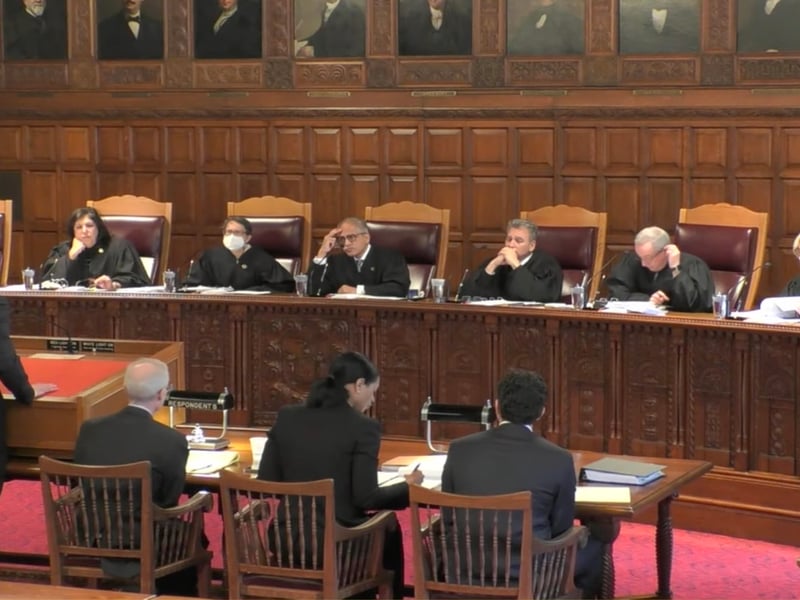
(CN) — Republican U.S. representatives asked New York’s high court Tuesday to overturn a law that allows any voter to request and submit a mail-in ballot, arguing the rule violates election provisions of the state constitution.
U.S. Representatives Elise Stefanik, Nicole Malliotakis, Nicholas Langworthy and Claudia Tenney, alongside other Republican elected officials, voters and the party’s state and national committees, filed suit on Sept. 20, 2023 — the same day Democratic Governor Kathy Hochul signed the Early Mail Voting Act into law. New York previously required voters to select a reason when applying to submit a mail-in ballot, including being absent from home, sick or disabled.
The New York Supreme Court Appellate Division’s Third Judicial Department affirmed the law and found there had been “no express provision” in the state constitution mandating in-person voting since Jan. 1, 1967. The Republican representatives’ appeal followed under claims the state constitution seeks to limit who gets to vote by mail.
“For more than 150 years, New York lawmakers, officials, and legal commentators universally understood the Constitution to impose limits on the Legislature’s ability to authorize absentee voting,” the plaintiffs said in their brief.
A 1966 amendment outlines conditions for vote-by mail-ballots, for instance, including absence or disability, which the plaintiffs claim applies more broadly than just to absentee voting.
“The constitution does not speak in terms of absentee voting,” Michael Hawrylchak, an attorney for the Republican representatives, said Tuesday. “Section two applies to two categories, some of whom are people who are absent, and others are people who are ill or disabled.”
Judges on the state’s high court pressed Hawrylchak on whether New York’s constitution expressly demands that voters cast their ballot in person.
“Is there anywhere expressly in the constitution excluding the prior language before 1966 that says in-person voting is required?” Justice Shirley Troutman asked.
“Not in those words,” Hawrylchak said, though he added he believes there are “textual indications” that imply it. The provision refers to people who are unable to appear physically at the voting place, he said, implying the restriction applies to mail-in as well as absentee voting.
“That reflects the understanding that the normal way of voting is personally at the polling place and the exception had to be made to enable to voter other than at the polling place,” Hawrylchak said.
Jeffrey Lang, an attorney for Governor Hochul and the state, argued Tuesday that the Republican representatives failed to demonstrate that the universal mail-in voting law was an overstep of the Legislature’s power.
“The Early Mail-In Voting Act promotes important state interests, allowing voters to exercise the franchise more easily,” Lang said.
The judges questioned him about an earlier proposed amendment that would enshrine no-excuse absentee voting in the state constitution, which failed at the ballot box in 2021.
“If we adopt your position, aren’t we ignoring the will of the people which spoke pretty emphatically when they rejected the amendment?” Justice Caitlin Halligan asked Tuesday.
Lang replied that there was a time when legislators thought a constitutional amendment was required to enact universal no excuse mail-in voting — but they later determined they had the authority to enact remote voting without one.
“This court has repeatedly said that very little can be inferred from any type of failed enactment and that would include a failed constitutional amendment,” Lang added.
The judges did not rule from the bench.
 Follow @NikaSchoonover
Subscribe to our free newsletters
Our weekly newsletter Closing Arguments offers the latest about ongoing trials, major litigation and rulings in courthouses around the U.S. and the world, while the monthly Under the Lights dishes the legal dirt from Hollywood, sports, Big Tech and the arts.