
 Search Articles


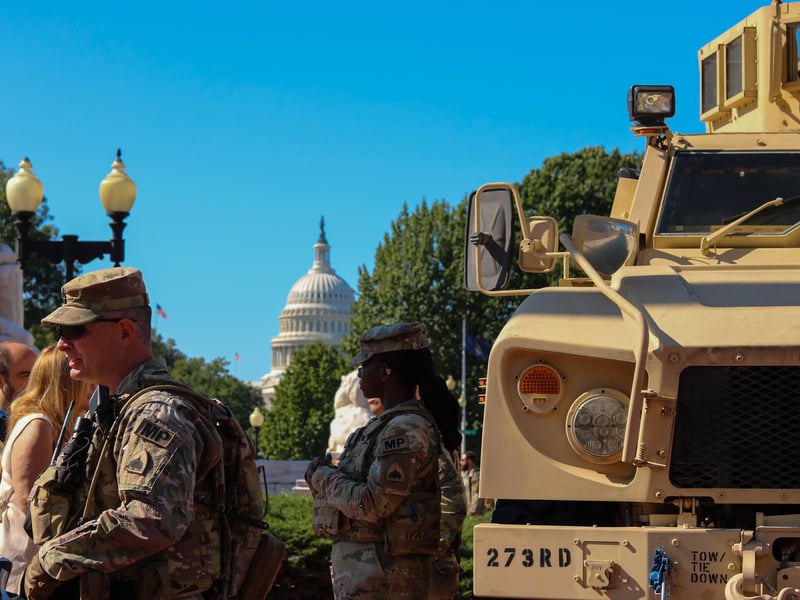
WASHINGTON (CN) — A group of 24 Republican attorneys general argued in an amicus brief Tuesday that the D.C. Circuit should further pause a court order threatening to end the deployment of National Guard troops in the nation’s capital.
West Virginia Attorney General John McCuskey said in the 22-page brief that President Donald Trump’s use of over 2,200 National Guard troops to patrol Washington’s streets and guard federal areas and metro stations have made the city safer.
“The district belongs to ‘the people’ as a whole, and its safety is critical to our constitutional republic,” McCuskey said. “For the last few years, however, crime in D.C. has surged — putting that safety in serious jeopardy. Rampant carjackings, robberies, murders and overall violence have impeded the operations of government and endangered the lives of civilians and government employees alike.”
U.S. District Judge Jia Cobb ruled that Trump’s Aug. 11 “crime emergency” — declared after 19-year-old former Department of Government Efficiency worker Edward Coristine, also known as “Big Balls,” was assaulted during an attempted carjacking — was unlawful on Nov. 20.
The order would have forced troops to end their daily patrols around the city immediately, but Cobb stayed her order until Dec. 11, allowing the deployment to continue as the Trump administration appeals her decision.
The case has yet to be assigned to a panel to consider whether a stay is warranted.
McCuskey pointed to the Nov. 26 shooting of two National Guard troops patrolling near the Farragut West metro station in downtown D.C., just blocks away from the White House, as proof that their deployment should continue to further “safeguard the city.”
“This mission has already produced strong results, but still more work must be done, and danger still lingers,” McCuskey said. “Just last week, an Afghani national committed a heinous terror attack, shooting two National Guardsmen at close range and murdering one.”
The suspected shooter, Rahmanullah Lakanwal, pleaded not guilty to newly filed first-degree murder, assault and firearm charges during his initial appearance Tuesday in D.C. Superior Court.
Cobb, a Joe Biden appointee, found Trump’s deployment violated Title 49 of the D.C. Code by activating troops for nonmilitary missions without any request from D.C. Mayor Muriel Bowser.
Further, the government did not have authority under Title 32 Section 502 to request governors from South Carolina, West Virginia, Mississippi, Louisiana, Tennessee, Georgia, Alabama and South Dakota send their own National Guard members to D.C.
The National Guard’s mission is currently set to end on Feb. 28, although Justice Department attorneys have stated in court that the deadline may be pushed to summer 2026 for the “America 250” celebration in July 2026.
McCuskey argued that Trump has the constitutional authority to increase security in D.C. and he’s required to ensure that “laws be faithfully executed” — a mission that cannot be carried out if government employees and officials “are imperiled or are scared away from serving government.”
McCuskey pointed to a series of high-profile crimes against government officials, lawmakers, staffers and foreign embassies as justification for the National Guard’s deployment. The cited incidents include: the fatal shooting of an Israeli embassy staffer and his fiancé in March; the murder of 21-year-old congressional intern for Kansas Republican Representative Ron Estes in July; the assault of Minnesota Democratic Representative Angie Craig in 2023; and the 2023 carjacking of Texas Democratic Representative Henry Cuellar.
While 2023 marked a significant surge in violent crime throughout D.C., last year marked the city’s lowest violent crime rate in over 30 years, according to a Justice Department report from January.
However, in the first three weeks after the National Guard was deployed on Aug. 11, violent crime dropped 49% when compared to the same period from 2024.
The National Guard has not been authorized to make arrests or directly engage in law enforcement activity throughout the deployment — federal agents from the FBI, ICE, Border Patrol and the U.S. Drug Enforcement Administration have made sweeping arrests — but Justice Department attorney Eric Hamilton suggested last month that the authorization would be lawful.
“Thanks to the president’s decisionmaking during exigent circumstances to get the acute crime problem in the district under control, the National Guard troops have created a sustainable situation that can be turned over to the district to manage in the long-term,” McCuskey concluded.
McCuskey was joined by attorneys general from South Carolina, Alabama, Alaska, Arkansas, Florida, Georgia, Idaho, Indiana, Iowa, Kansas, Kentucky, Louisiana, Mississippi, Missouri, Montana, Nebraska, North Dakota, Ohio, Oklahoma, South Dakota, Tennessee, Texas and Utah.
 Follow @Ryan_Knappy
Subscribe to our free newsletters
Our weekly newsletter Closing Arguments offers the latest about ongoing trials, major litigation and rulings in courthouses around the U.S. and the world, while the monthly Under the Lights dishes the legal dirt from Hollywood, sports, Big Tech and the arts.