
 Search Articles


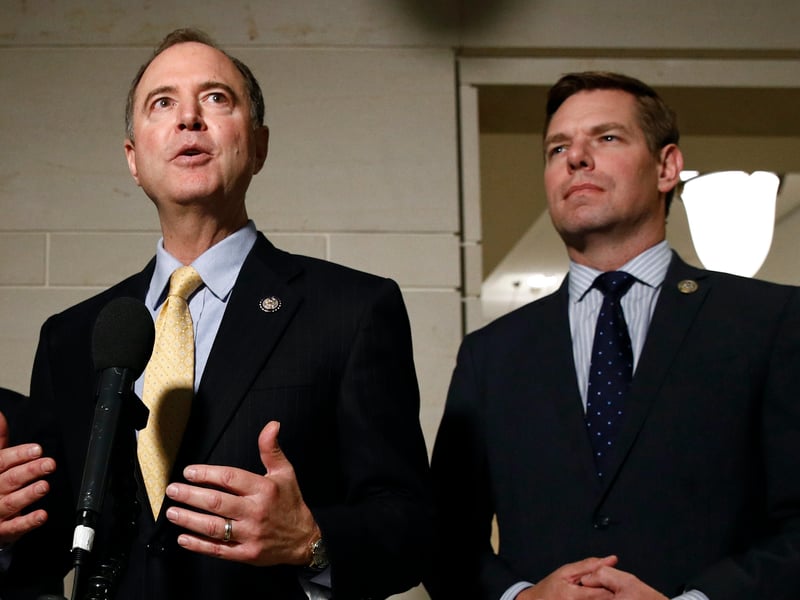
WASHINGTON (CN) — Congressional Democrat Eric Swalwell filed a federal lawsuit Tuesday against Bill Pulte, director of the Federal Housing Finance Agency, over a criminal referral to the Justice Department for supposed mortgage fraud — a charge Pulte has brought against several of President Donald Trump’s adversaries.
Swalwell, a seven-term California Democrat in the House of Representatives, filed the suit in the U.S. District Court for the District of Columbia, arguing that the Nov. 13 referral falsely stated he claimed a D.C. home as his primary residence in order to secure more favorable loans and was a “gross abuse of power.”
“The allegations in Pulte’s referral are patently false,” Swalwell wrote in the 19-page lawsuit. “Indeed, Representative Swalwell explicitly disclaimed any intent to occupy the District of Columbia home as his primary resident in a sworn affidavit attached to his mortgage agreement. The affidavit made clear that the home would be his wife’s primary residence — not his own.”
Swalwell is requesting a federal judge declare that Pulte’s actions violated the Privacy Act of 1974, the Administrative Procedure Act and the First Amendment, and direct Pulte to withdraw the criminal referral.
Swalwell is just the latest government official to be targeted with such a referral by Pulte, with near-identical claims brought this summer against California Senator Adam Schiff, a longtime Trump adversary, and New York Attorney General Letitia James, who brought the civil fraud case in New York against Trump.
“Pulte has abused his position by scouring database at Fannie Mae and Freddie Mac — two government-sponsored enterprises — for the private mortgage records of several prominent Democrats,” Swalwell said. “He then used those records to concoct fanciful allegations of mortgage fraud, which he referred to the Department of Justice for prosecution. The target of his most recent criminal referral is plaintiff Swalwell — one of the president’s most vocal and visible critics in Congress.”
On Monday, Senior U.S. District Judge Cameron McGowan Currie in Virginia threw out the fraud charges against James — alongside false statement charges against former FBI Director James Comey — after finding the appointment of Trump aide Lindsey Halligan as interim U.S. attorney for the Eastern District of Virginia unlawful.
Currie, a Bill Clinton appointee, determined Halligan’s placement violated the appointments clause of the U.S. Constitution and all actions flowing from that defective appointment, including securing the indictments against Comey and James, were unlawful exercises of executive power.
Specifically, Halligan had not been appointed either by the president or through a process Congress has authorized by statute, and was also wrongfully appointed after a 120-day deadline following the departure of a Senate-confirmed U.S. attorney, in this case Erik Siebert.
On Aug. 28, Federal Reserve Board of Governors Member Lisa Cook sued to block Trump’s “unprecedented and illegal” effort to remove her from the central bank based on mortgage fraud claims advanced by Pulte. The D.C. Circuit upheld a lower court order on Sept. 15 to keep Cook in her position.
In an Aug. 15 criminal referral to Attorney General Pam Bondi and Justice Department Special Attorney Ed Martin, Pulte said Cook had wrongfully claimed two different houses as her main residence in 2021 to obtain better loan terms.
Cook has denied any wrongdoing, noting that the conduct occurred before her Senate confirmation hearings in 2022 and did not sink her nomination
In his suit, Swalwell argues that Pulte’s referral to the Justice Department violated both the First Amendment and the Privacy Act.
First, the referral could result in criminal prosecution, which Swalwell says is based “solely on his protected political speech and views,” and thus breached “the First Amendment’s bedrock prohibition on viewpoint-based retaliation.”
Second, the Privacy Act — enacted in the wake of former President Richard Nixon’s use of citizens’ private information as a tool against his political opponents during the Watergate-era — explicitly forbids federal agencies from disclosing or transmitting to other agencies sensitive information about an individual for any purpose not authorized by law.
The use and disclosure of his mortgage documents, Swalwell said, clearly violated the Privacy Act’s basic prohibitions.
“Defendants’ unlawful actions in this case were not the result of some inadvertent failure to comply with obscure or technical legal requirements,” Swalwell said. “Rather, they represent a purposeful attack on core democratic norms and reflect a base desire to achieve exactly what the First Amendment and the Privacy Act exist to prevent: the use of government machinery to chill and silence the government’s critics.”
Swalwell is represented by Sean Hecker, of New York firm Hecker Fink, as well as Hecker Fink partners Trisha Anderson and Amy Jeffress.
The Federal Housing Finance Agency did not immediately respond to a request for comment.
 Follow @Ryan_Knappy
Subscribe to our free newsletters
Our weekly newsletter Closing Arguments offers the latest about ongoing trials, major litigation and rulings in courthouses around the U.S. and the world, while the monthly Under the Lights dishes the legal dirt from Hollywood, sports, Big Tech and the arts.