
 Search Articles


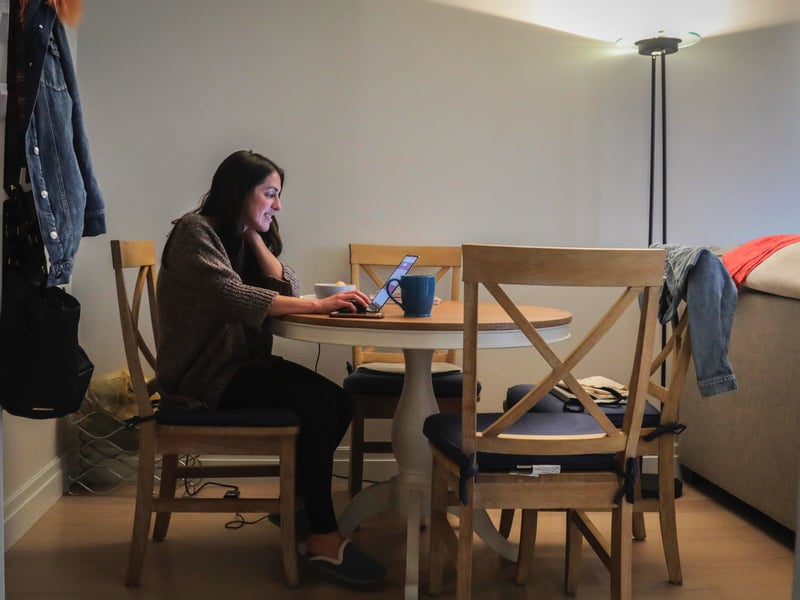
(CN) — Work-from-home positions are an economic double-edged sword: According to a new study, the positions have improved productivity and will lead to a higher lifetime income for many, but their prevalence is also likely to permanently increase income inequality.
The study published in the Review of Economic Studies outlines how remote work technologies impacted the American workforce during the Covid-19 pandemic. Researchers investigated changes in remote work productivity, income and real estate demand using a model focused on where people choose to live and how they allocate their work hours between home and an office.
The results indicated that Americans with remote working capabilities became more productive during the pandemic, creating a permanent shift toward remote work.
“The Covid-19 pandemic prompted a radical shift in how much people worked from home, which in turn boosted the productivity of working from home due to mass adoption of remote-work technologies,” lead author Morris Davis, an assistant professor of real estate and urban land development at Rutgers University, said in a statement.
As a result, the increased productivity of remote work has led to some positive outcomes like increased wages for those work-at-home employees. But those who are unable to work remotely are facing higher costs of living.
“The increase in productivity is predicted to lead to higher lifetime incomes for those workers in occupations with tasks that are most easily accomplished at home — predominantly high-skill workers — and thus a side consequence of the increase in productivity of working at home is a widening of income inequality,” Davis said. “The change in work-from-home productivity also increased the demand for housing, consistent with the increase in house prices we observed between 2020 and 2022.”
The authors note in the study that, while remote work hours have slowly risen since 2000, fully remote work days before the pandemic were relatively uncommon. In 2019, for example, the average American only spent around 5% of their work days at home. The employees with the most remote hours, the authors say, were those with a bachelor’s degree or higher.
Studies have since indicated that the number of fully remote days quadrupled moving into 2022, leading Davis and his co-authors to estimate that this change translates to a 48% jump in remote days for low-skill workers and an 82% increase for high-skill workers.
The change had significant impacts on U.S. real estate.
According to the researchers, the increase in remote hours decreased the demand for office rentals by 7% in central business districts and drove up the demand for home office spaces in residential areas. In turn, the researchers estimate that the increase in remote work has led to a 14% rise in inner-city housing costs and a 24% increase in outer suburbs.
The study’s model also found that the increase in remote work would disproportionately benefit high-skill workers, a finding the authors say parallels the rising income inequality that began in the 1970s with the arrival of technological innovation.
“This improvement in technology, this only helps certain types of workers,” explained co-author Andra Ghent, a professor of finance at the University of Utah, in an interview. “It doesn’t help your gardener, cleaning staff, massage therapists. And so, this exacerbates a long-term trend of what we call skill-based, technological change only benefiting college educated workers because most of the people in telecommunicable occupations have a college degree. So, this exacerbates income inequality.”
Perhaps as a consequence of earning more, the researchers found that remote workers are not only driving up the costs of real estate by requiring more space, but they are also consuming more non-housing-related goods and services.
“So, furniture, food, beverage, eating meals out, service consumption — so if you get a massage — that’s all in your consumption,” Ghent said.
In terms of what these findings mean for the future of America’s workforce and the education they need to keep up, Ghent explained that the value of college education will remain an important factor.
“Everything economists know about college-educated workers is the premium has just increased since 1980,” Ghent said, adding that the wage gap between college-educated and non-college-educated workers has significantly increased.
But while the study findings are a continuation of this trend, Ghent emphasized that not all increases in remote work will involve fully remote positions. Those jobs, she said, tend to involve information technology, and most people will need to reckon with how productive they actually are — especially in terms of career progression — while working from home every day.
“If you’re doing too much work from home, you’re not going to get the mentoring and be involved in these collaborative idea generation projects that help you increase your productivity long term,” Ghent said.
 Follow @alannamayhampdx
Subscribe to our free newsletters
Our weekly newsletter Closing Arguments offers the latest about ongoing trials, major litigation and rulings in courthouses around the U.S. and the world, while the monthly Under the Lights dishes the legal dirt from Hollywood, sports, Big Tech and the arts.