
 Search Articles


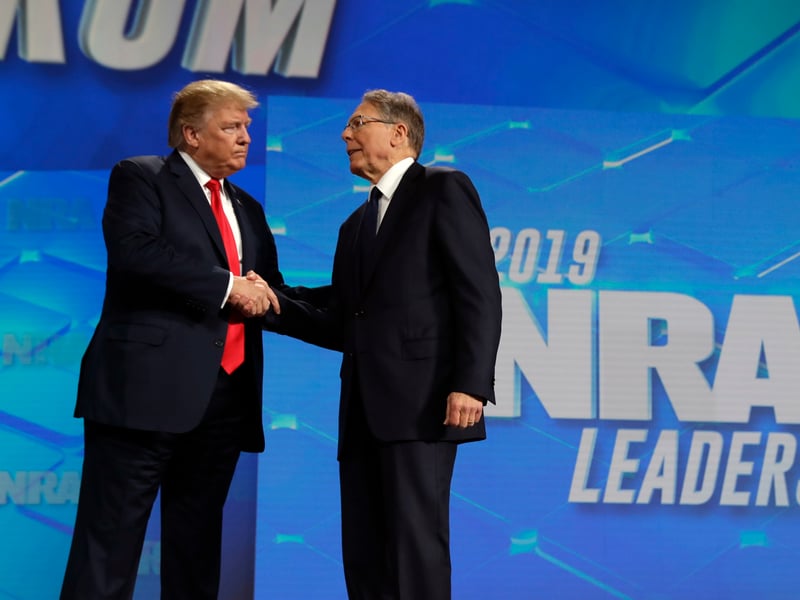
MANHATTAN (CN) — The second phase of the New York attorney general’s trial against the National Rifle Association kicked off Monday, as state attorneys began pleading their case for court-appointed oversight of the gun group’s finances.
It was a reunion in New York state court, as counsel for the NRA and the state returned to the same Manhattan courthouse where jurors reached a scathing verdict against the nonprofit five months ago. The jury in February found that the group’s longtime CEO Wayne LaPierre illicitly spent $5.4 million of donor cash on luxury trips, designer suits and other personal expenses, while the NRA’s board and executives did nothing to stop him.
Now, New York Attorney General Letitia James is looking to keep LaPierre, 74, out of the NRA for good. While the first phase of the trial focused on monetary relief, this second portion is a bench trial before New York Supreme Court Justice Joel Cohen, who will determine what injunctive consequences the NRA will face for their violations of state nonprofit law.
The attorney general sat front row in the gallery of Cohen’s sultry courtroom on Monday — her first in-court attendance of these proceedings against the NRA. Seated just feet away from her was LaPierre, who retired in January on the eve of trial after more than three decades at the organization’s helm.
James is asking Cohen to ensure that LaPierre can’t return to the NRA or its affiliated nonprofits in any leadership capacity. She also wants the court to appoint an independent monitor to oversee the group’s finances for the next three years, and for the NRA to send reports to the attorney general and the court to ensure its compliance.
State attorneys called on a familiar face Monday to start pleading that case: Charles Cotton, an influential NRA board member who previously served as the organization’s president until earlier this year. He testified at the first phase of the trial about the NRA’s internal efforts to track LaPierre’s errant spending.
On Monday, Cotton tried to distance himself and today’s NRA from LaPierre’s legacy of financial irresponsibility. Cotton still serves on several committees on the NRA board of directors — he chairs two of them — which the attorney general argues shows that the same old guard is still running the show, even with LaPierre no longer in charge.
Cotton testified that he understood February’s verdict to be an imputation on LaPierre and other individual officers, not the NRA itself, despite the jury also finding that the NRA retaliated against whistleblowers and submitted false tax returns.
“The jury didn’t find that every NRA member, every board member was somehow liable in all this,” Cotton said with his distinctive southern twang.
But state attorney Steven Shiffman pressed Cotton on the NRA’s press release in response to that verdict, which didn’t specifically denounce LaPierre’s behavior nor acknowledge his misappropriation of donor funds at all.
“He was never terminated or fired?” Shiffman asked.
“Correct,” Cotton replied.
“He was never even referred to by name?” Schiffman followed up.
“None of the individual defendants were,” Cotton said.
Cotton’s testimony reflected the very argument from the NRA that state attorneys will look to thwart in this phase of the trial. In court, the NRA has repeatedly pinned February’s verdict on individual executives like LaPierre. But according to the attorney general, there has been no serious effort by the NRA to acknowledge LaPierre’s wrongdoing to its members, leaving the organization susceptible to falling back into its old ways without court intervention.
State attorneys on Monday also elicited testimony from nonprofit governance expert Joshua Tenenbaum, who called the NRA’s policy manual a “dumpster fire” and lamented the large and “very problematic” size of its board. Tenenbaum acknowledged the NRA has made some progress to boost its financial transparency, but believes that a court-appointed monitor is necessary to see things through.
Earlier Monday morning, LaPierre’s attorney Kent Correll urged Cohen to allow him to call James to the stand “to ask her why she is asking this court for a lifetime bar on Wayne LaPierre.” Correll argued that it’s imperative that the attorney general reveal why she thinks such a ban is necessary, citing LaPierre’s life of “civil rights advocacy.”
“Frankly, none of that matters,” the judge said, rejecting Correll’s request. “This is now just a straight decision on nonmonetary remedies.
Trial will resume Tuesday with testimony from more state witnesses. The proceedings are set to last roughly two weeks, after which Cohen will issue a judgment on injunctive relief.
 Follow @Uebey
 Follow @uebey.bsky.social
Subscribe to our free newsletters
Our weekly newsletter Closing Arguments offers the latest about ongoing trials, major litigation and rulings in courthouses around the U.S. and the world, while the monthly Under the Lights dishes the legal dirt from Hollywood, sports, Big Tech and the arts.