Search Articles


(CN) — Nowadays, humans take for granted that we can breathe in and out through an attuned internal system without giving it much thought. Humans and other mammals breathe by filling air in the lungs and expanding the rib cage — a synchronized action that evolved from a prehistoric animal in the same taxonomic group.
Recently, scientists discovered a reptile fossil that provides the missing link between the transformation in the modes of breathing from sea-dwelling animals to humanity’s terrestrial kin.
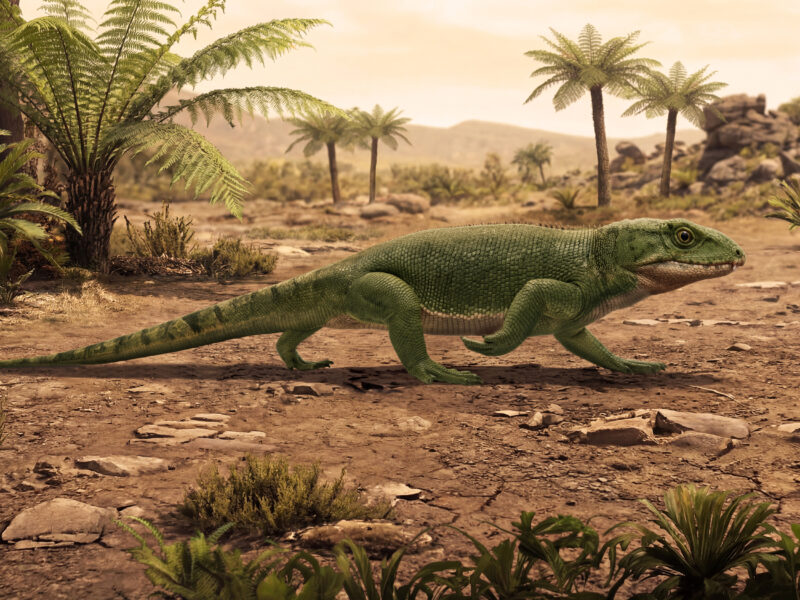
A study published Wednesday in the journal Nature about the remains reveals how an ancient reptile called Captorhinus from the Permian period used a complex breathing support system that included rib extensions with cartilage and a multipart cartilaginous sternum, not wholly unlike what other amniotes — the group of reptiles, mammals, birds that all have a common vertebrate ancestor — use today. Captorhinus moved on four short legs, had a wide head and snout and could detach its tail to evade predators.
Researchers at the University of Toronto analyzed the fossils found in a cave system from the early Permian period in Oklahoma. The Permian period was 298.9 to 251.9 million years ago and ended with the greatest mass extinction in Earth’s history. The specimen is incredibly rare, the scientists say, because they are well-preserved in fine clay and saturated with oil.
The composition of the fossils — including three-dimensional skin, cartilage around the ribs and shoulders, a sternum and different kinds of ribs and traces of protein in bone and skin — shows in intricate detail previously unknown structures of the extinct animal’s respiration.
“Particularly striking is the preservation of endogenous protein remnants that predates previous such evidence by nearly 100 million years,” said study lead author and paleontologist at the University of Toronto, Robert Reisz, in a statement. He said the reptile is “by far the oldest such preservation in a terrestrial vertebrate animal.”
To analyze the specimen, the scientists didn’t use traditional mechanical or chemical preparation to review the fossils, as it could have damaged the soft tissues. Instead, researchers and co-authors Joseph Bevitt and Ethan Mooney used neutron CT scans and “worked meticulously to render the underlying skeleton and tissues for anatomical study,” Reisz said.
A chemical analysis was performed to provide details of the soft tissues, confirming the cartilage was calcified, the same process of regeneration for living lizards.
“The mummified Captorhinus is certainly among the most significant early amniote fossils in the world,” Mooney said in a statement. “It offered an unparalleled window into the appearance, lifestyles, and evolution of the earliest reptiles, expanding dramatically our understanding of this pivotal episode of amniote evolution. As more work continues on this time period, more incredible discoveries are sure to be unearthed.”
Reisz said these unprecedented discoveries allowed the scientists to reconstruct important aspects of the biology of the early reptile, and it has great evolutionary significance.
“We propose that the system found in Captorhinus represents the ancestral condition for the kind of rib-assisted respiration present in living reptiles, birds and mammals,” said Reisz. “This efficient respiratory apparatus is important for their more active, energetic and competitive lifestyles compared to their amphibian counterparts.”
And conditions of the cave where the ancient animal was found effected with how well preserved it was.
Reisz said the cave had highly hyper-mineral-rich water at the bottom that readily precipitated out around the decayed carcasses and bones, and the oil seep rich in hydrocarbons acted as a preservative to stop the complete mineralization of the bones and tissues.
He noted the cave system in an active limestone quarry has been producing fossils since 1936.
“It is by far the richest assemblage of terrestrial vertebrates before the age of dinosaurs,” he said.
Subscribe to our free newsletters
Our weekly newsletter Closing Arguments offers the latest about ongoing trials, major litigation and rulings in courthouses around the U.S. and the world, while the monthly Under the Lights dishes the legal dirt from Hollywood, sports, Big Tech and the arts.