
 Search Articles


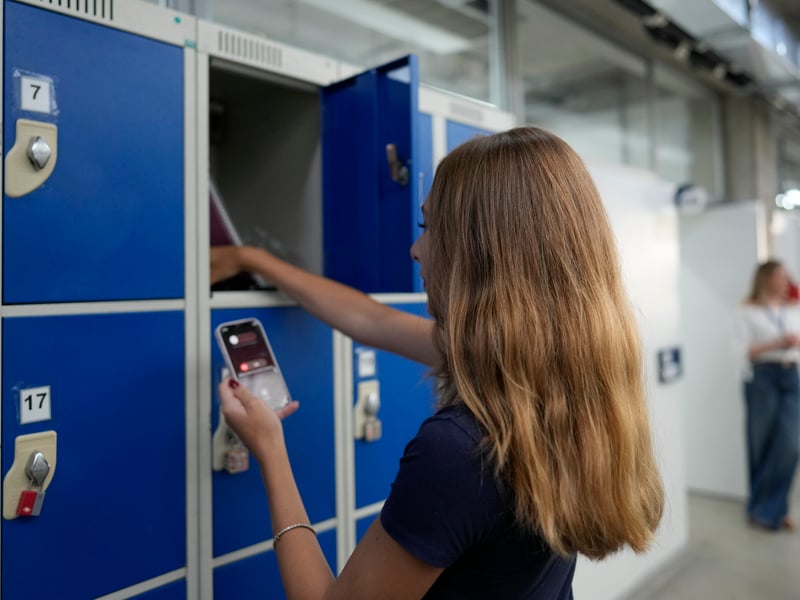
RIO DE JANEIRO (CN) — As soon as Isabelly Cavebon Gabana enters her school, the 16-year-old from Nova Prata, Rio Grande do Sul, must deposit her cellphone in a box to be held by the administration until classes end. The school implemented the policy last year in preparation for the enforcement of a law signed Jan. 13 by President Luiz Inácio Lula da Silva.
Law 15.100/2025 prohibits the use of portable electronic devices during classes, recess and breaks at all levels of basic education. It took effect for the 2025 school year, which began in most Brazilian states between Feb. 3 and Feb. 10.
The law includes exceptions for educational purposes and cases of necessity, danger, force majeure or accessibility.
“I think it is good because it removed distractions and prevented abuse of cellphone use,” Gabana said.
Two years ago, her school banned cellphones in classrooms but allowed them during recess. According to Gabana, cellphone use during classes worsened during the Covid-19 pandemic. “We became more dependent,” she said.
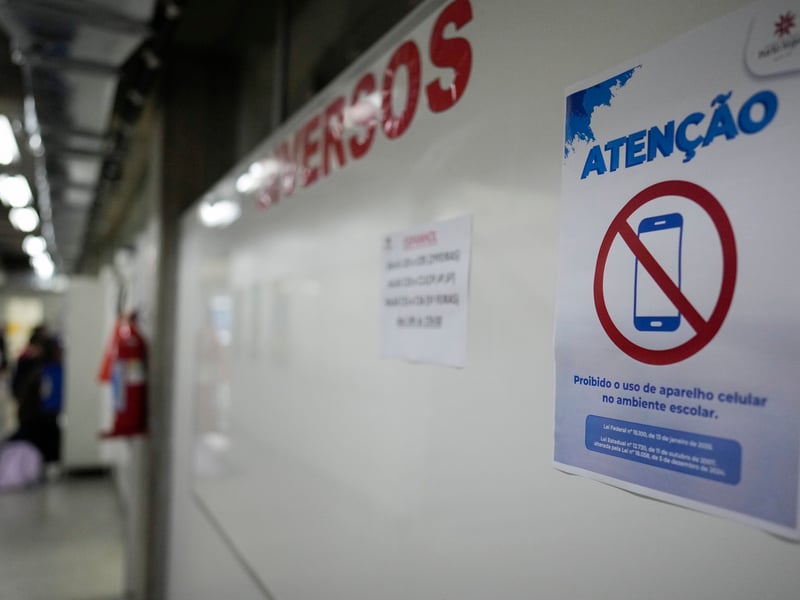
Brazilian legislation on cellphone use in schools mirrors global concerns about excessive device use in classrooms.
In July 2023, UNESCO published a report urging caution with cellphones in schools, citing Program for International Student Assessment results that suggest a negative correlation between device use and academic performance. In the latest assessment, from 2022, Brazil’s scores in mathematics, reading and science lagged behind those of other member countries in the Organization for Economic Cooperation and Development.
“Through this sanction, we recognize the work of everyone who cares for education and the youth of this country. Human beings were born to live in society and to interact in person, so this is a step that represents a lot for the future of the country. We want children to go back to playing, interacting with each other and studying,” Lula said during the signing ceremony.
Before the federal law, at least 16 states had already restricted or banned cellphone use in state-run schools. In 2024, the effort gained further momentum when Rio de Janeiro banned cellphones in its city-run schools.
Since then, according to Rio’s municipal secretary of education, Renan Ferreirinha — who resumed his mandate as a federal deputy in 2024 and served as the rapporteur of the law signed by Lula — ninth grade students have improved by 53% in mathematics.
“It’s spectacular. And with this success story, we were able to nationalize the agenda,” Ferreirinha said.
He noted that while children and pre-teens adapted quickly, teenagers took several weeks or months. “But it’s great to see that it works and that students are starting to rediscover schools. We can’t think it’s normal for a child to be unable to put their cellphones down.”
English teacher Luciana Mattos, of Escola Municipal Mozart Lago in Rio de Janeiro, said the federal law generated media attention that spurred discussions and greater awareness among those in charge. Mattos, who teaches students aged 6 to 9, said that students were constantly using their cellphones.
“It took a lot of effort to draw their attention and remind them they couldn’t use them. Most of them put them away; others pretended they weren’t using them, but we wasted a lot of time on this and it became another exhausting task in the classroom,” she said.
Rodrigo da Silva Carvalho, technical education coordinator at ORT, a private school in Rio de Janeiro, linked the rise in screen use — inside and outside the classroom — to the Covid-19 pandemic.
“In 2020 and 2021, digital devices became an integral part of the school environment and the educational process. They became an important tool, so removing them was not an easy task,” he said, adding that the federal law is positive because it creates a unique identity for Brazilian education.
Lawyer Alynne Nayara Ferreira Nunes, who specializes in educational law, said the federal law provides legal security for schools. “It’s difficult for parents to control and for schools to ask parents to collaborate because some families argue that cellphones are a safety issue. When legislation comes into effect, families understand that this is a requirement,” she said.
However, she expressed concern that the law does not specify sanctions for schools that violate its provisions and that some undefined terms — especially those dealing with exceptions — could lead to application problems.
“Talking about accessibility, health issues and guaranteeing fundamental rights is very broad,” she said, though she still considers the law an important step in changing behavior.
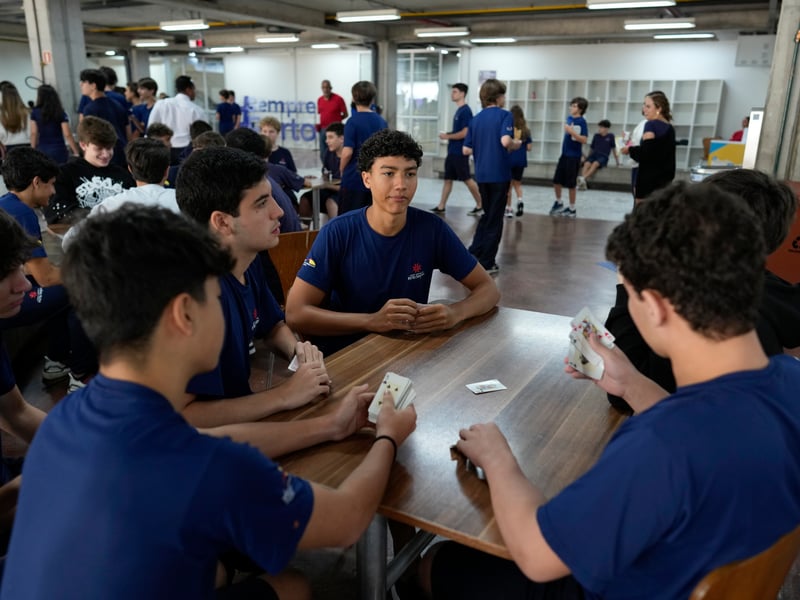
Henrique Bravo Andrade, 12, and Tomás Caheté Lopes Carvalho, 12, students at private schools in Rio de Janeiro, said the ban was unnecessary, and argued that in emergencies, they might be unable to contact their parents.
“Even though the school office is open, some matters can only be discussed with parents,” Carvalho said.
However, Clarissa Bravo, Henrique’s mother, and Flávia Caheté, Tomás’ mother, stressed that even before the legislation, they insisted that children should not use their devices during class. While Caheté saw the law as a positive step, Bravo was more hesitant.
“Education has to come from home. I understand that teachers cannot bear additional responsibility,” Bravo said.
Sharing that view was Vitor Nunes Caetano, a teacher at the municipal school system in Rio de Janeiro, who said he is against the law.
He explained, “This does not mean I oppose setting limits on cellphone use. Rather, it reflects an inability to educate about their proper use. The most harmful effects of inappropriate cellphone use will not be resolved by simply imposing a law. We ban cellphones in schools, but what happens after class?”
Clarice Morgado Koike, a 12-year-old student at a private school in Rio de Janeiro, expressed concern that the ban could lead to a regression in technological literacy. “We have computer classes precisely to learn how to handle technology, so they shouldn’t prohibit students from using it in educational ways,” she said.
But her mother Carolina Morgado, a teacher at a federal institution, supports the ban. Repeatedly interrupting classes to ask students to put away their cellphones is unproductive and exhausting for teachers, she said. However, she advocated for schools to take time to educate students about new technologies.
Educator Anna Helena Altenfelder, president of the board of directors of Cenpec — a nongovernmental organization focused on improving public education — said technological inclusion is a key issue that should be addressed alongside the new law.
“Banning cellphones in schools should not be equated with banning technology, which is crucial for children’s cognitive development,” she said.
Altenfelder also stressed that the legislation should be paired with connectivity policies to avoid widening educational inequalities. “As a country, we are quite behind, and the pandemic has exposed this,” she said.
The 2023 UNESCO report cautioning against cellphone use in schools noted that Brazil has 10 computers per 100 students, compared to Luxembourg’s 160 per 100 students.
Altenfelder also said the law raises practical challenges, such as where to store devices and how to enforce the rules. She considers cooperation among schools, families and society essential. “Children must understand that the law stems from a concern for their development. The goal is not punishment but ensuring healthy, complete, and integral development.”
Subscribe to our free newsletters
Our weekly newsletter Closing Arguments offers the latest about ongoing trials, major litigation and rulings in courthouses around the U.S. and the world, while the monthly Under the Lights dishes the legal dirt from Hollywood, sports, Big Tech and the arts.