
 Search Articles


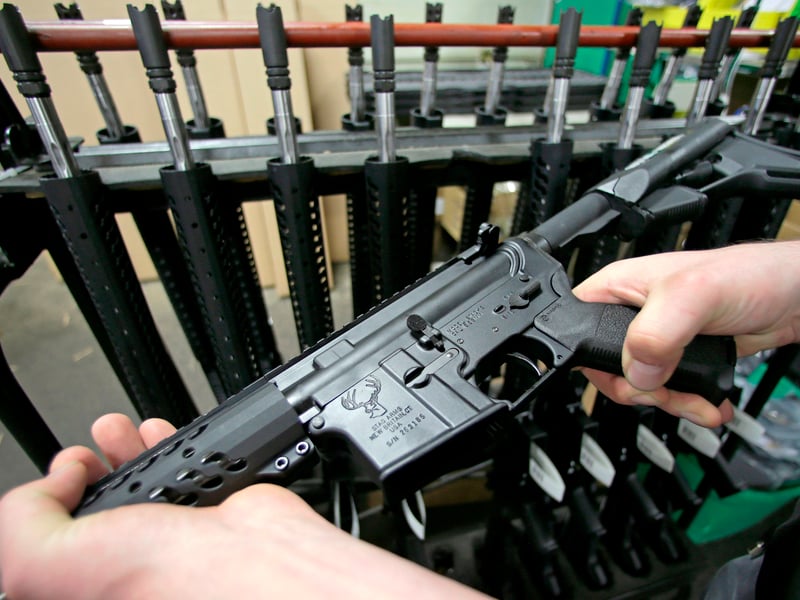
MANHATTAN (CN) — A Texas company that produces triggers that allow AR-15-style rifles to fire like automatic weapons asked the Second Circuit on Wednesday to overturn a preliminary injunction on sales of its product.
Rare Breed Triggers is currently locked in a legal battle with the federal government, which filed a civil fraud lawsuit against the company last year claiming it continued to market the trigger despite being warned by the Bureau of Alcohol, Tobacco, Firearms and Explosives that the product qualified as an illegal machine gun under federal law.
The government, seeking a permanent ban on sales of the trigger, claims Rare Breed Triggers defrauded its customers by not properly warning them that the ATF considers the product illegal.
“The appellants here wanted to sell as many illegal machine gun conversion devices as they could as quickly as they could before ATF could manage to stop them,” Assistant U.S. Attorney Michael Blume told a trio of Second Circuit judges Wednesday. “But to do that, they had to mislead their consumers, their customers, about the product.”
But the company contends it earnestly believes the trigger is lawful, and never intended to mislead its customers by continuing its sale.
“The crux of this case is whether it constitutes fraud for a private actor to disagree with an executive branch interpretation of the law,” Rare Breed Triggers’ attorney Gary Lawkowski, of Dhillon Law Group, argued.
In September 2023, a lower court granted a preliminary injunction barring Rare Breed Triggers from selling its flagship product — called forced-reset triggers, or FRT-15s — as the civil fraud case plays out.
The page on the company’s website that once sold the triggers is now empty, containing only the following message:
“Due to the preliminary injunction issued by a federal court in the Eastern District of New York on Sept. 5, 2023, ALL official Rare Breed Triggers Forced Reset Triggers (FRTs) are unavailable until further notice.”
Rare Breed Triggers wants the Second Circuit to overturn that order so it can continue selling the product and keep the company afloat.
The appellate panel will not decide whether the product should or should not qualify as a machine gun. Rather, it will determine whether the lower court’s preliminary injunction was justified based on the government’s claims that Rare Breed Triggers defrauded its customers.
U.S. Circuit Judge Richard Sullivan, a Donald Trump appointee, acknowledged the company may have put some consumers in jeopardy by selling them a product that could get them in legal trouble.
“Some of them at least thought they were paying for a gun that has been sanctioned by the federal government, that it’s OK to have,” Sullivan said, and likened the situation to a hypothetical pharmaceutical company hawking a drug that has been deemed ineffective.
“How is this any different from a manufacturer of a drug saying, ‘This drug cures cancer,’ when the FDA has said it doesn’t cure cancer?” he asked.
Lawkowski responded that in the case of the hypothetical, “the drug is not working as advertised. Whereas in this case, people are getting exactly what they’re paying for.”
Still, Sullivan remained steadfast that an unwitting purchaser of an FRT-15 might face “pain and headaches” when they’re faced with the inconvenient reality that they own an illegal machine gun, potentially threatening their ability to own firearms legally if criminally charged for its possession.
The rest of the panel, Barack Obama-appointed U.S. Circuit Judge Raymond Lohier and Joe Biden-appointed U.S. Circuit Judge Maria Kahn, echoed Sullivan’s concerns.
The ATF has encouraged any and all owners of FRT-15s to destroy them or turn them over to the bureau.
In July, a federal judge in the Northern District of Texas struck down the ATF’s classification of forced-reset triggers as machine guns. But the bureau maintains its position and the case is on appeal.
 Follow @Uebey
 Follow @uebey.bsky.social
Subscribe to our free newsletters
Our weekly newsletter Closing Arguments offers the latest about ongoing trials, major litigation and rulings in courthouses around the U.S. and the world, while the monthly Under the Lights dishes the legal dirt from Hollywood, sports, Big Tech and the arts.