
 Search Articles


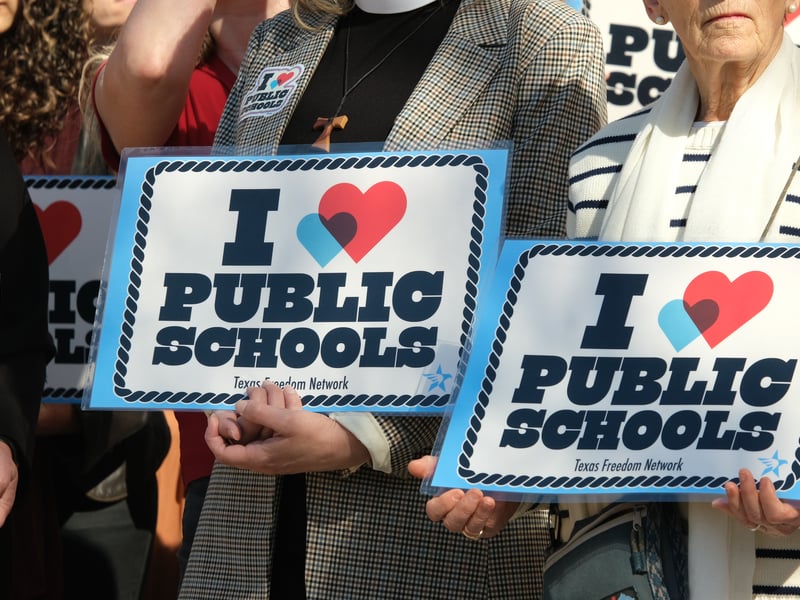
AUSTIN, Texas (CN) — With over 300 people waiting to voice their opinions Tuesday to lawmakers in the Texas House Public Education Committee, a hearing over House Republicans’ school voucher proposal ran for nearly 24 hours.
Committee chairman Representative Brad Buckley, a Republican from Salado, told fellow House members at the meeting’s 8 a.m. start that his bill aims to empower parents through a voucher-like program.
“My intent is to provide families with the opportunity to choose the best possible educational setting for their child,” said Buckley. “I believe House Bill 3 provides this choice while prioritizing Texas’ most high needs and vulnerable students.”
Under the legislation, families accepted into the program would get what the state bills as an education savings account with 85% of the money the state gives school districts for a student.
During the 2023 fiscal year, school districts received $12,815 per student, excluding federal statewide funds, according to the Texas Education Agency. Using that statistic, families in the program could get $10,893 to pay expenses like tuition, books, transportation and therapy. Students with disabilities could get up to $30,000 per year and would be prioritized for admission along with low-income students.**** Homeschoolers could get $2,000 to cover educational expenses.
Despite all the talk of giving parents a choice in education, many of the hundreds who showed up to share their thoughts with the committee urged lawmakers not to send the bill to the full House.
“As a Texas resident and parent, I already have school choice,” said Nicole Hutchison, a resident of Joshua, Texas, and homeschool parent. “Spending billions to create new programs is not conservative, especially when Texas has a budget surplus and public schools are underfunded.”
While Hutchison could stand to gain from such a program, she told the committee shortly after midnight that HB 3 could have far-reaching negative consequences.
“I urge you to reexamine the language and financial impact of this voucher program,” Hutchison said. “This is not the solution for public education, nor does it support teachers’ retirement. It will increase private tuition and devastate homeschoolers with unnecessary restrictions.”
Republicans in the state, including Governor Greg Abbott, have made such legislation an emergency item during the 2025 legislative session. The Texas Senate passedits proposal, Senate Bill 2, of an education savings account early last month. The measure is awaiting consideration in the House.
Under the Senate’s proposal, accepted students would get $10,000 for educational expenses; those with disabilities would receive an extra $1,500. The bill also provides $2,000 to homeschooled students, with an additional $500 for disabled homeschooled students.
Buckley and Republicans have argued that the voucher-type program is needed for parents who feel their child’s needs are not being met in their current public school. But as Republicans rally to support these measures, Democrats in the House have been united in their opposition, arguing that the proposed money for a voucher program should go to increased funding for public schools.
Abbott has also promised to fund public schools and give public school teachers a raise this session. He said that a voucher program is key to his plan of making Texas “number one for educating our kids.”
However, Zeph Capo, president of the Texas American Federation of Teachers, said during a news conference that voucher programs would lead to the dismantling of public education.
“We can afford to fully fund public schools to help 5 million kids thrive,” said Capo. “Underfunding schools is a choice. Dedicating $1 billion … to create a third taxpayer-funded school system when our neighborhood schools are laying off staff, closing campuses and cutting services to students, is a choice.”
During the committee meeting, Democrat Representative James Talarico of Austin questioned whether the bill truly gives parents a choice. Private schools would not be required to accept students with an education savings account. Schools could reject students with disabilities or those who are unable to pay full tuition. What’s more, students who are already enrolled in private schools would be eligible to receive these funds.
Talarico argued these facts show that the ultimate choice embedded in HB 3 lies with the schools. He called on Buckley to ensure his bill provides targeted aid to students who need it.
“Your bill allows for millionaires to take money that could go to public schools to subsidize their private school tuition,” said Talarico. “Are you OK with that, or should we work on that part of the bill?”
“I don’t have a microscope into the lives of every family,“ responded Buckley. “ I think that it is a red herring to talk about millionaires and billionaires accessing the program.”
Coming to Buckley’s defense, Republican Representative Terri Leo Wilson of Galveston said she resents the notion that HB 3 supports Texas’ wealthiest families.
“I just don’t think that that is reflective of who will benefit here when 75% is targeted at special needs and low-income students,” said Leo Wilson. “This is for all parents to decide, for whatever reason, what is the best thing for their student.”
Just after 6 a.m. Wednesday, the committee concluded public testimony and left HB 3 pending before the committee. Buckley did not say when the committee would meet again to vote on the bill, but they are expected to do so soon.
Of the 15 members on the Public Education Committee, Republicans hold nine seats, giving them the numbers to easily approve the bill and send it to a full House vote. And in a key difference from the 2023 session, where similar proposals died after failing to receive buy-in from Democrats and rural Republicans, they have a thin majority that could help them pass a school voucher bill.
 Follow @KirkMcDanie1
Subscribe to our free newsletters
Our weekly newsletter Closing Arguments offers the latest about ongoing trials, major litigation and rulings in courthouses around the U.S. and the world, while the monthly Under the Lights dishes the legal dirt from Hollywood, sports, Big Tech and the arts.