
 Search Articles


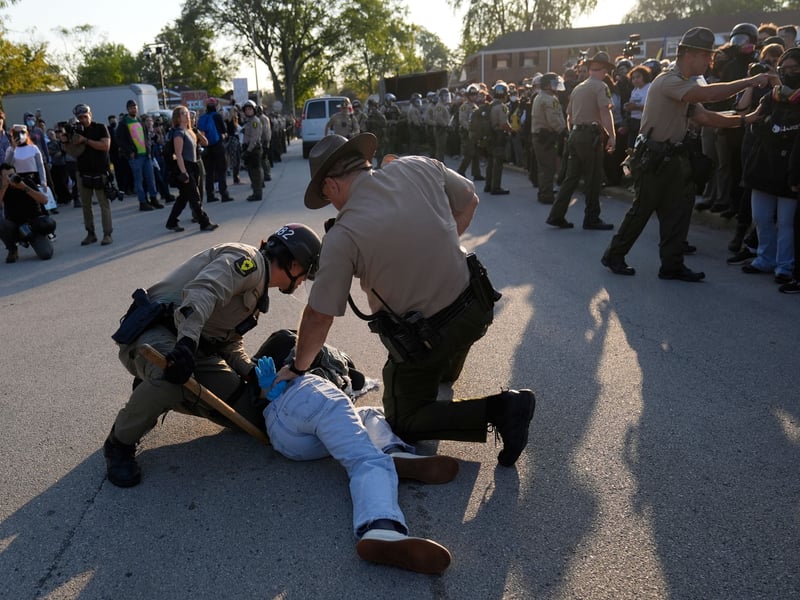
CHICAGO (CN) — The legal battle in Illinois against the Trump administration’s immigration enforcement efforts hangs in the balance after a federal judge dismissed a lawsuit over federal officers’ repeated use of excessive force on Thursday.
A group of protesters, religious leaders and journalists sued the Trump administration and the Department of Homeland Security in November, with accusations of improper and excessive force from immigration authorities throughout the course of “Operation Midway Blitz.”
U.S. District Judge Sarah Ellis previously granted the group a preliminary injunction and said she saw little reason for federal officers’ use of force against Chicago protesters — but a Seventh Circuit panel called the injunction overbroad and an infringement on the separation of powers.
The case appeared prime for arguments before the appellate panel, but in an interesting legal maneuver, the plaintiffs’ attorneys moved to dismiss the lawsuit in December.
“Because the Seventh Circuit has already stayed this preliminary injunction and says it has no force, and the legal standards that apply here require that there is some ongoing or immediate risk of harm, and so that currently is not present because Bovino has left the jurisdiction and he and his forces are moving concertedly to Minneapolis,” Steve Art, an attorney with Loevy + Loevy, told a gaggle of reporters after the initial hearing on the motion to dismiss.
“If they come back and the situation on the ground changes, then we will have the ground to file another lawsuit,” Art continued.
Ellis, Barack Obama appointee, declined to issue a ruling on the motion to dismiss when it initially came before her in January, just days after ICE agents fatally shot Renee Good in Minneapolis.
Conflicting views of ICE
Throughout the course of the immigration enforcement efforts, violence from federal officers has not been the only problem. Federal agents have consistently had very different accounts of enforcement incidents than protesters or average citizens.
Hiroshi Motomura, an immigration law professor at the UCLA Law School, noted the idea that President Donald Trump heavily emphasized that America is being “invaded” by immigrant communities during his first run for president.
“The idea because we’re being invaded its an emergency,” Motomura said. “It’s an emergency, not just [at] the border, but everywhere. And so that means that the message from the White House is that because we’re being invaded, we need to do everything in our power, and we have to suspend normal rules.”
Federal agents maintain that Good was shot in self-defense because she was driving toward them.
But their account of the incident was subjected to significant pushback. Witness footage showed Good trying to back her car away from the officers. Similarly, when officers fatally shot Silverio Villegas Gonzalez in Chicago, they said that it was because he was driving into a crowd of agents. Video footage, however, showed otherwise.
Ellis has also repeatedly admonished Border Patrol Commander Greg Bovino, the leader of Operation Midway Blitz, when he was ordered to testify before her after repeatedly violating her use of force order. She pointed, in particular, to an incident on Oct. 23, in which Bovino was seen throwing a tear gas cannister, without warning, over federal agents’ heads and into a crowd of protesters in Little Village.
Bovino testified that he threw the tear gas because someone in the crowd threw a rock at his head. But in a separate private deposition, Bovino couldn’t point to video footage that showed the aforementioned rock, and admitted that a rock was thrown at him after he deployed the tear gas.
“Videos of what happened in Little Village, even from agents body cam and helicopter footage, do not match up with agents’ description of the chaos that was going on,” Ellis said before she issued the injunction in November.
Several people have been criminally charged for interfering with immigration enforcement efforts, although few of those charges have stuck.
Juan Espinoza Martinez, a 37-year-old Little Village resident, was charged in a murder-for-hire plot after federal prosecutors claimed he offered $10,000 for someone to kill Bovino. The trial lasted just a few days and featured only four witnesses. Jurors found him not guilty on Thursday after three hours of deliberation.
States take on feds
Though the protesters’ lawsuit may have stalled, a lawsuit filed by Illinois against the Department of Homeland Security on Jan. 12, just days after Good’s shooting, remains in play.
In its lawsuit, Illinois say that ICE’s “menacing, violent, and unlawful incursion impedes Illinois and Chicago from carrying out core sovereign functions in violation of the Tenth Amendment.”
The attorney general for the state of Minnesota filed a similar lawsuit. The states asked federal judges to declare the heightened immigration enforcement efforts unconstitutional, and to cease the operations in both states.
Aside from courtroom efforts against Operation Midway Blitz, Illinois Governor JB Pritzker has levied his gubernatorial power against the feds.. He signed a bill in December designed to protect immigrant communities.
The legislation, which was passed during the Illinois legislature’s veto session at the end of October, restricts how federal immigration authorities can conduct their operations outside of courthouses and offers an avenue of legal recourse for people who believe federal agents might have violated their constitutional rights.
“With my signature today, we are protecting people and institutions that belong here in Illinois. Dropping your kid off at day care, going to the doctor, or attending your classes should not be a life-altering task,” Pritzker said in a statement then. “Illinois — in the face of cruelty and intimidation — has chosen solidarity and support. Donald Trump, Kristi Noem, and Gregory Bovino have tried to appeal to our lesser instincts. But the best of us are standing up to the worst of them.”
 Follow @RosenCaitlyn
Subscribe to our free newsletters
Our weekly newsletter Closing Arguments offers the latest about ongoing trials, major litigation and rulings in courthouses around the U.S. and the world, while the monthly Under the Lights dishes the legal dirt from Hollywood, sports, Big Tech and the arts.