
 Search Articles


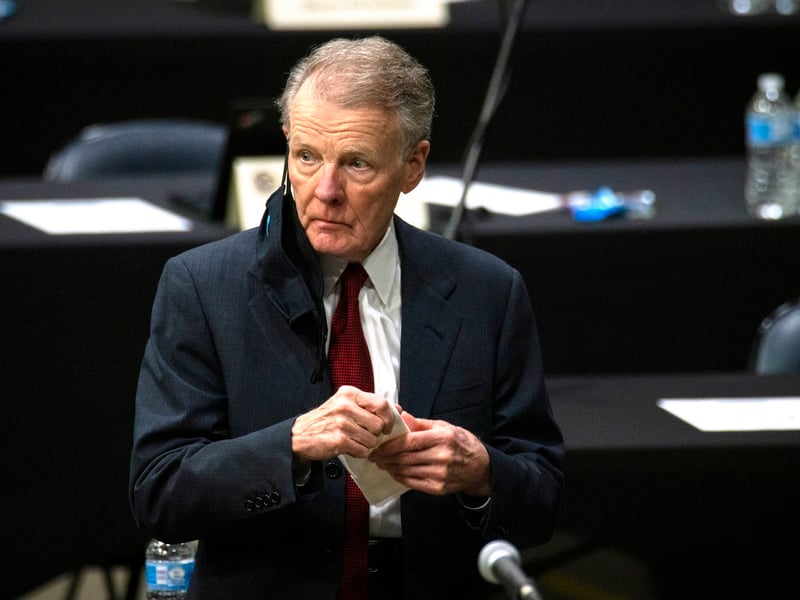
CHICAGO (CN) — U.S. attorneys didn’t officially rest in their corruption case against Democratic ex-Illinois House Speaker Mike Madigan on Tuesday, but they did tell the judge they’d come to the end of their witness and evidence list.
It’s unclear why the government didn’t formally rest before U.S. District Judge John Robert Blakey sent jurors home early for the day. Before lunch, federal prosecutor Amarjeet Bhachu told Blakey “we’re getting close to being done.”
After jurors came back from their lunch break, they sat through only about an hour of testimony and exhibits before going home.
That testimony came from the government’s ostensible last witness, FBI Special Agent Kyle Scherrer. Scherrer testified earlier in trial about his work on the Madigan case, and spoke Tuesday about when the FBI interviewed Democratic ex-state representative Eddie Acevedo in 2019.
Acevedo himself also testified Tuesday morning. He was the government’s last major known witness, and spoke on the stand Monday and Tuesday about his connection to AT&T, Illinois energy company ComEd and Madigan’s circle. He served as a state representative between 1997 and January 2017. His career included stints as Madigan’s assistant majority leader in the Illinois House and as co-chair of the Illinois Legislative Latino Caucus. He also pleaded guilty to a federal tax evasion charge in December 2021.
Prosecutors say Madigan — with the help of longtime Springfield lobbyist and co-defendant Mike McClain — arranged for AT&T to offer Acevedo a $22,500 do-nothing consulting job between April and December 2017.
In exchange, Madigan reportedly worked in support of AT&T’s 2017 legislative agenda in the Illinois legislature. Prosecutors also count Acevedo among multiple Madigan associates for whom ComEd officials reportedly arranged do-nothing consulting subcontracts between 2012 and 2019. As with AT&T, prosecutors say Madigan supported ComEd’s legislative goals in exchange for these jobs for his allies.
Over the course of the prosecution’s case, jurors saw dozens of documents and secretly recorded conversations, and listened to hours of witness testimony, which supported the accusations against Madigan and his circle, including Acevedo. But Acevedo himself gave muddled testimony on Monday and Tuesday.
He argued he did do work for AT&T after taking the $22,500 contract offer — which he said involved attending “hearings” on AT&T’s behalf.
This contradicted his 2022 grand jury testimony where he said he didn’t remember producing any oral reports for the company. Scherrer said in his own testimony Acevedo similarly denied producing work product for AT&T during a September 2019 interview.
Lobbyist Tom Cullen, another longtime Madigan ally whose firm paid the Acevedo family’s “Apex Strategy” consulting firm multiple checks in 2017 — Cullen says on AT&T’s behalf — also confirmed last week that the former state legislator was only ever given “busy work” for AT&T.
“You didn’t do any work for the $2,500 a month you got,” Bhachu asked Acevedo on Monday, regarding his AT&T contract.
“Yes I did. I told you, I went to hearings, I went to meetings,” Acevedo responded. “And I always filled in [AT&T lobbyist] Steve Selcke on what was happening.”
When Bhachu pushed him on the discrepancy, Acevedo said he couldn’t remember his grand jury statements. He also said he had difficulty reading the grand jury statements the prosecution offered to refresh his memory, because he forgot his glasses.
When trial proceedings ended Monday, Blakey ordered Acevedo to bring his glasses with him on Tuesday on pain of being held in contempt.
Acevedo did bring his glasses with him Tuesday, but his testimony was no clearer. At one point Bhachu asked him whether he told the FBI in September 2019 that Madigan’s once-chief legal counsel, Heather Weir Vaught, called him a few weeks prior and asked if he had an attorney.
Acevedo responded he couldn’t remember who Wier Vaught is.
The 61-year-old said on the stand that he has dementia and a brain tumor, and entered the courtroom with a walker both days. Besides the apparent inconsistencies in his testimony this week, he also gave responses that did not directly address prosecutors’ questions. During cross-examination, he began sniffling on the stand as he claimed to not be able to remember his grandchildren’s names.
He did give one definite answer to McClain’s attorney Patrick Cotter Tuesday, when Cotter asked him if he ever asked McClain for a “no-show” job.
“I never asked anyone for a no-show job,” Acevedo said.
Unlike the trial’s other big-name witnesses who spent multiple days on the stand — like ex-ComEd Vice President Fidel Marquez and ex-Chicago alderman-turned-FBI informant Danny Solis — Acevedo only spent about an hour testifying between Monday evening and Tuesday morning.
Besides Acevedo and Scherrer, jurors also heard testimony Tuesday from FBI Special Agent Eileen McDermott and former AT&T internal lobbyist Michael Lieteau.
After prosecutors formally rest their case, possibly on Wednesday, defense will have an opportunity to present their own case for jurors. Madigan faces 23 counts for bribery, fraud, racketeering and conspiracy. He’s joined by McClain on six of the same counts.
Since opening arguments in October, prosecutors have attempted to paint Madigan as a political kingpin in Springfield and Chicago. Madigan served as a Democratic state representative for parts of Chicago’s southwest side for half a century between 1971 and 2021. He led the state House of Representatives for 36 of those years and also chaired the state Democratic party for over two decades.
Prosecutors deemed him the head of the so-called “Madigan Enterprise,” and have spent weeks showing jurors evidence that his political machine funneled jobs to his allies and legal work to his private law firm Madigan & Getzendanner.
 Follow @djbyrnes1
Subscribe to our free newsletters
Our weekly newsletter Closing Arguments offers the latest about ongoing trials, major litigation and rulings in courthouses around the U.S. and the world, while the monthly Under the Lights dishes the legal dirt from Hollywood, sports, Big Tech and the arts.