
 Search Articles


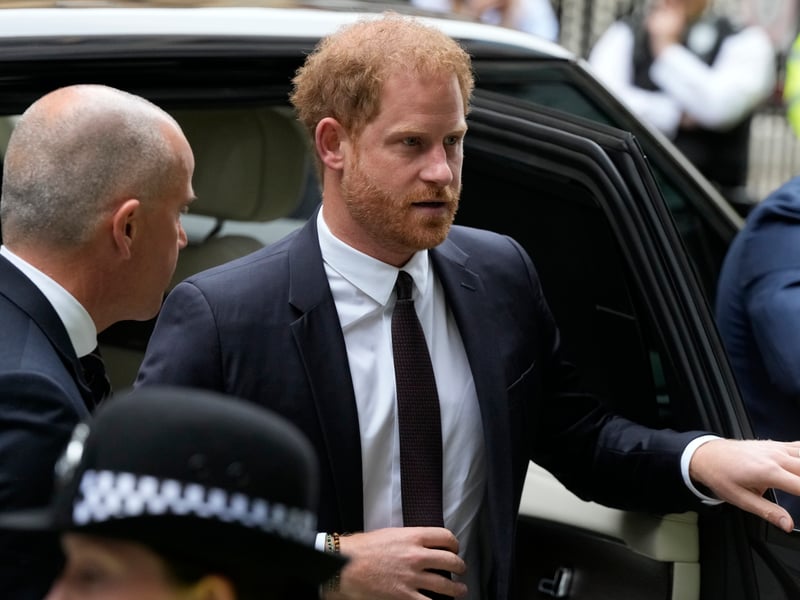
(CN) — Prince Harry has won a landmark court case against Mirror Group Newspapers, a major British tabloid publisher, in the culmination of high-profile proceedings relating to illegal information gathering and involving more than 100 other claimants.
The prince’s lawyer described Friday’s verdict as representing “a great day for truth as well as accountability,” after High Court judge Mr. Justice Fancourt accepted that 15 of the 33 newspaper articles presented to the court contained information that journalists obtained by illegally hacking the prince’s voicemail messages.
Harry has been awarded £144,060 in damages — over $182,000 and a good deal shy of the £440,000, or $558,000, he had been seeking — after the court found his phone was hacked “to a modest extent” between 2003 and 2009.
However, in a damning judgment on the Mirror’s wider journalistic practices at the time, the judge described “very extensive and habitual unlawful information gathering” as an “integral part of the system” at the newspaper.
Among other findings of the court, it was revealed that phone hacking at the newspaper started in 1996 and continued as late as 2011 — even during the public inquiry set up by the government to investigate the allegations.
In addition, the court also found that the practice had repeatedly been subject to a widespread cover-up, with information deliberately concealed from the publisher’s board of directors, from Parliament, from the relevant public inquiry, from shareholders, from the public, and even during a 2015 trial. The prince’s lawyer described the court’s ruling as exposing “systemic and appalling behavior followed by cover-ups.”
The Mirror Group, which publishes national tabloids including the Daily Mirror and the Sunday Mirror, said in a statement that “where historical wrongdoing took place, we apologize unreservedly, have taken full responsibility and paid appropriate compensation.”
The verdict may prove uncomfortable for some members of the British media establishment — in particular Piers Morgan, who was editor of the Daily Mirror between 1995 and 2004. Despite Morgan’s repeated denials that he had any knowledge of phone hacking, the judge found that there was “credible evidence” to support that Morgan was aware of, and involved in, the hacking of phones.
The case against Mirror Group Newspapers is the first of several the prince is pursuing, with cases against the publishers of the Daily Mail and The Sun also set to go to trial.
The prince’s relentless pursuit of the issue threatens to reopen the widespread British phone hacking scandal, a tabloid industry crisis which exploded into public view in 2011, and ended up implicating large parts of the British establishment including the police, the security services and members of the government.
Though phone hacking activities by tabloids had become public knowledge in the late 2000s, the scandal escalated considerably several years later after allegations emerged that journalists working for the News of the World had hacked the phone of murdered school girl Milly Dowler. The hacking was said to have given her family false hope that she was still alive, after journalists deleted voicemail messages on her phone during the period in which she was missing.
Journalists were also revealed to have hacked the phones of families of dead British soldiers, and victims of the 2005 London bombings, while the tabloid use of wiretaps and house bugging to obtain information was also exposed.
Public outrage over the revelations subsequently led to the closure of the News of the World, and widespread resignations among the management of News International, Rupert Murdoch’s U.K. media empire, which also owns major British newspapers The Sun, The Times, and The Sunday Times. Murdoch himself stood down as a director, as did his son James.
The scandal also had widespread ramifications for public institutions in Britain. Allegations emerged that London’s Metropolitan Police were complicit in the illegal information gathering, while then-Prime Minister David Cameron’s chief adviser Andy Coulson was forced to resign, having been implicated in the crisis as a former editor of the News of the World. Coulson was subsequently jailed over the scandal, an episode that severely undermined the former prime minster’s reputation.
The Leveson Inquiry, set up by the government to investigate the U.K.’s tabloid media culture, subsequently proposed a stricter form of press regulation which the government refused to implement. A second part of the inquiry, intended to investigate the relationship between the press and the police, was ultimately shelved by the government and the phone hacking scandal has gone relatively dormant ever since.
Still, for many of the victims of phone hacking, the issue remains unfinished business. A range of public figures and private citizens are among the 100-plus claimants taking the Mirror Group to court alongside Prince Harry. The success of their legal action is more than likely to open the door to countless other claims, and prompt a reevaluation of some of the statements made under oath by newspaper executives during the Leveson Inquiry.
A statement from campaign group Hacked Off, which represents victims of phone hacking and pushes for greater press regulation, said Friday’s ruling “paints the picture of a rotten corporate culture, desperate to escape accountability at all costs. This case serves as yet another reminder of the urgent need for effective and independent self-regulation of the press to protect the interests of ordinary people who are victims of wrongdoing by powerful and unaccountable newspaper groups.
“Other newspaper groups will also be looking over their shoulders, as this judgment shows that justice may yet catch up with them all.”
Subscribe to our free newsletters
Our weekly newsletter Closing Arguments offers the latest about ongoing trials, major litigation and rulings in courthouses around the U.S. and the world, while the monthly Under the Lights dishes the legal dirt from Hollywood, sports, Big Tech and the arts.