
 Search Articles


WASHINGTON (CN) — Conservative business owners appeared to come up short at the Supreme Court on Monday as they tried to convince the justices of a runaway task force with broad authority over preventative health care coverage.
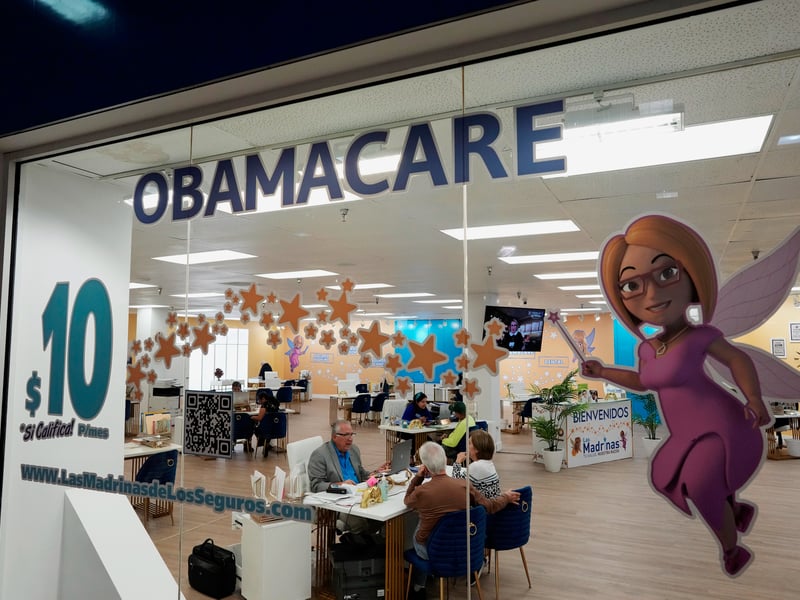
Under the Affordable Care Act’s preventive health care mandate, insurance companies must cover the full cost of certain services like cancer screenings, diabetes detection and HIV prevention drugs like pre-exposure prophylaxis, or PrEP.
Services are added to this list by the U.S. Preventive Services Task Force, an independent, nonpartisan panel comprised of 16 volunteer experts from various medical fields who undergo a rigorous vetting process. Members serve four-year terms but can be removed at any time.
The business owners argued that task force members operated as an independent agency without control from the political branches. However, the court seemed largely skeptical of their broad arguments.
“Your theory depends on treating the task force as this massively important agency that operates with unreviewable authority to make really critical decisions that are going to affect the economy,” Justice Brett Kavanaugh, a Donald Trump appointee, said.
Jonathan Mitchell, an attorney with Mitchell Law representing the business owners, simply responded, “It is.” Mitchell claimed that the board wielded more authority than the secretary of Health and Human Services or even the president on these recommendations.
“They are making recommendations that have a binding effect under another statute,” Mitchell said. “That’s quasi-legislative power.”
Mitchell said that task force members needed to be appointed by the president and confirmed by the Senate.
Led by conservative activist Steve Hotze’s firm, Braidwood Management, the businesses claimed that the task force was unconstitutional under the Appointments Clause. As CEO of Hotze Health & Wellness Center, an alternative wellness center run by Braidwood in Houston, Hotze joined a group of Christians and conservative businesses opposed to the task force’s recommendation to add PrEP to services provided with no out-of-pocket fees for private insurance plans.
Hotze refused to allow the company’s insurance plan to cover PrEP drugs because “these drugs facilitate behaviors such as homosexual sodomy, prostitution and intravenous drug use — all of which are contrary to Dr. Hotze’s sincere religious beliefs.” Hotze has promoted false medical claims, including about the Covid-19 vaccine. He opposes equal rights for gay and transgender people, whom he calls “homofascists.”
The business owners challenged the preventive care requirement under the Religious Freedom Restoration Act and the Appointments Clause. However, the constitutionality of the task force was the only question before the justices.
Mitchell argued that the task force was operating with too much independence from the political branches. Justice Amy Coney Barrett called Mitchell’s argument maximalist, noting that the board members could fulfill their role as independent experts while still answering to the secretary of Health and Human Services.
“Does independent even have to mean independent of the secretary?” Barrett asked.
Barrett related her question to her law clerks, stating that she could ask her clerks for their independent interpretation of a statute without considering any outside influences. Barrett said her clerks would still need to base that interpretation on the lens through which she sees the law, otherwise, their work would be unhelpful.
“They’re not independent of me or my instruction, even though I could say they were independent in a very real sense of the word,” Barrett said.
Mitchell argued that the task force was created as a purely advisory body, but now it was making binding recommendations without a head or director.
Justice Elena Kagan, a Barack Obama appointee, was incredulous that Congress would have set up a board and not said who should run it. She said taking a statute that doesn’t set up an independent agency and declaring it one was inconsistent with the court’s rulings.
“We don’t go around just creating independent agencies,” Kagan said. “More often, we destroy independent agencies.”
Chief Justice John Roberts, a George W. Bush appointee, questioned political appointees’ justification for overriding the experts’ determination. Justice Sonia Sotomayor, an Obama appointee, seemed to think that question was hypocritical.
“The chief asked a question about supervising technical advice,” Sotomayor said. “That might be true of even us. We’re given law clerks to help us on some of the things we don’t know anything about. That’s the nature of an agency, isn’t it, that they hire experts to help the decision-makers come to a conclusion?”
While the justices’ arguments centered on executive authority, their decision could ripple across the health care system. The U.S. is seeing decreases in HIV infections because of readily available access to PrEP, but cases could rise if those drugs are harder or more expensive to get.
Experts also worried that if insurance companies aren’t required to cover preventative care, out-of-pocket costs for millions of Americans could rise. One avenue for increased costs could come from tiered plans. If insurers aren’t required to cover preventive services, companies could force employees to pay more to access those services.
 Follow @KelseyReichmann
 Follow @kelseyreichmann.bsky.social
Subscribe to our free newsletters
Our weekly newsletter Closing Arguments offers the latest about ongoing trials, major litigation and rulings in courthouses around the U.S. and the world, while the monthly Under the Lights dishes the legal dirt from Hollywood, sports, Big Tech and the arts.