
 Search Articles


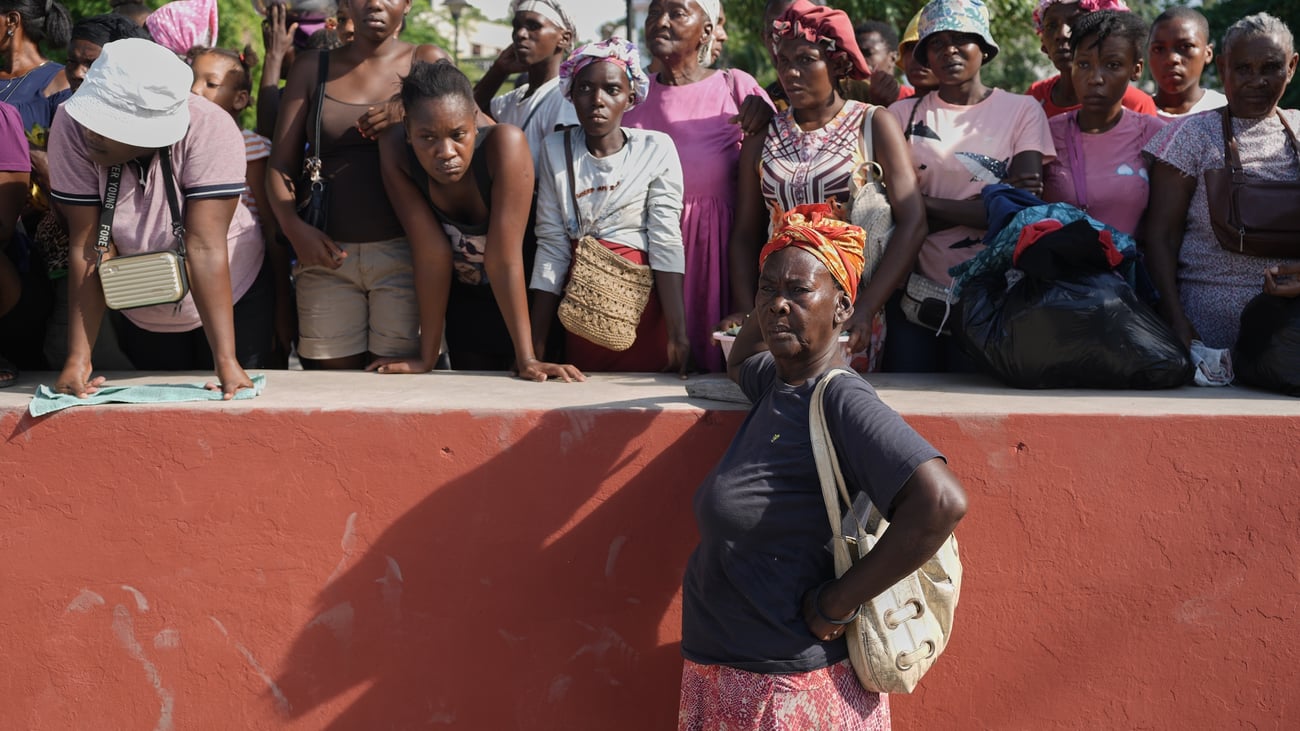
WASHINGTON (CN) — The Supreme Court’s tenuous relationship with presidential power will be on trial next week as the justices review President Donald Trump’s attempt to unilaterally strip protections from migrants legally living in the U.S.
Whether through immunity protections or shadow docket wins, Trump has benefited from the Roberts court’s decades long expansion of executive authority. But as the justices consider temporary protective status, or TPS, for Haitian and Syrian migrants, advocates say the White House should be held to the same standards as past administrations.
“Some of this is trying to force the court to really be apolitical and to treat this government the same way it’s treated prior governments,” Ahilan Arulanantham, an attorney with UCLA Law School’s Center for Immigration Law and Policy, told reporters. “I think if you apply the law in that sense, we have a very good argument.”
Representing Syrian TPS holders, Arulanantham says the executive branch constraints that tanked environmental initiatives and student loan forgiveness under former President Joe Biden should similarly constrain Trump here.
“At some basic level, we do have to force the court to really be neutral and treat the government the same way it would have treated this program if it were a Biden administration,” Arulanantham said.
Over a decade of protections to the wayside
Congress authorized the Secretary of Homeland Security to grant country-specific temporary relief to migrants who cannot return home due to armed conflict, natural disasters or other extraordinary conditions.
Once designated, eligible nationals already in the United States can apply for TPS, which shields them from deportation and provides work authorization.
Because the designations are temporary, the secretary regularly reviews them and may extend or revoke them based on conditions in each country. The cases before the court ask whether the Trump administration followed proper procedures in doing so for Syria and Haiti.
Syrian nationals received TPS in 2012 under Barack Obama amid a crackdown by then-President Bashar Assad. The designation was later extended due to the ongoing armed conflict and Assad’s rule.
In 2024, Assad was overthrown and fled to Russia, ending his family’s 53-year rule. Last September, former DHS Secretary Kristi Noem announced the termination of temporary protected status for Syrians. She argued Assad’s ouster and new diplomatic efforts meant Syria no longer qualified. The administration added that ongoing conflicts did not pose a serious threat to returning nationals, about 6,100 of whom hold protected status in the United States.
Haiti first received TPS in 2010 following a devastating earthquake and has since had its TPS extended due to ongoing instability. In January, the United Nations warned of a worsening crisis marked by escalating gang violence and a severe humanitarian situation. The country’s murder rate rose nearly 20% last year, and 5.7 million Haitians face food insecurity.
The State Department advises against travel to Haiti, citing risks of unrest, crime, health concerns, kidnapping and terrorism. For Level 4 travel risk countries like Haiti, the government recommends making contingency plans with family, designating a single point of contact in emergencies and leaving DNA samples and dental records in case identification is needed.
Over 350,000 migrants from the Caribbean island nation have TPS status in the U.S. Noem revoked their protections in 2025, based on her determination that there are no extraordinary conditions preventing Haitian nationals from safely returning to their country.
Lower courts blocked the TPS revocations for Haiti and Syria, prompting the Trump administration to file emergency appeals with the Supreme Court. The justices deferred a decision on the administration’s two emergency applications, keeping the migrants’ protected status in place.
Over before it started
A provision in the Immigration and Nationality Act says, “‘There is no judicial review of any determination of the [Secretary] with respect to the designation, or termination or extension of a designation, of a foreign state’ for TPS.”
The Trump administration argues that this is the end of the case, stating “‘no judicial review’ means no judicial review.” This insulation, the government argues, supports Congress’s respect for the executive’s foreign policy authority.
“Congress deliberately preserved executive branch discretion throughout — not only by codifying the secretary’s ‘discretion not to designate a country for TPS’ even if the statutory criteria are met, but by continuing to shield all TPS determinations from judicial review,” U.S. Solicitor General John Sauer wrote. “Here as elsewhere, Congress effectively insulated discretion-laden judgments from judicial review.”
But the TPS holders argue that Congress intended to constrain, not enshrine executive discretion by laying out specific criteria for the secretary to consider.
“Contrary to what the government suggests, the secretary does not ‘decide’ to extend or terminate a TPS designation,” the TPS holders wrote. “Rather, she ‘determine[s]’ whether the statutory conditions for designation continue to exist. If she determines that the conditions are satisfied, the designation is extended by operation of statute; if she determines that they are not, she must terminate the designation.”
TPS holders don’t quibble with the secretary’s authority to make that designation or whether it can be reviewed. The crux of their argument concerns the process for doing so. Attorneys for the migrants said DHS didn’t follow the statutory requirements for issuing a TPS designation, which is subject to judicial review.
Rules for all or just one
TPS holders argued that without strict procedural safeguards, the executive branch would have unchecked control over the immigration status of millions. They said the statute and common sense show Congress did not delegate such broad authority.
They urged the court to apply the major questions doctrine, citing its use in striking down the student loan forgiveness plan and the Clean Power Plan. They argued that the executive branch must be limited to explicit congressional authority not present here, citing Biden v. Nebraska and West Virginia v. EPA.
While the court has been reluctant to limit executive discretion in foreign affairs and national security, TPS holders said foreclosing all review of the administration’s actions here would break from precedent, citing the court’s 2022 ruling in Biden v. Texas.
Bigger picture
Congress ordered DHS to consult with other agencies when reviewing TPS designations. The Trump administration says it sought advice and information from the State Department before terminating the designations.
But the TPS holders say the consultations fell short of prior reviews. They said Haiti’s review consisted of a three-sentence email change between two staffers.
This kind of critique, the Trump administration said, was the reason such determinations shouldn’t be reviewable.
“Judicial micromanagement of the form and length of agencies’ input is especially inappropriate because courts are ‘generally not free to impose additional judge-made procedural requirements on agencies that Congress has not prescribed and the Constitution does not compel,’” Sauer wrote.
Noem determined that TPS for Haiti and Syria was “contrary to the national interest.” The administration said it could not reliably vet Syrians because there is no U.S. embassy in Syria, making an extension a public safety risk.
For Haiti, officials said TPS acted as a “pull factor” for illegal immigration. Noem also cited vetting concerns, noting the country lacks a functioning central authority to share law enforcement and security information.
TPS holders argued the terminations reflect broader immigration policy goals. Before returning to office, Trump made unfounded claims about Haitian migrants in Ohio eating dogs, called TPS a “little trick” and pledged to revoke Haiti’s TPS designation if reelected.
“Ending TPS is one more chapter in a long history of racially-motivated Trump administration attacks on vulnerable people,” Sejal Zota, co-founder and legal director at Just Futures Law, representing the Haitian TPS holders. “There is ample record of evidence that anti-black and anti-Haitian animus motivated the administration’s decision to terminate Haiti’s TPS designation. The most damning evidence: President Trump’s own words.”
In a day one executive order, Trump called for an overhaul of the nation’s immigration enforcement through a slew of administrative actions. As Noem began terminating TPS designations, she cited the order and claimed to be carrying out the president’s directive.
TPS holders said the administration has terminated the designation for every country that has come up for review, warning the justices against allowing the administration to effectively nullify the statute.
The Trump administration defended its determinations, stating that DHS followed the statutory procedures and conducted individualized reviews of each country’s designation.
“The president and the secretary ‘c[a]me into office with policy preferences and ideas,’ but the secretary adhered to the statutory process and ‘substantiate[d] the legal basis for a preferred policy,’” Sauer wrote. “That is ‘hardly improper.’”
The Supreme Court will hear oral arguments on Wednesday.
 Follow @KelseyReichmann
 Follow @kelseyreichmann.bsky.social
Subscribe to our free newsletters
Our weekly newsletter Closing Arguments offers the latest about ongoing trials, major litigation and rulings in courthouses around the U.S. and the world, while the monthly Under the Lights dishes the legal dirt from Hollywood, sports, Big Tech and the arts.
Additional Reads
 Investors ignore fog of Iran war as Fed meeting looms April 24, 2026
 Arizona sues to block ICE facility near chemical warehouse April 24, 2026
 California, other states sue feds over air quality April 24, 2026