
 Search Articles


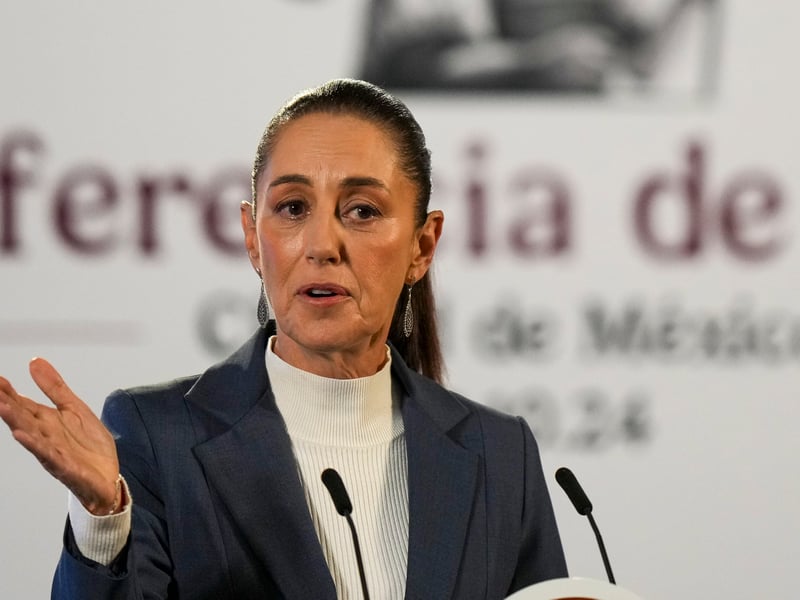
MEXICO CITY (CN) — In her first public speech on Oct. 1 as Mexico’s president, President Claudia Sheinbaum ran through a list of her 100 steps towards the fourth transformation of Mexico in front of thousands of her supporters in Mexico City’s Zòcalo. Those steps have taken a pressing turn following the gruesome murder of the newly elected mayor of Chilpancingo, the capital of Guerrero state.
The fourth transformation was former President Andrés Manuel López Obrador’s promise to transform the country after the first three transformations in Mexico’s modern history: the Mexican War of Independence, the Reform War and the Mexican Revolution. Sheinbaum has vowed to continue López Obrador’s fourth transformation and called her own administration the “second floor” of this transformation.
What her administration will look like got a head start on the night of Oct. 2, just a day after Sheinbaum took office, when the military attacked 33 migrants traveling in two vans in Chiapas, leaving six dead and 10 injured, an early hurdle for Sheinbaum that catapulted her militarization and migration policies — both largely informed by López Obrador’s presidency — to the forefront of her barely begun presidential term.
“On the first day of her presidency, Sheinbaum said we are not going to send the military against the people. We are not going to repress them. Then, [on her second night] as president, the military kills six migrants in Chiapas,” said Rodrigo Castro Cornejo, assistant professor of political science at the University of Massachusetts-Lowell and associate director of the UMass-Lowell Center for Public Opinion. “She is not going to change militarization. She will continue AMLO’s militarization strategies. He allowed the military more control, for one thing, because it affords them less constitutional checks.”
Sheinbaum said during an Oct. 4 press conference that investigations into the attack are ongoing.
López Obrador, commonly referred to as AMLO, was widely criticized by human rights organizations and the U.S. government for his administration’s human rights violations, specifically concerning Mexico’s armed forces and his unwillingness to aid in solving the case of 43 missing students from the Ayotzinapa Rural Teachers’ College.
On Sept. 25, in one of López Obrador’s final acts as president, his Morena party passed a reform that put Mexico’s National Guard under military command, giving more power to the military to perform everyday security tasks.
This act came in addition to López Obrador granting the military control of infrastructure projects such as the Tren Maya railway project and the new Felipe Ángeles International Airport, as well as the border and migration.
In the weeks leading up to her inauguration, the State Commission for Human Rights of Michoacán published a document prepared by the Ministry of National Defense, the Ministry of the Navy and the Secretariat of Security and Citizen Protection, outlining the Sheinbaum administration’s security priorities during her first 100 days as president.
The main objectives are to combat crime in the 10 largest areas of high-impact crime by strengthening Mexico’s National Intelligence Center and Executive Secretariat of the National System of Public Security and creating a new intelligence and police investigation unit.
Sheinbaum’s administration vowed to bring justice to those responsible for the gruesome murder of the mayor of Chilpancingo, Alejandro Arcos Catalan, who was beheaded on Sunday after just a week in office.
At least 41 political candidates were killed during the election cycle, including José Alfredo Cabrera, a mayoral candidate in Coyuca de Benítez, Guerrero, and Ricardo Arizmendi, a mayoral candidate in Cuautla, Morelos.
Even Sheinbaum was not spared by confrontation when her convoy was stopped in April at a checkpoint in Motozintla, Chiapas by men who delivered a strong message: “Remember these mountains, the poor people, when you’re in power.”
“She needs to figure out how she is going to exercise supervision and control over military and civilian agencies into a much more coordinated and strategic approach,” said Earl Anthony Wayne, a former U.S. ambassador to Mexico. “That relates to working with the U.S., which has been a point of tension between the governments. They need to get on the same broad line and then implement results, which is the most important. Rebuild confidence, work as a team to try and track down groups that work on both sides, which is not easy.”
During her inauguration speech, Sheinbaum called López Obrador the greatest president in Mexican history and said she will continue all of his social welfare programs, such as pensions for older adults, people with disabilities, public education scholarships and welfare programs for certain young people between 18 and 29. She also vowed to expand one of his programs by creating a new pension for women between the ages of 60 and 64, who will receive $150 bimonthly.
Sheinbaum applauded a controversial judicial reform passed at the end of López Obrador’s presidency, which will see all of Mexico’s judges elected by popular vote.
“The popular vote of judges and magistrates means more independence and autonomy for the judicial power,” she said during her speech.
Wayne thinks this can create a complex situation where judges may be influenced not only by organized crime but by other financial interests.
“We won’t know for a while how they’re going to figure out how to elect these judges. It’ll be at least two years and it’s already not the fastest system,” he said. “And once you have a record [of the judges’ decisions] it may be that the U.S. decides that the cases are not being handled fairly. Decisions by unqualified judges that don’t represent past practice could undermine investors.”
Another potential problem is if the judicial reform violates the United States–Mexico–Canada Agreement, which will be reviewed in 2026. Manufacturers go through the local Mexican courts, and if those courts aren’t fully independent, there could be a violation of the trade agreement.
Wayne said that the real issue within the Mexican judiciary though is impunity, and this reform doesn’t deal with that.
Sheinbaum, a former climate activist, will inherit López Obrador’s staunch supportive policies of Pemex, Mexico’s state-owned petroleum company, while trying to revamp the country’s energy sector and hoping to regain confidence from foreign investment, including the prospect of nearshoring.
“We are going to boost renewable energies. The goal is that by 2030, they will have a 45% share [of total electricity production],” Sheinbaum said in her speech in the Zócalo, straying from her predecessor.
López Obrador focused on propping up Mexican oil production sovereignty during his administration through megaprojects such as the construction of the Dos Bocas oil refinery in his home state of Tabasco, owned by PEMEX, which is, according to some estimates around $102 billion in debt.
Sheinbaum will also weigh the viability of adding a third nuclear reactor to the country’s only nuclear power plant. Sheinbaum, along with Energy Secretary Luz Elena González, are expected to explore the viability of the project, taking into consideration public perceptions of safety and the high cost.
Sheinbaum, the country’s first female president, quickly got to work, proposing on Oct. 3 a package of constitutional reforms guaranteeing wage equality, freedom from gender violence and gender parity in local and federal government cabinets.
“After 200 years of the Republic, for the first time, we women come to lead the destinies of our beautiful nation. And I say ‘we arrived’ because I do not arrive alone; we all arrived,” Sheinbaum said in her first message to the country on Oct. 1.
Subscribe to our free newsletters
Our weekly newsletter Closing Arguments offers the latest about ongoing trials, major litigation and rulings in courthouses around the U.S. and the world, while the monthly Under the Lights dishes the legal dirt from Hollywood, sports, Big Tech and the arts.