
 Search Articles


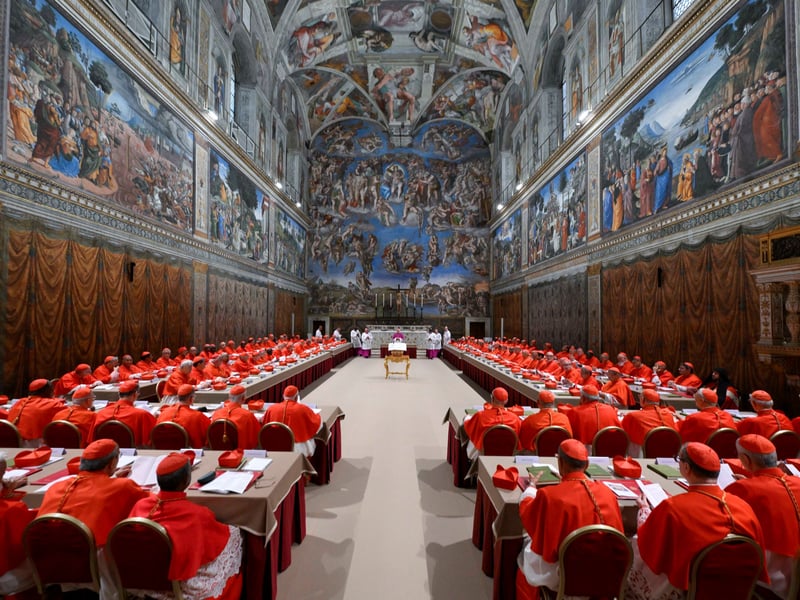
MARSEILLE, France (CN) — All eyes were on the Vatican during the second day of the papal conclave to see if white smoke would billow from the Sistine Chapel, signaling that 1.4 billion Catholics have a new leader.
But in a strikingly chaotic time for global politics — with extreme-right political groups garnering ever-more strength, longtime alliances breaking and a general feeling of uncertainty — this papal conclave will be especially critical for geopolitics.
“It’s undeniable that the selection of a new pope carries significant weight, not just for the Catholic Church and its global following, but also in the realm of international politics, particularly in Europe,” Craig Considine, a senior lecturer in the department of sociology at Rice University, told Courthouse News. “The moral and spiritual authority wielded by the pontiff can influence public opinion, social values and even diplomatic relations.”
In the days immediately preceding the conclave, which began Wednesday, global heads of state were at the center of discussion, both overtly and discreetly.
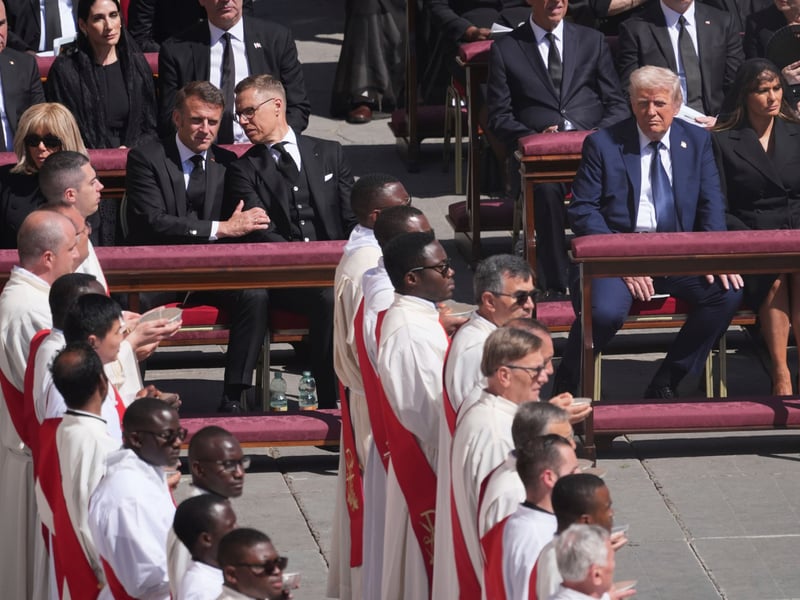
On April 29, after saying that he would choose himself as pope, U.S. President Donald Trump was asked who should replace Pope Francis, who died on April 21.
“I have no preference,” he said, adding “I must say, we have a cardinal that happens to be out of a place called New York who’s very good, so we’ll see what happens.”
An apparently AI-generated image of Trump as pope was then shared to the president’s Truth Social account, though he denied knowing its origins.
Meanwhile, French President Emmanuel Macron held lunch with four out of the five French cardinal electors including Jean-Marc Aveline, the archbishop of Marseille who is rumored to be a strong contender for the papacy and Macron’s personal choice.
“He’s someone who is a pied-noir of modest origins from Marseille, so that gives a certain working-class profile,” Thomas Tanase, expert on geopolitics of the papacy and former member of the research institute The French School of Rome, told Courthouse News. “He is someone who, to my knowledge, does not speak Italian, which can be a problem; and it’s interesting because it shows that he’s someone who didn’t program himself to make a career in Rome.”
The meetings sent the Italian media into a frenzy; the paper Il Tempo accused Macron of “interventionism worthy of a new Sun King,” in reference to Louis XIV and an apparent dig at the president, who is often criticized as embodying a modern monarch. Others said Macron was “seeking to choose the next pope,” which the French government officially denied.
Martin Dumont, the secretary general at the Research Institute for the Study of Religions, told Courthouse News that it’s important to keep in mind that the media is very intellectually close to Italian Prime Minister Giorgia Meloni, and didn’t publish the same articles about the interest she showed in certain Italian candidates.
If a candidate is suspected of being politically influenced, it’s considered a blow to their chances of being elected pope.
Experts aren’t convinced that Macron’s meetings were anything beyond diplomacy.
“In Macron’s case, what I observe is primarily a concern for continuity — a desire to reinsert France into the global religious conversation. We’re in a secular republic, but it is politically relevant for him to show that France is not disconnected from the spiritual and moral dynamics shaping global affairs, particularly those linked to the Catholic Church,” Jean Decorvet, a theology professor at Aix-Marseille University, told Courthouse News.
The rise of France’s extreme-right National Rally, led by Marine Le Pen and Jordan Bardella, two years ahead of the nation’s next presidential election could be playing a role in Macron’s thinking.
“It can certainly be advantageous for a head of state to see a pope who understands a country’s internal dynamics — in this case, those of France. But I wouldn’t interpret this as Macron seeking control over the Catholic Church. Rather, it appears to be an effort to position France — and himself — in alignment with the currents that matter on the world stage,” Decorvet said.
Regardless, there’s an ongoing interplay between national identity and the papacy, according to Considine.
“A French pope, for example, might be seen as bolstering France’s cultural and diplomatic sway in Europe and beyond,” he said. “Similarly, an Italian pope could be viewed by Meloni’s government as reinforcing Italy’s historical connection to the Holy See and potentially offering a figure who understands and prioritizes Italian perspectives within the church’s global mission.”
Historically, the influence of political powers on papal elections is a well-documented phenomenon, Considine said, which took various forms from direct pressure to lobbying. Although the more overt tactics have largely disappeared, states may try to subtly push for a choice that aligns with their national interests.
“Therefore, while the Holy Spirit is believed to guide the cardinals in their selection, it would be naive to entirely dismiss the potential for national interests and political considerations to play some role, however subtle, in the upcoming papal choice and its subsequent impact on Europe’s geopolitical landscape,” he said.
 Follow @lilyradz
Subscribe to our free newsletters
Our weekly newsletter Closing Arguments offers the latest about ongoing trials, major litigation and rulings in courthouses around the U.S. and the world, while the monthly Under the Lights dishes the legal dirt from Hollywood, sports, Big Tech and the arts.