
 Search Articles


BRUSSELS (CN) — While some celebrated openly, most European leaders put on a brave face for President Donald Trump’s return to the White House, stressing the need for good transatlantic ties — but subtly, some warned they would defend Europe’s economic interests.
As is usual with an incoming American president, European leaders widely congratulated the Republican and urged good relations.
Under the surface, however, there were also messages that could be perceived as a subtle warning.
“A lot is at stake for both sides, so our first priority will be to engage early, discuss common interests, and be ready to negotiate,” European Commission President Ursula von der Leyen said in a speech in Davos, Switzerland, on Tuesday, where she was attending the World Economic Forum. She didn’t mention Trump by name.
“We will be pragmatic, but we will always stand by our principles. To protect our interests and uphold our values — that is the European way,” she said.
Von der Leyen emphasized that no other economies in the world are as intertwined as America’s and Europe’s, with the trade volume accounting for 1.5 trillion euros ($1.56 trillion), representing 30% of global trade.
“While some in Europe may not like this new reality, we are ready to deal with it,” she added.
NATO Secretary-General Mark Rutte on Monday stressed that Trump’s return “will turbo-charge defense spending and production.”
Trump has repeatedly called on Europe to up its defense spending, and most recently pitched lifting the current NATO member target from 2% of GDP to 5%, a number not even Washington currently meets.
Only hours before Trump’s inauguration, French President Emmanuel Macron warned that European taxpayer money should be invested in homegrown weapons to boost the bloc’s own industry, not only to buy American weapons.
“When we say ’let’s spend more for our armies,’ in many countries it means, way too often, ‘buy more American materiel,’” Macron told top military brass in Paris.
The European Commission voiced “concerns” Tuesday about Trump’s decision to pull the U.S. out of the World Health Organization and with that potentially undermine the response to a future pandemic.
“If we want to be resilient to global health threats, we need to have global cooperation,” European Commission spokeswoman Eva Hrncirova told reporters in Brussels.
“We trust that the U.S. administration will consider all this ahead of the formal withdrawal,” she added.
Treading cautiously
On Tuesday, European diplomats in Brussels pointed toward the lack of remarks or specific measures Trump offered about Europe at his inauguration.
“It’s like waiting for the axe to fall,” one European diplomat quipped.
In the days prior, most EU officials and diplomats largely avoided sticking out their necks and commenting on Trump’s latest remarks — about buying Greenland, or threats to raise tariffs of up to 25% on European goods.
“No one wants to draw attention to themselves too early to give him room to focus on them,” one European diplomat told Courthouse News.
When EU ambassadors met on Jan. 9 for the first time this year in Brussels, Denmark did not bring up the issue of Trump’s comments about Greenland. They reportedly did not want to dive into lengthy discussions of “what if.”
Most EU diplomats also underlined that the bloc’s institutions were largely doing what they were supposed to do — namely, keeping the temperature and responses down as long as necessary.
European foreign ministers are expected to hold an EU-U.S. discussion when they meet for the first time this year on Monday, a week after the inauguration.
A key question is how much difference there will be between Trump’s rhetoric leading up to the inauguration and what he will do in office.
“Nevertheless, there is an understanding that Trump’s second term will be so much worse than the first one was,” a third EU diplomat said.
EU task force
A survey by AmCham EU, a body that represents American commercial interests in Europe, found that nine out of 10 companies expected the EU-U.S. trade and investment relationship to worsen.
Two-thirds of companies expected Trump’s new policies to have a negative impact on their operations in Europe.
The dedicated European Commission team around Ilze Juhansone, secretary-general of the EU executive, was installed last summer to determine the impact of the U.S. elections on EU policies and has primarily focused on potential trade measures.
EU member states, in parallel, had already started considering what bargains they could strike with the next resident of the White House.
European Commission officials have been looking into what Biden-era risk being reversed, such as sanctions imposed after Russia’s invasion of Ukraine.
Brussels insiders believe efforts will ramp up to organize an EU-U.S. summit, or at least ministerial-level Trade and Technology Council talks, to mitigate fallout.
Those talks originated as an attempt to repair transatlantic ties after Trump’s first term in office; the last edition raised doubts about whether the format would survive a second Trump term.
Trump’s allies celebrate
Meanwhile, Europe’s far right rejoiced.
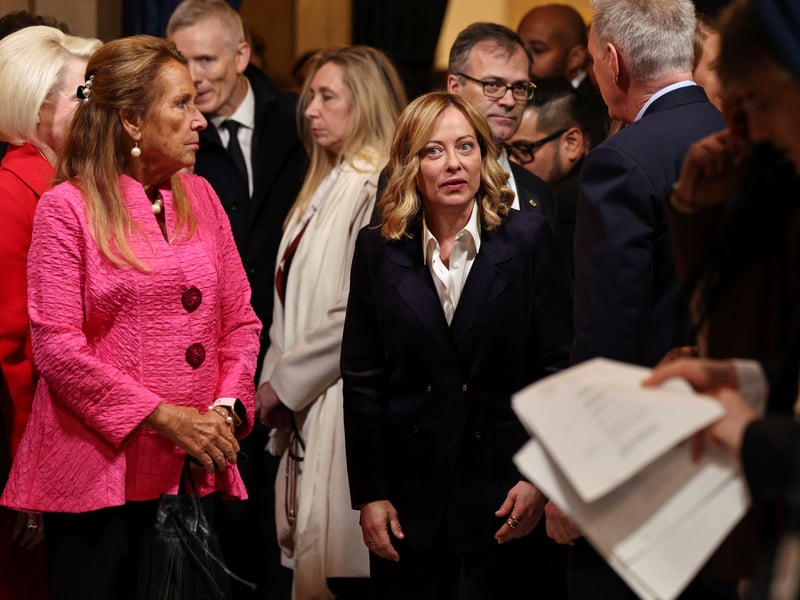
Italy’s Prime Minister Giorgia Meloni, the only EU leader invited to the inauguration, said Rome would “always be committed to consolidating the dialogue between the United States and Europe.”
Several other European far-right party leaders, including those from Belgium, Germany, Poland, Spain and France, were also in attendance.
Hungary’s Prime Minister Viktor Orbán, who is the most avid supporter of Trump in Europe, said the Republican’s return to the White House would trigger a right-wing surge in Europe
“Only a few hours and even the sun will shine differently in Brussels. A new president in the U.S., a large faction of patriots in Brussels, great enthusiasm,” Orbán said.
“The great attack can start. Hereby, I launch the second phase of the offensive that aims to occupy Brussels," he added.
Subscribe to our free newsletters
Our weekly newsletter Closing Arguments offers the latest about ongoing trials, major litigation and rulings in courthouses around the U.S. and the world, while the monthly Under the Lights dishes the legal dirt from Hollywood, sports, Big Tech and the arts.