
 Search Articles


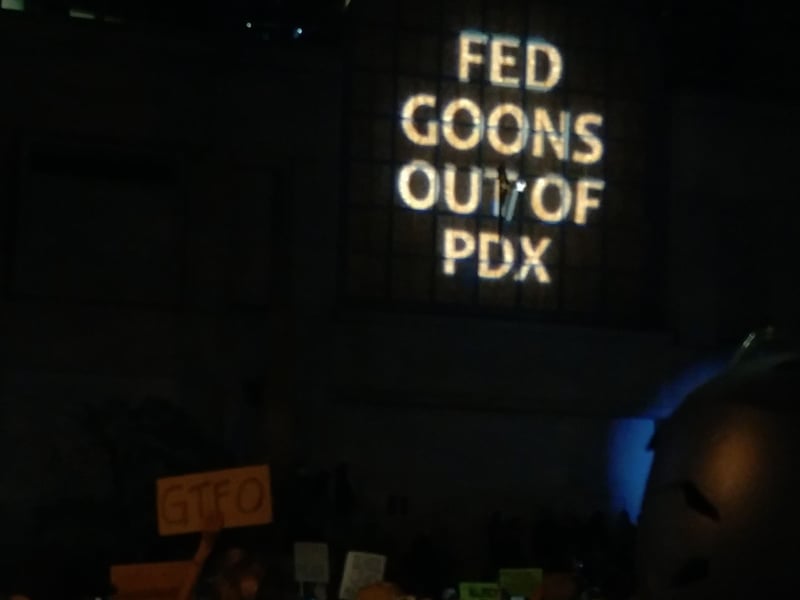
PORTLAND, Ore. (CN) — In a high-profile federal hearing on Friday, a Donald Trump-appointed judge balked at the Trump administration’s justification for deploying 200 Oregon National Guard members to Portland.
Both the state of Oregon and the city of Portland asked U.S. District Judge Karin Immergut for a temporary restraining order to block the deployment, arguing it infringes on state sovereignty and lacks sufficient legal justification under federal statutes.
The case, which emerged swiftly after a Sunday order from the Department of Defense, marks the latest legal battle over federal intervention in cities governed by Democratic administrations. The order in question, signed by Secretary of Defense Pete Hegseth, authorizes the deployment of National Guard troops to Portland to defend federal properties and personnel —specifically ICE facilities — amid what the administration describes as persistent threats of violence.
Attorneys for Oregon and Portland argue that the order unlawfully federalizes the National Guard under Title 10 and the Insurrection Act, statutes that require a high threshold for federal intervention. They claim that threshold has not been met and that the order is based on outdated and unrelated events, including protests in Los Angeles earlier in the summer.
“Regardless of the level of specificity required, it cannot be satisfied here,” said Scott Kennedy, lead counsel for the state from the Oregon Department of Justice.
At the center of the legal debate is whether the situation in Portland qualifies as a “danger of rebellion,” one of the few triggers that would permit federalization under the Insurrection Act. Immergut repeatedly returned to this language during the nearly two-hour hearing.
“Is there even a danger of rebellion?” the judge asked pointedly, expressing skepticism. She questioned whether the federal government’s reliance on general unrest and sporadic incidents met the burden imposed by law.
Immergut was also skeptical of social media posts by Trump that were cited as justification by the defense. One such post on Truth Social claimed Secretary of Homeland Security Kristi Noem had requested assistance in Portland and that the president had ordered the deployment in response.
“Really, a social media post is going to count as a presidential determination that you can send the National Guard to cities?” the judge asked. The defense responded that the posts reflected prior deliberations between Trump and Hegseth.
Caroline Turco, representing the city of Portland, challenged the factual basis of the deployment and pointed to documented reports from Portland police leaders that consistently described the protest activity outside the ICE facility as “mild.” In some cases, officers were even sent home due to the lack of significant unrest, she noted. The most serious reported incident, according to court documents, was resolved in less than three hours.
“The president’s perception of what is happening in Portland is not the reality on the ground,” Turco said. She emphasized that invoking federal troops would likely escalate tensions and referenced the city’s prior experience in 2020, when federal deployments during Black Lives Matter protests resulted in widespread unrest.
“It’s a big country,” Kennedy said, “and there will always be unrest or unfortunate incidents that can be pointed to somewhere.” But pointing to unrest in other jurisdictions — such as a recent shooting at an ICE facility in Dallas — does not justify deploying troops in Portland, he argued.
The federal government, represented by Department of Justice attorney Eric Hamilton, maintained that intervention was justified due to what they described as ongoing threats to federal property and personnel. They cited recent confrontations involving masked individuals at the Portland ICE facility and incidents where demonstrators blocked vehicles and used flashlights to blind drivers.
Hamilton argued that the Federal Protective Service has been stretched beyond its limits and that law enforcement agencies are working 12-hour shifts to manage the threat. “The threat has been pushed beyond its breaking point,” he said. “There’s been a monthlong targeting of the Portland ICE building.”
Still, Immergut appeared unconvinced that the factual record supported federal claims of a sustained or unmanageable threat. “Is it your suggestion that any time a law enforcement agency needs additional reinforcement, that is enough to demonstrate that the National Guard can be called out?” she asked.
A key theme throughout the hearing was the balance of federal power and state sovereignty. Oregon’s attorneys argued that allowing such deployments without a clear statutory basis would effectively grant the president unlimited authority to deploy federal troops within states. “Almost any form of ordinary protest or criminal activity could be classified as rebellion under this reasoning,” Kennedy argued.
“This case represents one of most dramatic infringements on state sovereignty in Oregon’s history,” said Kennedy. He emphasized that the city has seen “dwindling, relatively small protests” over the summer and that law enforcement has managed any unrest effectively.
Immergut, who stepped in after U.S. District Judge Michael Simon recusedhimself due to a potential conflict of interest, said she would review the extensive record and aimed to issue a ruling by the end of the day or by tomorrow at the latest.
“This matter is of great importance to many people,” she said, acknowledging the complex constitutional and factual questions at play.
Whether the court grants the restraining order may have implications well beyond Portland, potentially setting a precedent for how the federal government justifies military intervention in states without their consent.
Subscribe to our free newsletters
Our weekly newsletter Closing Arguments offers the latest about ongoing trials, major litigation and rulings in courthouses around the U.S. and the world, while the monthly Under the Lights dishes the legal dirt from Hollywood, sports, Big Tech and the arts.