
 Search Articles


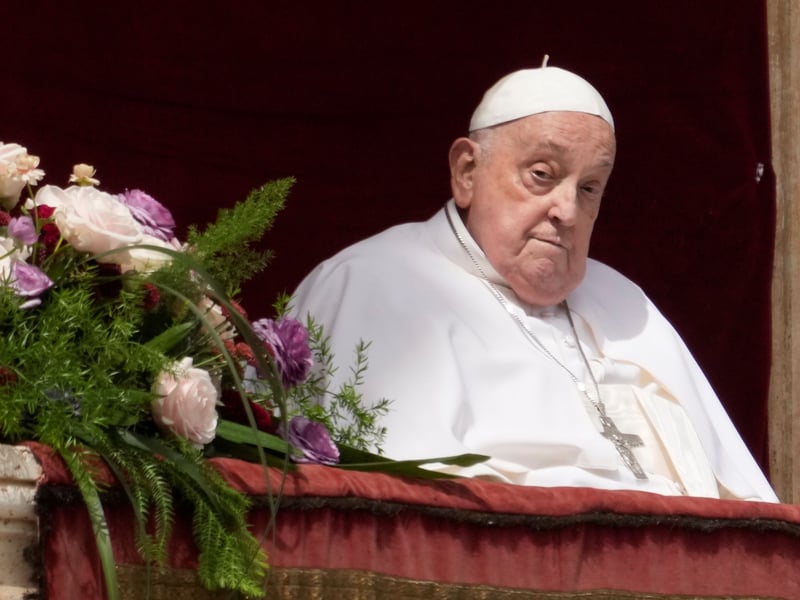
PALERMO, Sicily (CN) — Pope Francis, the groundbreaking Roman Catholic Church leader praised around the world as a humble and charismatic progressive leader, died on Easter Monday at age 88.
Francis died at 7:35 a.m. at his residence in the Vatican’s Casa Santa Marta following a bout of illness and extended hospital stay caused by double pneumonia. He suffered respiratory problems for most of his life after a serious lung infection as a young man that caused part of his lung to be removed.
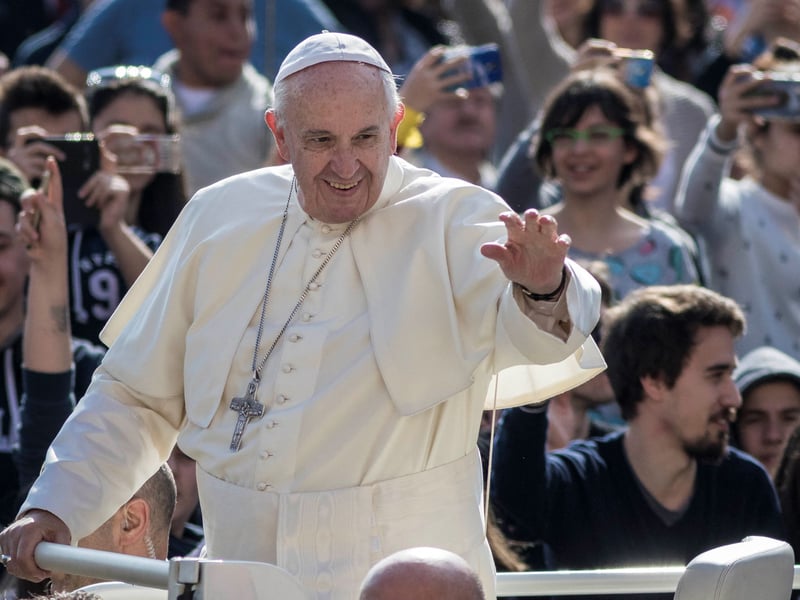
Although frail, he returned to public life over the past week and on Easter Sunday appeared on the balcony of St. Peter’s Basilica. He then boarded the popemobile and greeted the crowds in St. Peter’s Square for the first time since his hospitalization in February. During the day, he also met with U.S. Vice President JD Vance.
His death left millions of Catholics around the world in mourning and tributes to the 266th pontiff poured in.
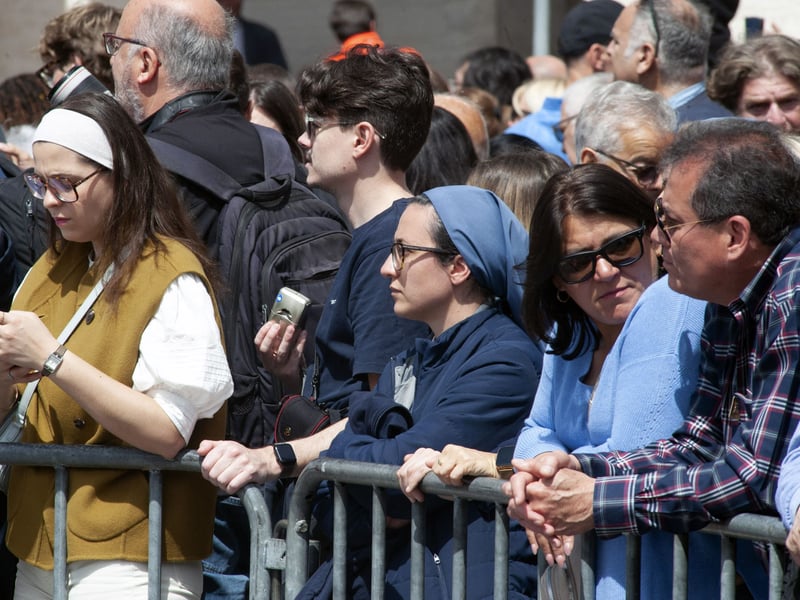
In Buenos Aires, the pope’s native city, Julián Cidanes was among throngs of people paying tribute to Francis at the city’s Metropolitan Cathedral.
Cidanes, a 25-year-old psychology student, described Francis as “a revolutionary figure within church doctrine” who pushed for progressive ideas.
“He had his detractors and his followers, but I think he was more loved than not — especially in Argentina,” he said, speaking to Courthouse News.
He hoped the next pope would find a way to reach younger generations. “Today, many young people are drifting away from faith. If Francis couldn’t quite do it, maybe the next pope can.”
Around the world, leaders lavished praise on Francis.
“The fact he’s leaving on Easter Monday, it’s like he wanted to do his duty until the very end,” said Italian Prime Minister Giorgia Meloni, speaking to RAI, the Italian broadcaster.
“Rest in Peace Pope Francis! May God Bless him and all who loved him!” U.S. President Donald Trump said on social media.
“He was unlike any who came before him,” said former U.S. President Joe Biden. “For decades, he served the most vulnerable across Argentina and his mission of serving the poor never ceased. As Pope, he was a loving pastor and challenging teacher who reached out to different faiths. He commanded us to fight for peace and protect our planet from a climate crisis. He advocated for the voiceless and powerless.”
Now begins the secretive Vatican process of selecting his successor, the conclave, which will once again bring to the surface fierce debates over the direction of the Catholic church as traditionalists and progressives clash.
He was born Jorge Mario Bergoglio on Dec. 17, 1936, in Buenos Aires, Argentina, and in 2013 he became the first pontiff from Latin America and also the first Jesuit pope. He chose the name Francis in honor of Saint Francis of Assisi, patron saint of nature and the poor.
His papacy was marked by his desire to reform the church from within to make it more inclusive and progressive. He spoke about the need to provide legal protections for gay couples and opened debate about letting women take on ordained roles.
Bergoglio entered the Society of Jesus in 1958 and was ordained as a priest in 1969. He dedicated himself to the poorest parishes in Buenos Aires before becoming the city’s archbishop in 1998. He was made a cardinal in 2001.
Due to his commitment to social justice, grounding in Jesuit teachings and affection for people, he became known as the “people’s pope” as he waded into crowds, hugged children, kissed old women and talked about the need to care for the less fortunate.
“He loves the company of people,” said the Rev. Thomas Massaro, a Jesuit priest, professor of religion at Fordham University and author of two books about Francis.
Upon becoming pope, he chose not to live in the papal palace and instead took up residence in the Casa Santa Marta, the Vatican’s guesthouse, a move that reflected his Jesuit worldview which values community and modesty.
“He wanted to eat meals with other people, he wanted to press the flesh,” Massaro said, speaking by telephone. “From the minute you enter the Jesuits, you live with other people. You have meals with other people. You have a Mass every day together, the whole community, dozens of people. And the idea of living alone is very antithetical.”
In Buenos Aires, he was renowned for taking to the streets and mingling with people of all walks of life.
“You’ve heard stories of him going into people’s homes unannounced,” Massaro said. “He would ride the subway, walk among people. He didn’t have servants. He cooked his own meals. So, a ‘people’s pope,’ I think that’s a very good phrase.”
Chris Lowney, the author of “Pope Francis: Why He Leads The Way He Leads,” said Francis’ main goal was to decentralize the church’s structures and include more voices.
“Clearly, his vision has been that we need to be a church where decisions and direction does not just happen top down from a small group of cardinals, or even from the pope itself,” he said, speaking by telephone. “But where at every level of the church, we’re bringing around the table a very representative community of those who are the church, in this parish, in the city and across the world.”
As part of this effort, Massaro said Francis appointed cardinals in numerous nations that had never had cardinals before, including Mongolia, Central African Republic, Bangladesh, Mauritius Island, Papua New Guinea, Malaysia, Lesotho and Albania.
“He wants the church to be a world church,” Massaro said. “He just wants the church to be broad-based, not dominated by the center.”
Massaro said Francis wanted the periphery of the Catholic world — long dominated by Europe and North America — to be better represented.
“He said when he was elected: ‘You reached to the end of the world to bring me to Rome and here I am,’” Massaro said. “So, he likes the idea of those periphery countries that never had a say before.”
Over the 12 years of his Vatican reign, he also appointed about 79% of the 139 cardinals who now will convene in the Sistine Chapel of the Vatican and pick his successor.
Francis was viewed as a moral leader on the world stage who spoke out clearly about the most pressing issues facing humanity and the planet.
In speeches, conferences and papal letters, known as encyclicals, he criticized growing economic inequality, urged world leaders to tackle climate change, demanded refugees be taken care of, supported labor unions and community organizers, praised the importance of the family but also urged priests to embrace divorcees, made pleas for peace and called for an end to the arms trade.
Massaro said he would be chiefly remembered for his environmentalism, which included openly scolding the oil industry and the United States for failing to live up to carbon emission reductions, and for his concern for the plight of refugees.
He was “very strong on environmental leadership,” Massaro said, referring to a lengthy document Francis wrote in 2015 about the environment.
“It goes without saying that he’s known worldwide as an advocate for the rights of refugees and that will continue,” Massaro said.
In 2013, shortly after becoming pope, Francis visited Lampedusa, a Sicilian island off the coast of North Africa that has become a symbol of the plight of refugees. Every year, scores of asylum-seekers try to make it to Lampedusa on unseaworthy vessels in a bid to reach Europe, but the crossing has become one of the deadliest spots in the world for migrants.
“Whoever is the next pope cannot take away from that,” Massaro said. “It’s just so closely tied to everything in the Bible, things that Jesus said. And of course, it’s against the tide of xenophobia that we see in places like Hungary and, I would say, the United States now too.”
His death marks a huge loss of moral leadership on the global stage, Massaro said.
“He leaves a huge hole in moral leadership, especially for refugees and for peace and for the environment,” he said.
Massaro said one of the biggest tasks facing Francis was the church’s child sex abuse scandals. He said he was elected in part because he was “perceived as an outsider” with few ties inside the Vatican.
The idea was that “he would have the outsider perspective to be very strict on adopting new rules for preventing clergy sexual abuse and also for punishing the perpetrators,” Massaro said.
“It was harder than he suspected,” Massaro said. “He made progress, but it was very gradual.”
By 2020, Francis began issuing edicts to grapple with sex abuse within the church and created a system for reporting and handling perpetrators, Massaro said.
“All of these rules are in place now,” he said. “The next question is: Are we administering them or implementing them exactly?”
Fundamentally, Francis should be viewed as a leader who wanted to make sure the church was focused on the needs of the poor and marginalized, Lowney said.
“He has somehow managed to disappoint both progressives and traditionalists,” he said. “Progressives because he didn’t go far enough on women’s ordination and so on. Traditionalists, because he went too far in opening blessings for same-sex couples and so on.”
But he questioned evaluating his legacy in such terms.
“We just read him through the wrong lens of our ideological bias,” he said. “His whole vision, ministry, mission, purpose, whatever words you want to use, was to kind of resurrect and emphasize the idea that in the Gospels, Jesus talks about feeding the hungry, clothing the naked, and so on. And to me, that really is the key to understanding what he was about.”
Courthouse News reporter Cain Burdeau is based in the European Union.
Lucía Cholakian Herrera contributed to this report from Buenos Aires, Argentina.
 Follow @cainburdeau
Subscribe to our free newsletters
Our weekly newsletter Closing Arguments offers the latest about ongoing trials, major litigation and rulings in courthouses around the U.S. and the world, while the monthly Under the Lights dishes the legal dirt from Hollywood, sports, Big Tech and the arts.