
 Search Articles



PARIS (CN) — During France’s presidential elections, voting occurs in two rounds, where the two leading candidates participate in a final runoff. And as the saying goes: During the first round, people vote with their hearts; in the second round, they vote with their heads.
France’s municipal elections are said to mirror a similar principle. If that’s the case, the first round of voting Sunday showed a growing number of people would favor the far-left France Unbowed and the extreme-right National Rally as their top choices in the looming 2027 presidential election.
“These forces, which had no influence at all on French political life just 20 or 25 years ago, are now, taken together, truly almost a majority or very close to it,” Gilbert Casasus, a prominent political scientist, explained. “In other words, there is a new state of affairs, a new reality in French political life — roughly speaking, the National Rally plus France Unbowed account for 50% of the vote.”
In Paris, Socialist candidate Emmanuel Grégoire led in the first round with 37.98% of the vote Sunday. However, this is far from decisive; right-wing candidate Rachida Dati took 25.46% of the vote but will likely benefit from Sarah Knafo, the extreme-right candidate, dropping out of the race and leaving roughly 10% up for grabs.
Sophia Chikirou from France Unbowed took 11.72% of the vote and will stay in the race, which will complicate a win for Grégoire. The second and final round of voting for municipal elections takes place this coming Sunday, where — unlike the presidential elections — more than two candidates can run if they obtain over 10% of the vote in the first.
“Ms. Chikirou is staying in the race at the risk of causing a loss,” Pierre Allorant, historian and political scientist at the University of Orléans, explained. “[During] the debate [on Wednesday], she was very virulent, very aggressive toward Emmanuel Grégoire… So, there is a risk of making the left lose and letting Ms. Dati win.”
Marseille, France’s second-largest city, is also being watched closely. There, incumbent Mayor Benoît Payan is leading with 36.70% just ahead of the National Rally’s Franck Allisio (35.02%). France Unbowed also took roughly 10%, but its candidate bowed out to curb Allisio’s chances of winning.
“There was a surge in the municipal elections, which is quite new, from the two extremes — the National Rally and France Unbowed — whereas just a few years ago, they weren’t interested in them,” Allorant said.
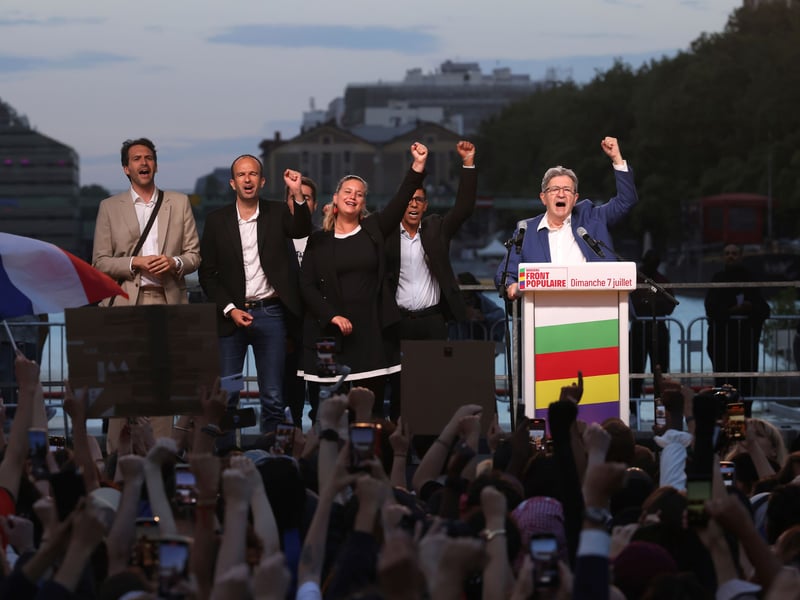
France Unbowed’s turnout was more surprising, even though its numbers may not seem strikingly high. In recent years, the party has become somewhat ostracized; its leader, Jean-Luc Mélenchon, was widely criticized for his reaction to Hamas’ Oct. 7, 2023, attack on Israel.
Casasus was surprised by a “breakthrough” of the party, especially in cities and certain suburbs.
“If you will, it is the expression of a radicalization of a certain segment of the left that poses a great deal of problems,” he said. “While the numerical balance of power is certainly in favor of the Socialist Party, the political balance of power favors France Unbowed.”
France’s municipal elections are viewed as a way to check the pulse of its political landscape. Sunday’s vote has experts predicting that in 2027, there could likely be a presidential runoff between the two extremes — Jordan Bardella from the National Rally, and Mélenchon from the left.
“Today, there is a scenario that is no longer being ruled out at all — a second-round runoff between Bardella and Mélenchon, and in that case, Bardella would obviously win,” Casasus said. “In other words, the strategic weaknesses of the traditional governing parties — were evident last Sunday and is likely to be evident again next Sunday.”
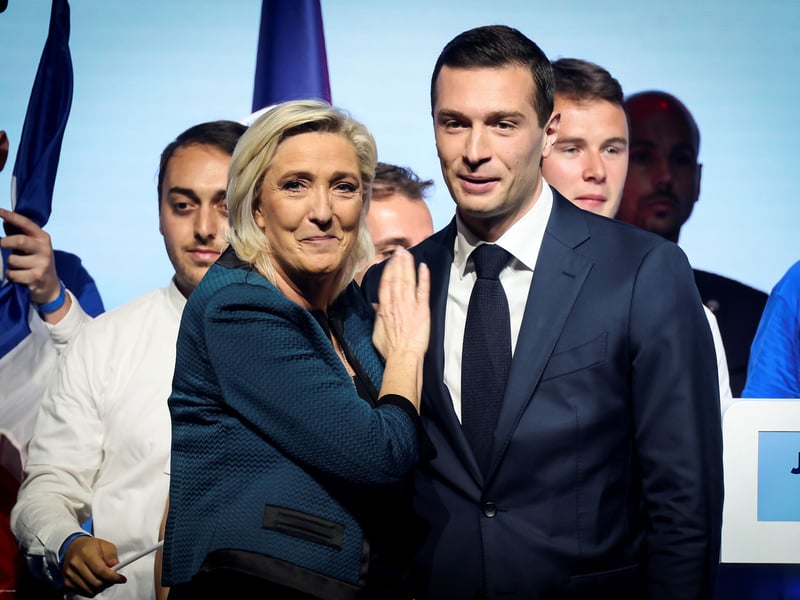
Out of 3,290 voting districts, Macron’s Renaissance party led the race in just seven. Centrist candidates who aren’t members of any major party arrived first in roughly 500 districts.
Casasus believes people are challenging France’s current political foundations because there’s a “weak president at the end of his term” and a “completely fractured Parliament” with no clear majority.
“So there’s a kind of institutional decay that is reflected in, or finds its extension in, a partisan and political breakdown,” he said. “So we’re choosing a path of radicalization instead, whether it be on the right or the left, believing — wrongly, in my opinion, though that is a normative question — that through radicalization, France could find a way out.”
Maxime Lefebvre, a diplomat and professor at the ESCP Business School in Paris, said the situation is pretty “ambiguous” so far and the results will depend heavily on the “local context” of cities. However, he wouldn’t be cautious about taking the municipal results as a forecaster of the presidential elections.
“Of course, it’s a kind of anticipation for the presidential election because it shows the strengths of each party, the alliances, etc.,” he said. “But I would say that things remain quite open for next year.”
 Follow @lilyradz
Subscribe to our free newsletters
Our weekly newsletter Closing Arguments offers the latest about ongoing trials, major litigation and rulings in courthouses around the U.S. and the world, while the monthly Under the Lights dishes the legal dirt from Hollywood, sports, Big Tech and the arts.