
 Search Articles


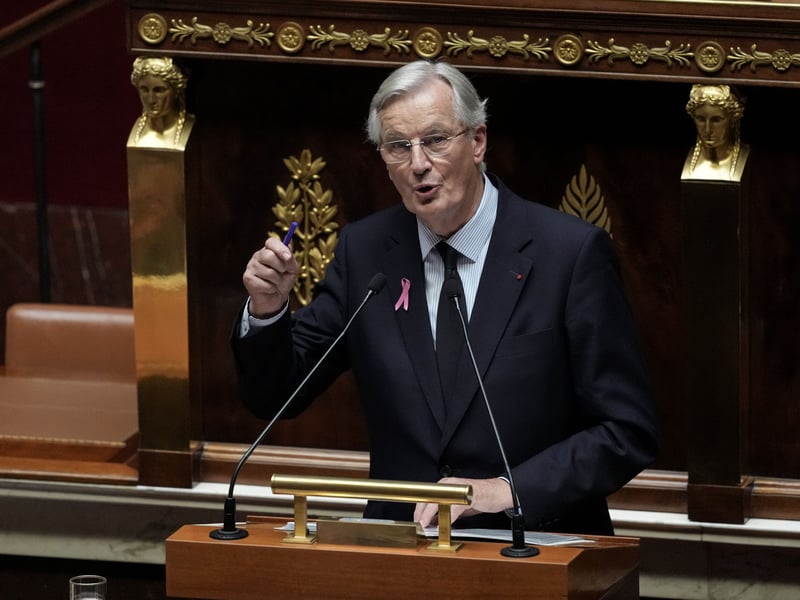
MARSEILLE, France (CN) — Prime minister Michel Barnier is finally rolling out France’s much-anticipated 2025 budget. So far, only a few things seem clear: The country is publicly acknowledging its severe economic deficit, no political group is happy with the budget and the prime minister will most likely force it into action anyway.
“Deep down there are major political protests, but everyone knows that we still need to deal with a major budgetary problem,” Luc Rouban, a senior research fellow at Sciences Po Paris, told Courthouse News. “He’s doing the dirty work for everyone.”
France’s debt is over €3.2 trillion, which is equivalent to over 110% of its GDP. The immediate goal is to reduce the country’s deficit to 5% by 2025, and drop it under 3% by 2029.
The new budget proposes €60 billion in savings; €40 billion would come from budget cuts, and €20 billion from temporary tax hikes.
Olivier Costa, a director at France’s National Center of Scientific Research (CNRS), told Courthouse News that economic deficits and budget constraints are often a subject of political taboo in France. Acknowledging the severity of the situation is already a big deal. And, the urgency in passing the budget is perhaps the only thing that parties across the spectrum can agree on, which should play into Barnier’s favor.
Beyond that, political groups haven’t agreed on much else.
The billions in budget cuts will largely take from social services including health care, pensions and the unemployment system. In an already strained education sector, over 4,000 teachers are expected to lose their jobs, though this will be somewhat offset by the hiring of 2,000 professionals that will support students with learning disabilities. The left’s platform hinges on boosting social services.
The bill proposes eliminating caps on electricity and gas bills, which were put into place during Europe’s energy crisis throughout 2020-2022.

The centrists have also been vocal against the new plan. When Emmanuel Macron became president in 2017, his political doctrine was anchored in reducing taxes to stimulate the economy and encourage small businesses to prosper. Barnier’s €20 billion signifies the symbolic end of an era.
“There have been many tax reductions decided by Emmanuel Macron for a number of years — like the abolition of housing tax, which caused a lot of trouble for large municipalities, because there was much less tax revenue so they depended more on state aid,” Rouban explained. “You had a lot of tax cuts, and we’re going back on these policies, so the problem is that it’s the end of Macronism.”
Under the new scheme, companies making between €1 and €3 billion per year would be taxed at 30%. Profits above that number would be hit with 36% tax rate, though these would be gradually reduced in the years following 2025. Individual households would also be affected: Any single person bringing in €250,000 per year — or couple at €500,000 — will face temporary hikes. This represents roughly 0.3% of taxpayers.
The left argues these taxes should be increased to offset the public spending cuts. The right argues they’re too high.
“On the right side, the government is very uncomfortable with the idea of taxing the rich, obviously, of taxing companies, or of reintroducing something that would be like the wealth tax,” Costa said. “The far right is very concerned particularly about the interests of retirees with the idea that we should not reduce retirees’ pensions.”
“So if we make a sort of table by looking at who agrees with what, it’s obvious that there is no majority in this matter,” Costa continued.
Barnier’s budget outlines plans to push back a scheduled pension increase from January to July 25, a point of contention for the extreme-right National Rally camp, led by Marine Le Pen and her protégée Jordan Bardella. The increase was derived to offset the effects of inflation.
Though no one is in agreement about the budget, it is likely to pass. Barnier is expected to invoke the French constitution’s controversial Article 49.3, which allows the prime minister to pass legislation without a parliamentary vote. This was the procedure used in the 2023 pension reforms that sparked nationwide protests. But experts argue that this time, it shouldn’t be a big issue — everyone knows that the budget needs to be addressed, and fast.
“Nobody will be satisfied, but I think that there will be no censure of the government,” Costa said. “The left will pretend to bring down the government, the far right will pretend to be in opposition, and Barnier will pretend to discuss with Parliament. … There will be parliamentary debates, but it is very clear that the text is already written and that it will not take into consideration the opinions of one and all.”
Barnier, as modern France’s oldest prime minister at 73, is not expected to run for president in the upcoming 2027 elections. Rouban argues that this makes him someone favorable to other political parties as a non-threatening force navigating through endless constraints. He’s taking on the job that no one else wants, and in some ways this is helpful, so they don’t have to admit it.
 Follow @lilyradz
Subscribe to our free newsletters
Our weekly newsletter Closing Arguments offers the latest about ongoing trials, major litigation and rulings in courthouses around the U.S. and the world, while the monthly Under the Lights dishes the legal dirt from Hollywood, sports, Big Tech and the arts.