
 Search Articles


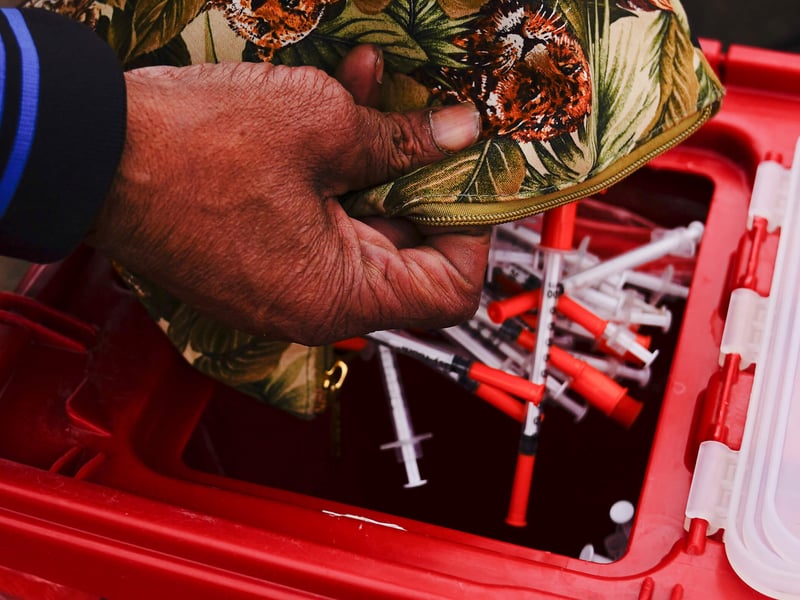
PHOENIX (CN) — The city of Phoenix on Wednesday passed two public safety ordinances that health care providers say will only erode public health and criminalize both homelessness and health care.
Against the adamant opposition of council member Anna Hernandez, seven council members and Mayor Kate Gallego voted Wednesday to restrict medical treatment in public parks and prohibit the distribution of harm reduction kits intended for safer drug use. They also voted to codify a public park “code of conduct,” first written in 2021, that prohibits behaviors at parks, including bathing in public hydrants, fountains or sinks, and obstructing another’s use of a park and its amenities. Violation of either would result in a class 1 misdemeanor.
Council members, including Republican Jim Waring, say the two ordinances will crack down on drug use and violence and make the parks safer for the whole community. But dozens of citizens who spoke at Wednesday’s meeting, including lawyers, EMTs, public health researchers and community volunteers, say they will prevent vulnerable people from receiving necessary care and enable police to harass and target the city’s homeless population.
The “Safe Medical Care” ordinance also prohibits community syringe exchange programs, despite overwhelming evidence that they reduce the transmission of infectious diseases without increasing crime in the area.
After hours of public testimony in opposition, council member Laura Pastor offered a compromise to the medical community: The ordinance will not take effect until March 30, and in the meantime, city staff will work with community groups and medical professionals to “improve the language.”
Hernandez remained unconvinced that effective changes could be made without risking the safety of those who rely on public medical services.
“We are completely doing this process backwards,” she said as she cast the sole no vote. “I have to take a vote on an empty piece of paper with zero guarantees that we will save lives.
“People will die if we pass this ordinance,” she added. “This is an immoral ordinance, I fully reject this ordinance, and I vote vehemently no.”
As he cast his vote in support of the code of conduct ordinance, Waring said he’s tired of citizens feeling too scared to go to city parks because of rampant drug use.
“We’re letting 7,000 people dictate how the rest of the 1.6 million of us are gonna live,” he said, referring to the city’s estimated homeless population. “You know what people don’t wanna do when they encounter a dead body? Go back to that place again.”
He complained that at least 14 bodies were found in city parks last year.
“I guarantee you there will be more dead bodies in the park with this ordinance,” said William Ellert, chief medical officer for the nonprofit Circle the City.
Circle the City runs 10 outreach teams across Phoenix that meet with people in parks to provide a variety of medical care, including testing for HIV and other diseases and distribution of safety items like clean syringes, fentanyl test strips and alcohol wipes. Other volunteers with Circle the City said they fear that the medical care ordinance won’t discourage drug use, but will only remove access to reliable health care and increase the spread of disease.
Only one public speaker supported the ordinance. Phoenix resident Juliane Summer, like Waring, complained that allowing people to use drugs in public parks reduces the quality of life for the rest of the community. She said she’s seen drug deals right outside her window.
“We’re trying to get our children and our neighbors involved in our parks, and the use of drugs is not helping,” she said.
Drug use is already prohibited in all public places in Phoenix. Nonprofits like Circle the City practice medicine in parks only because homeless populations tend to aggregate there.
The code of conduct ordinance came with more public support, though opinions were mixed.
The ordinance establishes a misdemeanor for violating park rules, including remaining on park property after hours, using public water to bathe or using the park and its amenities outside their intended use.
“We should not have to take five and six-year-olds to a park and have them sit there and watch naked people bathing in the irrigation,” said Jeff Tisot, president of the East Sunnyslope Neighborhood Association. “This has nothing to do with homeless people. Anyone can use our parks, but they have to follow the code of conduct.”
Others said public drug use has worsened in recent years.
Opponents complained that the rules could be vaguely and arbitrarily applied to target and harass anyone the police might want pushed out of the community. Hernandez called the ordinance “shameful and racist.”
“Let’s work on real solutions that don’t put people in cages for facing poverty,” she said.
Council member Laura Pastor asked city staff whether the implementation of the code of conduct rules in 2021 has resulted in decreased drug use or an increase in situations. City staff told Pastor they did not have that data.
The council voted 8-1 on both ordinances.
 Follow @JournalistJoeAZ
Subscribe to our free newsletters
Our weekly newsletter Closing Arguments offers the latest about ongoing trials, major litigation and rulings in courthouses around the U.S. and the world, while the monthly Under the Lights dishes the legal dirt from Hollywood, sports, Big Tech and the arts.