
 Search Articles


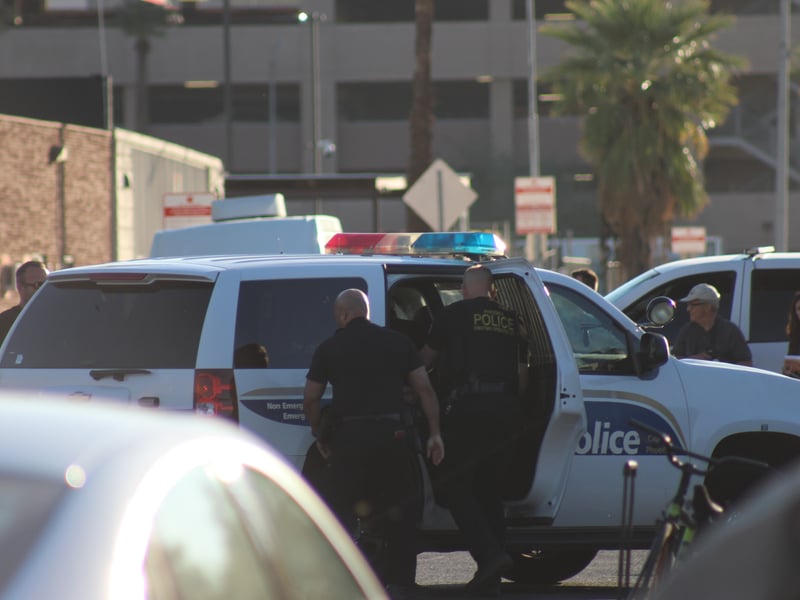
PHOENIX (CN) — Attorneys gave opening statements Tuesday in a six-day trial against the city of Phoenix and a police lieutenant two men say unlawfully ordered their arrest at a 2019 protest.
Jorge Soria and Phil Martinez say in a lawsuit that they were unfairly targeted by Police Lieutenant Benjamin Moore when he ordered their arrest while letting other similarly situated protesters walk free. They claim Moore didn’t like the content of their political speech and retaliated against their free expression.
“Why are we here?” plaintiffs’ attorney Mart Harris asked jurors Tuesday afternoon. “Because Jorge was violent, or because police didn’t like being called child killers? Because Mr. Martinez assaulted police officers, or because police didn’t like being called ‘fucking pussies?’”
The city says police arrested the two and others for refusing to leave after Moore, leader of the Phoenix Police Department’s Tactical Response Unit, declared the assembly unlawful.
“All they had to do was leave,” defense attorney Michele Molinario told the jury in her opening statement. “They did not follow that order.”
Soria attended a “Lights for Liberty” candlelight vigil at a church in downtown Phoenix and marched with the crowd to the U.S. Immigration and Customs Enforcement building to protest the inhumane treatment of migrant children at the U.S.-Mexico border. Soria carried a large Soviet Union Flag and a sign calling police “child killers.” Throughout the evening, the protest spilled out into the street and onto the light rail tracks, prompting police to get more physical with protesters and threaten arrest.
Molinario played multiple videos of the protest, explaining to the jury the danger protesters created by sitting on the tracks and refusing to leave the street. But Soria is found on neither the street, nor the tracks in any of the videos played. Instead, he stands on the sidewalk, waving the Soviet Union flag back and forth until he is apprehended.
Martinez, a well-known critic of the Phoenix Police Department, was riding the light rail through the area and was forced to get off and walk along the sidewalk to the next stop because of the disruption. Walking past police officers, Harris said Martinez scoffed at their helmets and riot gear, calling them “fucking pussies.” After his arrest, officers claimed that he was arrested for throwing a “hammer fist punch” at one of them while he was being apprehended.
“He ordered the arrest for something that happened in the future?” Harris asked about Moore’s motivations.
The video Harris played showed Martinez’s arrest from a distance, and it’s unclear whether Martinez threw a punch.
Harris said police targeted the two plaintiffs not for their conduct but for their anti-police messaging. He admitted that the plaintiffs defied orders by staying when they were told to disperse, but argued that because others did the same and weren’t arrested, these arrests must have been targeted and retaliatory in nature.
Molinario played dispatch audio of Moore ordering the arrest of anyone who resisted police efforts to push the protest off of the street. She said Moore paid no attention to what Martinez said or what was written on Soria’s sign and flag.
The trial, set to conclude on Jan. 15, begins seven months after the U.S. Department of Justice declared the Phoenix Police Department engaged in patterns of civil rights violations and excessive force. Defense attorneys argued to U.S. District Judge David Campbell that certain parts of the Justice Department investigation, such as the finding that officers unlawfully restrict free speech and expression, should be redacted from the jury’s view to maintain neutrality. Campbell, a George W. Bush appointee, said he would decide that matter before evidence is presented Wednesday.
Jury selection took up most of the first day of trial, as many potential candidates shared passionate views on policing and protests, and those who shared political opinions were dismissed. After questioning the jury, Harris divulged that it was his “first time doing this,” and later displayed that inexperience by repeatedly referring to his client Soria as “George” rather than Jorge, and at one point calling him “Jorge slash George.”
In just the first few minutes of his opening statement, Harris suddenly dropped to his belly, stunning the jury, to demonstrate Soria’s arrest. He later brought a roughly seven-foot bamboo staff into the courtroom and asked that Campbell allow him to use it to demonstrate how Soria handled his flag pole while Soria testifies. Though clearly taken aback, Campbell said he’d allow it.
 Follow @JournalistJoeAZ
Subscribe to our free newsletters
Our weekly newsletter Closing Arguments offers the latest about ongoing trials, major litigation and rulings in courthouses around the U.S. and the world, while the monthly Under the Lights dishes the legal dirt from Hollywood, sports, Big Tech and the arts.