
 Search Articles


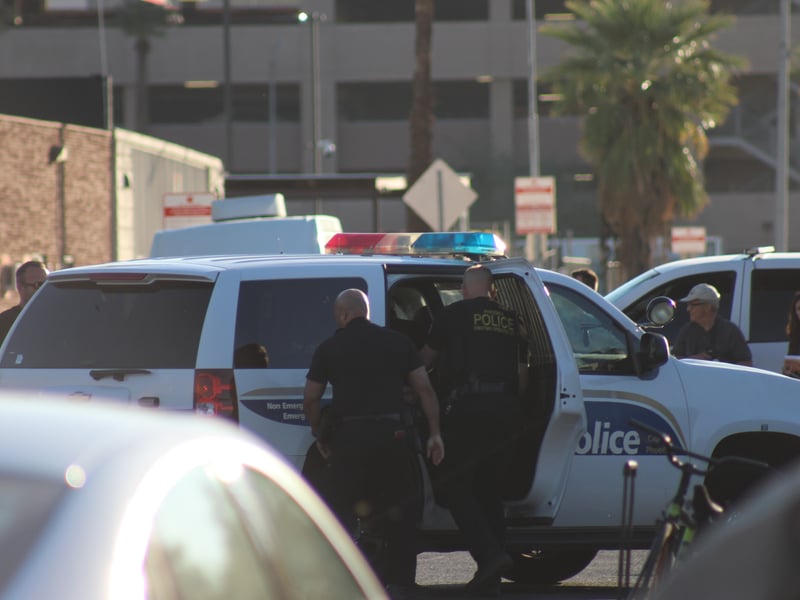
PHOENIX (CN) — Just two months after Phoenix police officers repeatedly punched and tased a deaf Black man with cerebral palsy, the city council approved a $22 million contract for even better tasers.
The city will pay just under $2 million to Axon Enterprise in 2025 and around $5 million in each of the next four fiscal years to upgrade the police department’s tasers and provide new deescalation training software. It’s unclear how much of the $22 million will go to the tasers.
In a city council meeting Wednesday afternoon, dozens of Phoenix residents raged against the council’s unanimous support of the contract in light of Phoenix police’s recent actions.
“The timing of this $22 million proposal is a slap in the face for every Phoenix resident,” local organizer Percy Christian told the council. “Just months after the DOJ exposed the Phoenix Police Department’s pattern of excessive force. Just weeks after your officers beat and repeatedly tased Tyron McAplin, a deaf Black man with cerebral palsy. You have the audacity to continue to ask for more weapons.”
The U.S. Department of Justice released its findings from a nearly three-year investigation in June, detailing civil rights violations including excessive and unjustified deadly force and discrimination against Black, Hispanic and Native American people. Among other findings, the Justice Department says that Phoenix police use tasers “unreasonably,” often without warning, and against people exhibiting signs they’re experiencing a mental health crisis.
“You want to reward the violence with $22 million more dollars,” Christian said.
Despite a poor track record with tasers, Phoenix police say the upgrades will increase safety for both officers and citizens they interact with.
The new Taser 10 model nearly doubles the range from 25 to 45 feet, and operates at a lower voltage. The changes will allow officers more time and space to deescalate a situation before other uses of force become necessary, interim Chief Michael Sullivan told the city council.
The Phoenix Police Department first introduced tasers in 2003, following a record number of officer shootings the previous year, which in part contributed to a reduction in officer shootings by nearly 75%. Supporters of the Axon contract point to a similar statistic from 2019 when Phoenix first entered a contract with the public safety corporation.
Officer shootings spiked to 45 in 2018, but fell to just 15 in 2019 when the department equipped the Axon Taser 7. That number has since fluctuated between 13 and 26, which remains in line with pre-2018 numbers, and is at 19 so far in 2024.
Residents don’t buy the causation.
“Weapons like tasers also kill. They torture our community,” a woman named Angelena said in Spanish. “Violence brings more violence.”
Of the dozen or so people who signed in to speak, only one supported the proposal.
“Our officers need technological resources in order to properly provide our community with public safety,” Anne Ender told the council. “We have to give the police department the resources they need. Those who don’t want that in their communities, we’ll take it. We want public safety.”
While the first year of the contract is covered by the police’s budget, fiscal year 2025-26 will require an additional $3.7 million. City Manager Jeff Barton said he isn’t yet sure where that money will come from. The city is facing a deficit of at least $120 million over the next few years.
“It’s going to have to come out of your budget,” Council member Laura Pastor told Sullivan. “I think that’s fair.”
While still voting to support the contract, Pastor said that if the city can find $22 million for tasers amid a deficit, it needs to do a better job finding funding for social programs.
“When people have services and housing and a place to be, it helps police and it helps the safety of our community,” she said.
The council also approved a $304,641 settlement with residents and business owners in the area of downtown Phoenix formerly referred to as “the zone,” where at one point nearly 1,000 people resided in tents as a result of the city’s homelessness crisis. A state judge ordered the city to clear the area of tents in September 2023 after he found the city responsible for what amounted to a public nuisance.
Later in the meeting, the council voted to reduce the age restriction to ride electric scooters and bicycles on public roads from 18 to 16. Council member Ann O’Brien requested that the age be reduced to 14, given that’s the age when kids can work and go to high school, and they may not have access to school buses or other public transit.
But other council members said they fear allowing 14-year-olds to share the streets with other motorists before they learn the rules of the road, which is typically by 16 when they earn a driver’s license.
Spin and Lime, Phoenix’s two “micro mobility” electric scooter rental partners, say they will maintain a minimum age of 18 years for safety and insurance purposes.
The council voted 8-1 with O’Brien’s dissent.
 Follow @JournalistJoeAZ
Subscribe to our free newsletters
Our weekly newsletter Closing Arguments offers the latest about ongoing trials, major litigation and rulings in courthouses around the U.S. and the world, while the monthly Under the Lights dishes the legal dirt from Hollywood, sports, Big Tech and the arts.