
 Search Articles


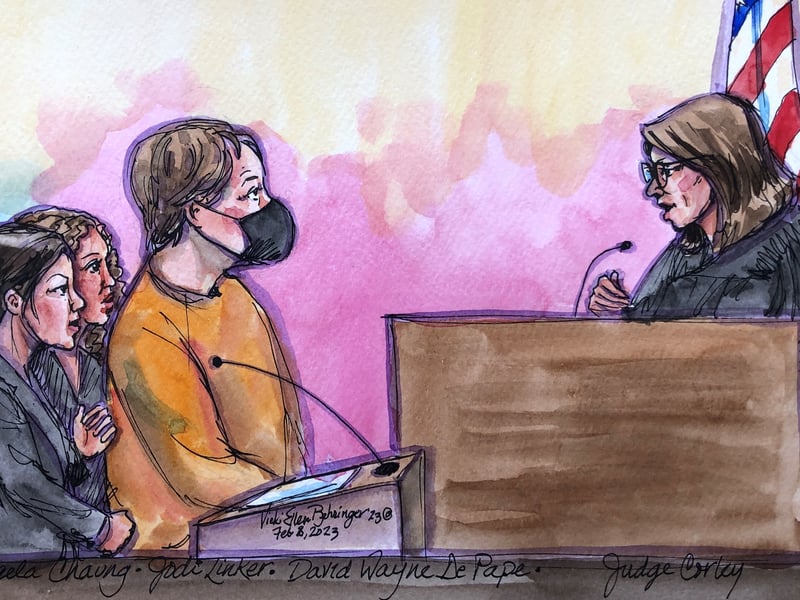
SAN FRANCISCO (CN) — The man who broke into former House Speaker Nancy Pelosi’s home and fractured her husband’s skull with a hammer told a Ninth Circuit panel Wednesday that his constitutional rights were violated during a federal jury trial that ultimately resulted in a 30-year prison sentence.
David DePape was found guilty of attempting to kidnap a federal official and assaulting the family member of a federal official in a November 2023 trial. He said he intended to kidnap Nancy Pelosi and “break her kneecaps," and when he found out she wasn’t home, he took Paul Pelosi hostage before striking him three times on the head with a hammer when police arrived.
DePape’s primary appeal to the panel focused on the jury instructions, which defined the term “federal officer,” but not “official duties,” in relation to then-Speaker Nancy Pelosi’s position as a member of Congress.
Todd Borden, DePape’s public defender, explained that Pelosi had other duties outside of the House of Representatives, such as roles at the Democratic National Committee, that were “purely political duties,” and that DePape “had a lot of beliefs that were unrelated” to Speaker Pelosi’s duties ini Congress. He added that the prosecutor’s statements during the trial that there is a “made-up distinction” between politics and official actions may have influenced the outcome of the case.
“What we have here is an unusual situation where the prosecutor essentially weaponizes the district court’s refusal to give a clear, precise instruction of what official duties are in a single place and points to the lack of that as a basis for rejecting a legally valid defense theory. That undermines my client’s constitutional rights,” Borden said.
U.S. Circuit Judge Patrick J. Bumatay, a Donald Trump appointee, questioned Borden about the harm of the wording. Borden responded that the harmlessness doesn’t matter because the instruction was “so prejudicial” based on the fact that it was during closing arguments.
In contrast, Assistant U.S. Attorney Ross Mazer argued that DePape “never drew distinctions” between Nancy Pelosi’s role in Congress and her role as leader of the Democratic National Committee.
“He referred to her as ‘leader of the Democratic Party in Congress.’ He even made specific references, not just to general corruption that he perceived in Washington, D.C., but also specific congressional acts. The evidence in this case would satisfy any definition of official duties,” he said.
Mazer added that the defense omitted a sentence when arguing about the prosecutor’s claims of no distinction between politics and official actions.
“The prosecutor said, ‘This is a made-up distinction. The defendant made no such distinction.’ The prosecutor was talking about the defendant’s intent and saying he, himself, did not distinguish between these political and official duty motivations,” Mazer said.
Borden also brought up other qualms he had with the federal court’s handling of the case, including the court’s admittance of bloody videos and photos of the aftermath of Paul Pelosi’s assault, which Borden said had “infinitesimal probative value and an extreme risk of unfair prejudice.”
“It is quintessential evidence that sort of urged the jury to, or that would have the effect of, causing the jury to base its verdict on its emotional reaction, rather than the narrow legal elements that were at stake in this case,” he said.
U.S. Circuit Judge Ana de Alba, a Joe Biden appointee, asked Borden if he was suggesting that DePape was “entitled to a trial free of any sort of emotional impact,” adding that “this was a pretty grave case.”
Borden responded that the specific images they were objecting to were “especially disturbing” and “had less evidence.”
“We were not trying to sanitize this beyond all recognition, but I think the impact of the additional footage that was admitted was very high,” he said. “Even when there’s only a modest risk of unfair prejudice, when the probative value is so low, it still is an abuse of discretion.”
Borden further argued that “automatic reversal is required” because the federal court did not allow DePape to speak before sentencing.
Previously, U.S. District Judge Jacqueline Scott Corley, a Joe Biden appointee who oversaw the federal jury trial, admitted she failed to allow DePape to speak at the original sentencing hearing and apologized before handing down his sentence.
“The importance of the right to allocution, I don’t think, is merely technical. It actually goes back to the 1600s," Borden said. “It has really deep roots.”
In rebuttal, Mazer said the government only admitted videos and images to contest the defense’s arguments, including the severity of the force and injuries, the use of a hammer as a deadly weapon and the claim that DePape and Paul Pelosi remained “cordial” until the end.
“Both the district court and the government took an extremely conservative approach to any evidence that was emotionally charged,” he said.
As for the federal court’s failure to allow DePape to speak before sentencing, Mazer argued there was no need to remand the case back to the lower court because DePape had a chance to speak during the hearing redo.
A representative for the Department of Justice declined to comment.
A representative for DePape did not respond to a request for comment.
The panel was rounded out by U.S. Circuit Judge Anthony D. Johnstone, a Joe Biden appointee.
DePape was sentenced to life in prison without the possibility of parole for his crime in a separate state trial last year.
 Follow @mhattridge_
Subscribe to our free newsletters
Our weekly newsletter Closing Arguments offers the latest about ongoing trials, major litigation and rulings in courthouses around the U.S. and the world, while the monthly Under the Lights dishes the legal dirt from Hollywood, sports, Big Tech and the arts.