
 Search Articles


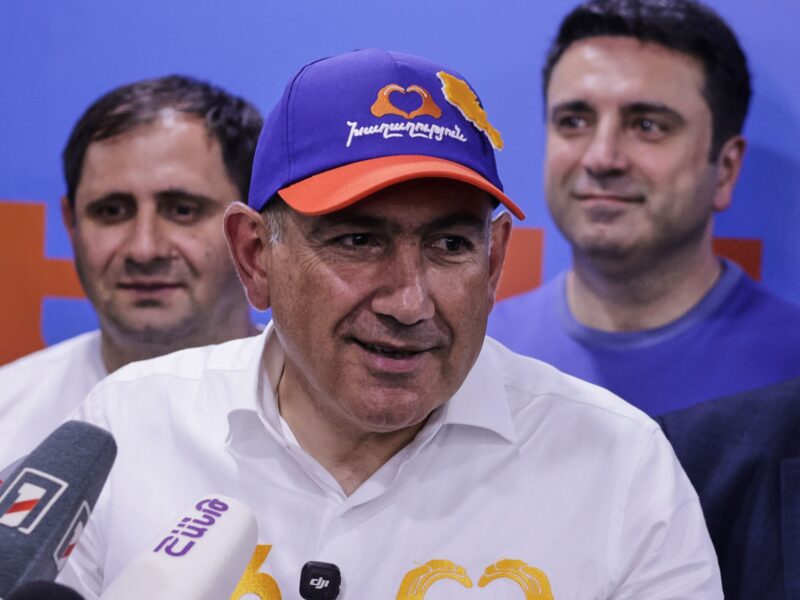
(CN) — Armenia’s pro-European Prime Minister Nikol Pashinyan overwhelmingly won reelection Sunday, an outcome that will keep on track his efforts to move his landlocked South Caucasus nation closer to the West and end tensions with Azerbaijan and Turkey.
Pashinyan’s Civil Contract won 49.8% of the vote and 64 seats in the 105-seat National Assembly; however, it fell short of the supermajority needed to pursue constitutional changes.
The election unfolded amid geopolitical instability in the South Caucasus and domestic tensions within Armenia. Turnout reached roughly 59%, up from the previous national vote.
Pashinyan remains locked in bitter feuds with rivals, whom he accuses of corruption, vote-buying, seeking to seize power and acting as Russian agents.
Pashinyan’s chief rival, billionaire Samvel Karapetian, spent the campaign under house arrest on charges of attempting to usurp power. Karapetian, who has called for restoring close ties with Russia, was labeled a Kremlin spy by Pashinyan. His Strong Armenia bloc finished second with 23.3% of the vote.
The election was Armenia’s first parliamentary election since the loss of Nagorno-Karabakh, the mountainous region that was predominantly ethnic Armenian but internationally recognized as part of Azerbaijan.
Azerbaijan seized the enclave in September 2023, forcing the withdrawal of Armenian forces and the exodus of roughly 120,000 ethnic Armenians.
After the takeover of Nagorno-Karabakh, Pashinyan moved to normalize relations with Azerbaijan and Turkey.
“Nikol Pashinyan campaigned on a peace agenda,” said Laurence Broers, a South Caucasus expert at the Royal Institute of International Affairs, a think tank in London.
In August 2025, U.S. President Donald Trump got Pashinyan and Azerbaijani President Ilham Aliyev to sign a peace deal to end the long-running conflict over Nagorno-Karabakh and other territorial disputes.
However, as part of that deal, Azerbaijan demanded Armenia remove language from its constitution staking claim to Nagorno-Karabakh, and Sunday’s election results made it more difficult for Pashinyan to carry that out because he failed to obtain a supermajority.
“This means that the political track of the peace process may spend some time in limbo now,” Broers said.
Therefore, to “keep momentum going” on the peace deal, Broers said Armenia and Azerbaijan may need to focus on another key aspect of Trump’s deal.
Under the agreement, Pashinyan agreed to grant the United States a 99-year development lease on the 27-mile Zangezur Corridor, located along Armenia’s border with Iran.
Azerbaijan and Turkey have long sought to open the corridor, as it would connect the allies and link Azerbaijan to its landlocked Nakhchivan exclave, situated between Armenia and Turkey.
Since taking power in 2018 following a popular uprising known as the “velvet revolution,” Pashinyan has moved Armenia closer to the West by seeking entry into the European Union and getting closer to NATO and Washington.
The pro-Western turn has strained relations with the Kremlin, Armenia’s traditional ally, security guarantor and largest trading partner. The two countries share deep economic, cultural and religious ties, but Russia’s influence in the South Caucasus has waned since its peacekeepers failed to prevent Azerbaijan’s takeover of Nagorno-Karabakh.
As part of his realignment, Pashinyan unveiled a doctrine he’s called “Real Armenia.”
Under the concept, Armenia should abandon nostalgic visions of a “Greater Armenia” and territorial claims to historic Armenian lands, particularly Nagorno-Karabakh. Instead, Pashinyan argues the country should focus on its internationally recognized borders as an independent former Soviet republic.
“This is a huge shift and redefinition of Armenian priorities, away from irredentism, diaspora and ethno-nationalism to citizenship,” Broers said.
The expert said the shift inverts the long-held belief that “there is no Armenia without Karabakh,” favoring the idea that “Armenia is better off without Karabakh.”
Pashinyan has sought to cement that vision by reshaping the country’s symbols, most notably by moving to remove or downplay the image of Mount Ararat on official state documents.
Mount Ararat, known in Turkey as Mount Agri, holds deep symbolic significance for Armenians but lies within modern-day Turkey and is visible from Armenia’s capital, Yerevan.
In Judeo-Christian tradition, Noah’s Ark landed on Ararat after the biblical flood and the mountain is featured prominently on Armenia’s coat of arms, Armenian currency, alcohol and cigarette brands and a soccer team is named after it.
During World War I, Armenians were driven from settlements around Ararat as part of Ottoman-era mass killings of up to 1.5 million Armenians in what dozens of countries recognize as genocide.
Pashinyan’s policy shifts were central to the election with his critics accusing him of a series of unilateral concessions to Turkey and Azerbaijan and endangering the country by antagonizing Russia.
As Armenia’s main trading partner and supplier of discounted natural gas, Russia could seek to exert pressure on Pashinyan by cutting off trade.
“Russia still has a lot of power to hurt Armenia, which it can use to punish Yerevan but not necessarily to persuade,” Broers said.
But he said Armenia has become less reliant on Russia.
“Armenian-Russian relations have been in crisis for a long time, reflecting the fact that this is a relationship whose fundamentals are changing,” he said.
“The main pillar of the old relationship, the ‘rescue fantasy’ that Armenia’s loyalty earns Russian security guarantees, has collapsed,” Broers said. “Moscow has lost its principal source of leverage over Armenia in the unresolved Karabakh conflict.”
More generally, Broers said Russia’s influence and leverage over the South Caucasus was in “long-term decline.”
Still, he expected Pashinyan to try to maintain good relations with the various competing powers, including Russia.
“Pashinyan has so far proven adept at inhabiting a strategic ambiguity in his foreign policy and I don’t think that there is another leader in Armenia right now who could be better in this regard,” he said.
After winning the election, Pashinyan stressed Armenia would continue pursuing closer ties with the West while maintaining cooperation with Russia and the Eurasian Economic Union, a trading bloc of post-Soviet states.
Broers said all South Caucasus states “are walking fine lines” because there are many overlapping interests in the region — Russia, Turkey, Iran, Israel, China, India, Pakistan, the European Union, the United States.
“This is the nature of a small region populated by small states surrounded by bigger powers,” he said.
He said South Caucasus states believe they can gain advantages by pursuing “multi-alignment as a strategy that leverages their pivotal location at the center of the conventional world map.”
“This is the future of geopolitics in the region, rather than memberships of rival geopolitical blocs,” he said.
Courthouse News reporter Cain Burdeau is based in the European Union.
 Follow @cainburdeau
Subscribe to our free newsletters
Our weekly newsletter Closing Arguments offers the latest about ongoing trials, major litigation and rulings in courthouses around the U.S. and the world, while the monthly Under the Lights dishes the legal dirt from Hollywood, sports, Big Tech and the arts.
Additional Reads


 Ukrainian strikes hit oil sites in Russia and Crimea June 8, 2026