
 Search Articles


RICHMOND, Va. (CN) — The Fourth Circuit’s employment dispute resolution process does not violate judiciary employees’ due process rights, a panel of appellate judges found Friday.
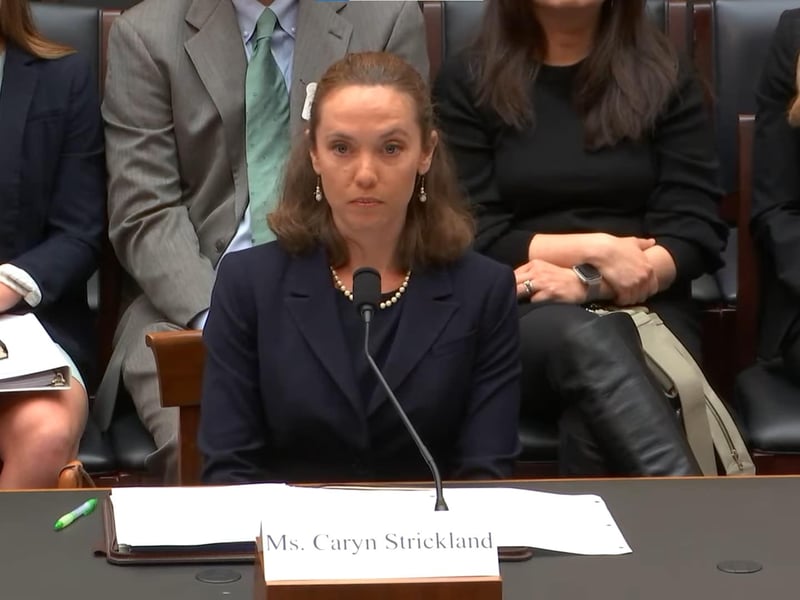
Caryn Strickland, a former assistant federal public defender, argued before the Fourth Circuit in June that the court’s sexual harassment reporting process denied her due process and violated standards established by Title VII of the Civil Rights Act, which prohibits employment discrimination based on race, religion or sex. The process infringes on her right to be free from sex discrimination, she said, and the judiciary’s handling of her complaint through the Fourth Circuit’s internal complaint process — called the Employment Dispute Resolution Plan — is fundamentally unfair to victims.
Employees of the judiciary are not covered under the Civil Rights Act, which forced Strickland to claim constitutional violations when she filed suit in March 2020 against her former employer, arguing the federal defender’s office for the Western District of North Carolina mishandled her sexual harassment investigation and caused her to be constructively discharged.
The office made the decision to take no disciplinary actions until a final hearing in her case, which did not occur because she withdrew her dispute when she resigned. She believed that the office’s head federal public defender, Anthony Martinez, would have had influence over the final hearing, making the process “futile” and “fundamentally unfair.”
A federal judge dismissed her claims in 2024, while simultaneously issuing recommendations for the judiciary to revise its dispute resolution plan.
The Fourth Circuit has since revised its employment dispute resolution plan, Senior U.S. Circuit Judge Ronald Lee Gilman of the Sixth Circuit said in Friday’s unanimous opinion. A three-judge panel from outside of the Fourth Circuit was brought in to hear the case, as Strickland clerked at the Fourth Circuit. The Fourth Circuit’s Chief U.S. Circuit Judge Albert Diaz and executive James Ishida were also named as defendants in the case.
Judiciary employees behaved “imperfectly” during the investigation process, Gilman said, but Strickland forfeited her due process claim when she withdrew her dispute before the final hearing. Her belief that Martinez would be the final decisionmaker on her complaint was unreasonable, the Bill Clinton appointee said, and would not lead a person to believe that he would have refused to comply with any mandated remedies. Gilman added that the procedures established for the hearing process are “facially adequate” despite not including disciplinary options, as it provides the complainant other remedies such as a comparable position, promotion or leave.
And the government allowed Strickland to telework, transfer out of the chain of the command of the office’s first assistant — whom she said harassed her — and potentially move to a different office, the panel said. The process was not so “fundamentally unfair” that it violated her due process rights or coerced her to abandon the resolution process, nor is the process inadequate, the judges determined.
The process, which the lower court found took far too long, was due to delays by appointed investigator delaying, not a failure of the hearing process, the panel said, which would have likely been timely. The judiciary spent four months on the investigation before Strickland left in March 2019.
“Strickland’s dissatisfaction with the remedies available through the plan also does not establish that the plan’s process was a sham,” the panel said. Senior U.S. Circuit Judge Susan Graber, a Clinton appointee from the Ninth Circuit, and U.S. Circuit Judge W. Duane Benton, a George W. Bush appointee from the Eighth Circuit, served with Gilman on the panel.
Strickland was not constructively discharged or coerced into resigning, they found, nor was Martinez deliberately indifferent to her sexual harassment complaint or retaliatory or discriminatory. She also was not pressured to withdraw her claim, and did so voluntarily after accepting the clerkship.
Strickland’s claim that the exclusion of judiciary employees from the Civil Rights Act is unconstitutional was only raised on appeal, the panel said, and the court generally does not consider issues brought for the first time on appeal.
“Declining to consider an issue that was raised for the first time five years into the litigation does not constitute a ‘miscarriage of justice,’” Gilman said. “We therefore decline to reach the merits of her Title VII argument.”
The government had argued that Strickland can’t make a last-minute constitutional challenge to the Civil Rights Act’s exclusion of judiciary employees, and that even if she showed an equal protection violation, that she does not have any prospective relief. Strickland needed to show that Fourth Circuit employees acted with deliberate indifference, Kevin Sotor, an attorney from the U.S. Department of Justice who represented the defendants, argued last June. Their actions were not unreasonable just because a victim argued for stronger remedial measures, he added.
Counsel for Strickland declined to comment. Representatives for the Department of Justice did not reply to requests for comment.
 Follow @SKHaulenbeek
 Follow @shaulenbeek.bsky.social
Subscribe to our free newsletters
Our weekly newsletter Closing Arguments offers the latest about ongoing trials, major litigation and rulings in courthouses around the U.S. and the world, while the monthly Under the Lights dishes the legal dirt from Hollywood, sports, Big Tech and the arts.