
 Search Articles


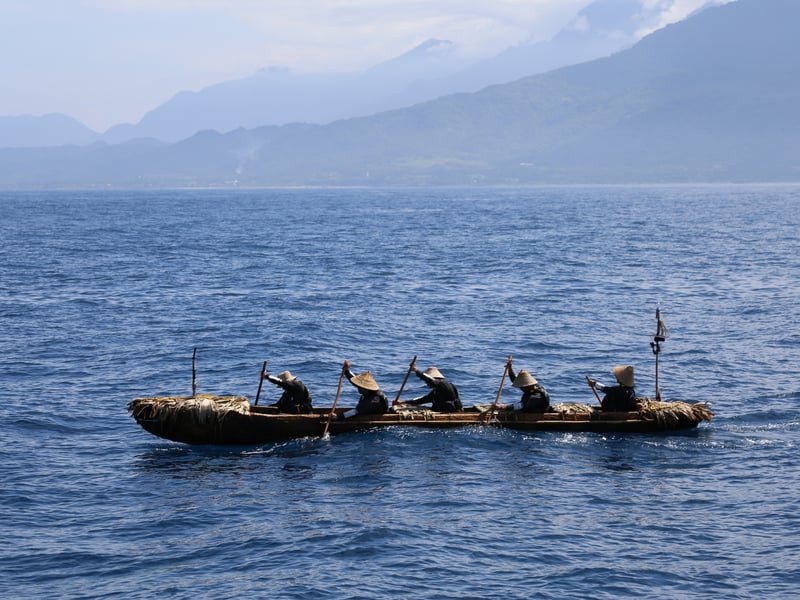
(CN) — The nearly 25-foot longboat cuts through the waves with ease. The vessel, also called a dugout canoe, was hand-crafted from a Japanese cedar trunk with replicas of ancient stone axes and designed with one goal in mind: to carry its five paddlers from Taiwan to the westernmost island of the Japanese Archipelago, a path first rowed by their migrating ancestors 35,000 years before.
Although the migration of early humans across East Asia is fairly well-recorded, how populations traversed open ocean without the use of maps, metal tools or modern boats has baffled historians. Particularly of interest to University of Tokyo professor Yousuke Kaifu was what tools and strategies were used by paleolithic people in order to safely ensure their sea crossing from Taiwan to remote southern Japanese islands such as Okinawa.
“Archaeological evidence such as remains and artifacts can’t paint a full picture, as the nature of the sea is that it washes such things away,” said Kaifu in a statement, citing Norwegian explorer Thor Heyerdahl’s controversial 1947 Kon-Tiki expedition in which he sailed from Peru to Polynesia to prove a theory of ancient migration routes. “So, we turned to the idea of experimental archaeology.”
Published Wednesday in the journal Science Advances, the paper Traversing the Kuroshio by lead author and UTokyo visiting researcher Dr. Yu-Lin Chang uses numerical simulations and virtual recreations to show exactly how traditional boats likely travelled against the aggressive Japanese current.
Paleolithic seafaring in East Asia, a second paper also published in Science Advances on Wednesday, was headed by Kaifu and is an in-depth recollection and analysis of the team’s experience building the authentic canoe and using it for the journey south.
Departing from Taiwan on July 7, 2019, the canoe travelled nearly 140-miles and reached Japan’s westernmost island, Yonaguni, just two days later. Although that may seem quick, the 45-hour journey was treacherous as the four-man, one-woman team paddled nonstop and even crossed the Kuroshio, one of the world’s strongest ocean currents — all while navigating only by the sun, stars, swells and their instincts.
But these rowers weren’t just athletes inspired by their ancestry — their roles doubled as historians and scientists, as the primary purpose of the venture was to collect data on the journey.
After years of plugging data into test models and analyzing information, the team began to come to some conclusions on what the journey was like for paleolithic people and how such a migration was accomplished.
In the initial planning stages, the team first hypothesized that rafts were used in the great migrations — a dugout canoe was the last thing researchers expected ancient people to have taken into such wild ocean waters. But after a series of experiments, it was clear that canoes were the fastest and most durable, making them ideal for passing the Kuroshio.
But determining what vessel was used is only half the story, Kaifu emphasized. Pioneers with experienced paddling and navigational skills and “a strong will to explore the unknown” were key to the success of the migration, as travelers must fight aggressive waves and navigate without visible land for the majority of the journey.
“The Kuroshio Current is generally considered dangerous to navigate — I thought if you entered it, you could only drift aimlessly,” said lead author Chang, who studies oceanography at the Japan Agency for Marine-Earth Science and Technology. “But the results of our simulations went far beyond what I had imagined.”
Both papers, financially supported by a Kakenhi research project grant, helped illuminate how the ancient ocean voyages occurred, said Chang. While the virtual simulations helped fill informational gaps that a one-time experiment could not, offering helpful recommendations on ideal launch points and paddling angles, physically performing the actual journey to Yonaguni told a story no data can tell.
Those who successfully completed the migration likely had a high level of strategic seafaring knowledge, and they faced a brutal journey.
“Scientists try to reconstruct the processes of past human migrations, but it is often difficult to examine how challenging they really were,” said Kaifu, noting that many ancient people had no maps yet travelled almost the entire Pacific Ocean. “One important message from the whole project was that our paleolithic ancestors were real challengers. Like us today, they had to undertake strategic challenges (in order) to advance.”
A feature-length documentary was produced on the researchers’ experimental voyage. The documentary is named after the canoe, Sugime, a Japanese word which has roots in the word “success.”
Subscribe to our free newsletters
Our weekly newsletter Closing Arguments offers the latest about ongoing trials, major litigation and rulings in courthouses around the U.S. and the world, while the monthly Under the Lights dishes the legal dirt from Hollywood, sports, Big Tech and the arts.