
 Search Articles


(CN) — Four Pacific states on Wednesday pushed aside the federal government in favor of their own winter virus vaccination recommendations.
The decision came on the same day a California state senator announced a bond measure to fund scientific research he wants on the November 2026 ballot.
Both moves were an answer to what West Coast leaders say is damage the Trump administration has wreaked across scientific research and vaccine health.
The vaccination recommendations come through the West Coast Health Alliance, a recent creation Western governors say is a response to the federal Centers for Disease Control and Prevention’s lack of credibility and scientific integrity under Health and Human Services Secretary Robert F. Kennedy Jr.
The recommendations include the 2025–26 Covid-19, influenza and RSV vaccines.
“Our states are united in putting science, safety and transparency first — and in protecting families with clear, credible vaccine guidance,” the governors said in a statement. “The West Coast Health Alliance stands united in protecting public health and always putting safety before politics.”
The governors include Gavin Newsom of California, Tina Kotek of Oregon, Bob Ferguson of Washington and Josh Green of Hawaii.
They pointed to Kennedy in their statement, saying he’s weaponized the CDC by dismantling its vaccine advisory committee. He fired its 17 members, and in their place put cherry-picked appointees, including vaccine skeptics.
Kennedy also has pushed out the CDC director and overseen the resignations of high-level and career-staff — crippling the agency’s credibility when it’s needed most, the governors said.
Additionally, in California, Newsom signed Assembly Bill 144 into law. That enables the Golden State to base its immunization guidance on medical organizations other than the CDC’s advisory committee, which Newsom’s office called increasingly politicized.
“We want the people who live and work in our states to know that there is a strong public health, health care and scientific community that will continue to stand together to provide and use the data and evidence needed for you to make healthy choices, and we are here to protect our communities,” said Dr. Erica Pan, director of the California Department of Public Health, in a statement.
The announcement by the Western governors came on the same day that California state Senator Scott Wiener unveiled legislation that would provide funding for scientific research in the wake of federal cuts.
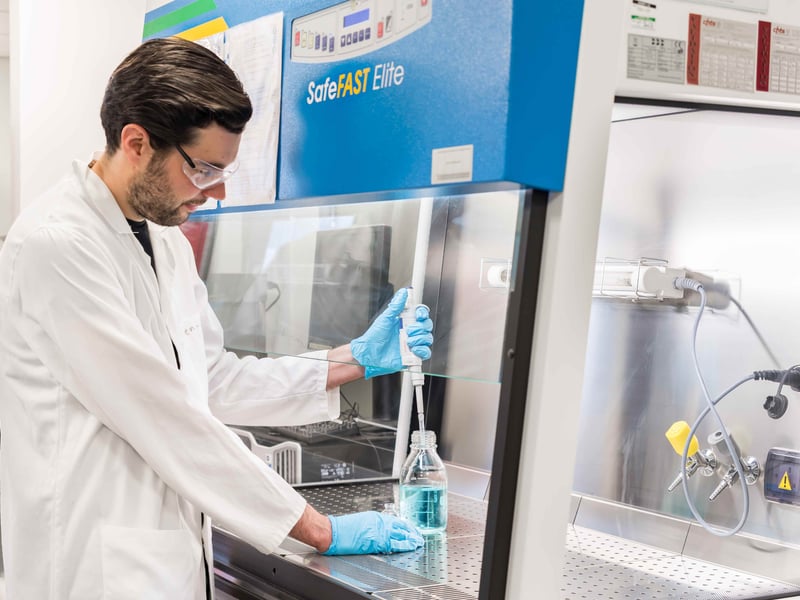
David Shackelford, a professor at UCLA’s David Geffen School of Medicine, works toward discovering cures for cancer. It’s one reason why he’s pushing for a bond measure that would provide some $23 billion in funding for research labs like his.
Wiener’s Senate Bill 607 — written by state Senator Scott Wiener — was introduced last Friday during one of the Legislature’s busiest days of the year, but it took center stage Wednesday during a Zoom press conference. Wiener emphasized that SB 607 is needed to fill a funding gap created by the federal government.
“This is so destructive,” Wiener said, placing blame for the funding cuts at Trump’s feet. “We want to stop this and turn this around. And if we can’t, then California needs to lead.”
The San Francisco Democrat drew a straight line to Trump’s administration, saying it had canceled billions of dollars earmarked for scientific research. That’s led to the closure of labs working on treatments and cures for the most debilitating diseases.
His office fears more cuts are on the horizon. On Tuesday, a group of University of California labor groups filed suit against the Trump administration, claiming it’s using the threat of cuts to push the system into implementing ideological policies that infringe on free speech and academic freedom.
“After suspending nearly $584 million in funding for research at UCLA, the Trump administration has demanded a $1 billion payment,” said Mike Miller, director of the International Union, United Automobile, Aerospace and Agricultural Implement Workers of America Region 6, in a statement. “The state of California will not be extorted.
Wiener’s bill seeks to stem the funding loss through a new agency that would award grants and loans.
The legislation would create the California Foundation for Science and Health Research inside the state’s Government Operations Agency. It would give grants and loans to universities, health care organizations and others for scientific and health care research and development.
However, the bill must first secure a two-thirds vote in both legislative chambers before reaching voters during the November 2026 election. After having just come off a marathon final two days of their session, lawmakers won’t return to Sacramento until January.
Wiener said he wanted the bill in print now, providing an early start to the process. A similar bill died in committee this year.
“Donald Trump’s cuts threaten not just research, but the lives of our loved ones,” said Assemblymember José Luis Solache Jr., a Lynwood Democrat and coauthor of the bill, in a statement. “This measure makes clear that Californians will take control of our future and invest in lifesaving research — because our families, our health, and our economy are too important to leave in the hands of Washington politicians playing games with people’s lives.”
Shackelford has seen work in his lab frozen, as some $8 million in federal funding didn’t materialize.
“This is really hurting patients,” he said. “We are world leaders in research.”
Elaine Huang, a graduate student researcher at UCLA, said her lab has made many discoveries over the past few years. The federal cuts have impacted her as well. Many scientists worry about losing their jobs, as money for their salaries is in question.
“Experiments are complex,” she said. “They can’t be stopped and restarted easily.”
Support for the legislation also came from John MacMillan, a professor at UC Santa Cruz. New approaches and datasets to help treat childhood cancer are made at his institution. Additionally, his university researches climate change and builds tools to combat a warming planet.
Like others, his university also has faced impacts from federal cuts.
“SB 607 will make a difference in the lives of everyday Californians,” MacMillan said.
Speaking at the Zoom press conference, Miller said that California gives more money to the federal government each year than it receives — some $83 billion annually.
“This measure would allow us as Californians to take our future into our own hands,” he added.
Subscribe to our free newsletters
Our weekly newsletter Closing Arguments offers the latest about ongoing trials, major litigation and rulings in courthouses around the U.S. and the world, while the monthly Under the Lights dishes the legal dirt from Hollywood, sports, Big Tech and the arts.