
 Search Articles


PORTLAND, Ore. (CN) — The courtroom battle over whether an Oregon electric company has a claim to five acres of land along the shore of the state’s largest waterfall came to a close on Tuesday, with an Oregon tribe urging the court to keep the land in the state’s hands.
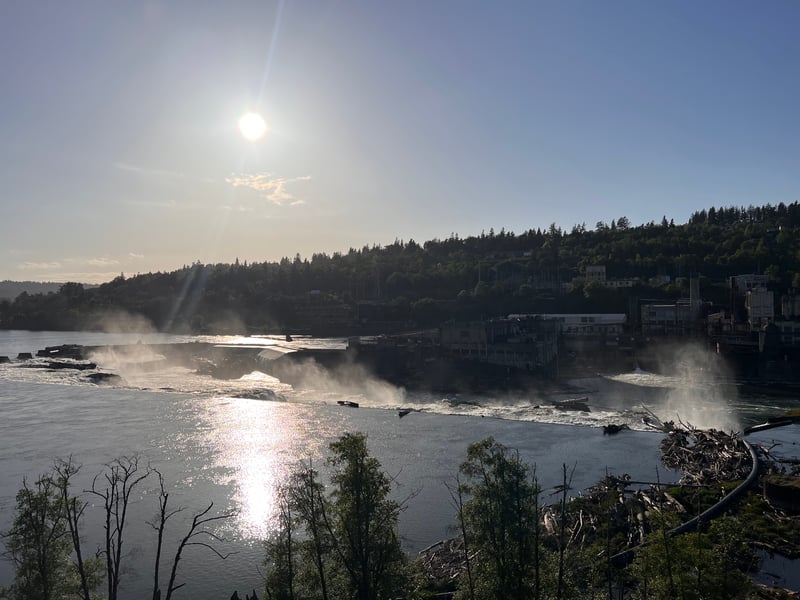
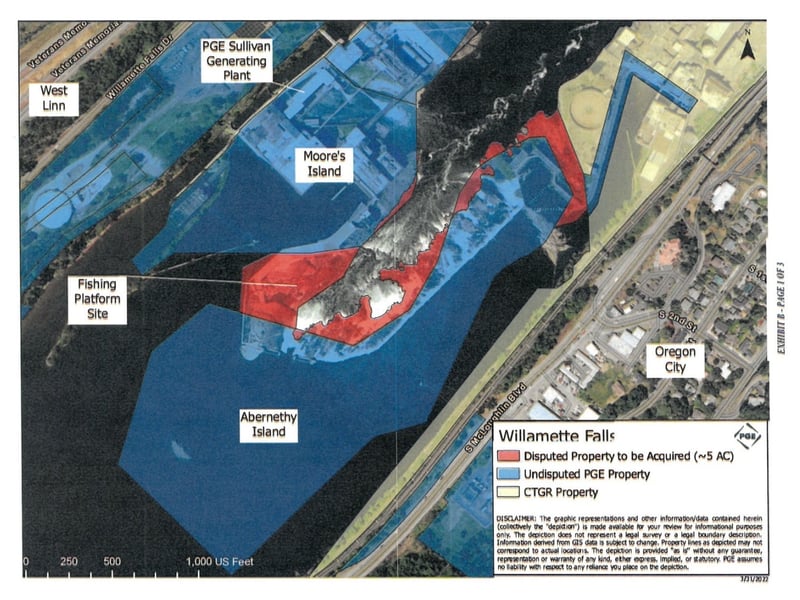
Upon the rocky outcropping at the base of the country’s second-largest waterfall by volume is a ceremonial fishing platform built by the Confederated Tribes of Grand Ronde in 2018. Surrounding the platform and falls is a hydroelectric facility operated by Portland General Electric.
The central question of the case, according to Grand Ronde, is whether the power company’s bid to condemn the land encompassing the fishing platform and rocky shores falls within its lawful authority.
“The answer is a clear and resounding no,” argued Kimberly D’Aquila, attorney for Grand Ronde, in closing statements Tuesday.
When the power company sued the state in 2022 to condemn five acres of land on the rocky shores of Willamette Falls surrounding its hydroelectric facility, Grand Ronde intervened as a defendant.
The state gave the tribe a waterway registration to use the area at the base of the horseshoe-shaped waterfall in 2018. Willamette Falls has housed a hydroelectric facility since 1895 and has been the site of tribal fishing for centuries.
According to Grand Ronde, the power company’s decision to condemn the land in dispute was arbitrary, capricious and was made in bad faith.
“What changed wasn’t the facts on the ground, it was PGE’s business calculus,” D’Aquila said.
Four other tribes — the Confederated Tribes and Bands of the Yakama Nation, the Confederated Tribes of Umatilla Indian Reservation, the Confederated Tribes of Warm Springs and the Confederated Tribes of Siletz Indians — released a joint statement in support of the power company ahead of the trial.
Grand Ronde argues that the power company prioritized its business relationships with other tribes, such as Warm Springs, with which it co-owns a hydroelectric facility in Eastern Oregon, and pulled out of discussions once the other tribes objected.
“There’s no bad faith or anything untoward whatsoever about listening to other stakeholders so PGE can make the best decision,” argued Erick Haynie, a Perkins Coie attorney representing the power company.
Soon after talks stalled, a land ownership study commissioned by Oregon came back showing the state as the owner of the rocky outcropping in question, so Grand Ronde applied for and received a registration for the platform through the state.
The power company has maintained that not only has it made decisions in good faith, but that condemning the disputed land is necessary for it to remain in compliance with its Federal Energy Regulatory Commission license. Under the license, the power company is required to control all property necessary for the operation of its plant.
But Grand Ronde argues that the power company has no reason to try to condemn the land now when it hasn’t encountered any issues from the commission.
“It’s not about what PGE needs, it’s about what it wants,” D’Aquila argued.
The power company says that its decision to condemn the land wasn’t arbitrary or capricious and that it is “appropriate stewardship of a hydroelectric facility that the operator owns and controls all the area needed to operate.”
“Even if Grand Ronde were the best of neighbors, it doesn’t fix the problem that PGE would have no control over access granted by the State of Oregon,” Haynie said.
Plus, the attorney said, accessing the site without the power company’s approval represents a safety risk.
“Common sense would confirm that if you’re operating a hydroelectric facility, you need to keep the area safe,” Haynie said.
But to Grand Ronde, the power company’s concerns about safety have been inconsistent and served merely as a pretext to assume control.
“What it boils down to is the safety argument is really post hoc rationalizations,” D’Aquila said.
What alarms Grand Ronde, she said, is the lack of evidence in the record showing the power company properly analyzed the condemnation before committing to the action.
“This isn’t a minor oversight, it’s a telling absence,” D’Aquila said, adding the power company would have alerted to being out of compliance earlier, but the fact that it didn’t supports the argument that the platform doesn’t jeopardize its license.
“It’s already doing what it’s required to do,” D’Aquila said.
PGE has maintained that it intends to provide tribes with access to the falls for cultural practices, including through a Perpetual Cultural Practices Easement through the Federal Energy Regulatory Commission that authorizes tribes to access the land for fishing and other cultural practices.
For the Siletz, the easement would resolve some of the intertribal conflict. The tribe appeared in court in favor of the condemnation, stating that the part of the power company’s actions are likely the result of not wanting to referee the conflict.
“I think they had no idea of the hornet’s nest they walked into when this platform issue came up,” said attorney Lee Ann Easton. But, the power company isn’t able to receive an easement without owning the disputed land.
Then there’s the state, which is the named defendant in the action but remained largely silent throughout the trial, though former Oregon Governor Ted Kulongoski attended closing arguments and met with U.S. District Judge Michael H. Simon his chambers afterward.
Simon, a Barack Obama appointee, asked the state why it didn’t just sell the land to the power company when it made an offer, especially considering the state has largely abstained from arguing during the trial.
“PGE is saying ‘We need this land, we need to condemn it,’ if the state thought that was the right reason, presumably the state could’ve solved this problem,” Simon said.
The state’s position is that it is not waiving its ownership interest or its jurisdiction over the platform site, but recognizes that the power company may have the power to exercise eminent domain over the property.
The land in question includes not just the area encompassing the fishing platform, but also land along the east shore — land that Simon admitted to being skeptical about whether the power company had shown it needed.
Simon estimated he would return a written decision within 60 days, though he stated it may stop short of a judgment if he determines he wants to rewrite the condemnation boundary but lacks the authority to do so.
Subscribe to our free newsletters
Our weekly newsletter Closing Arguments offers the latest about ongoing trials, major litigation and rulings in courthouses around the U.S. and the world, while the monthly Under the Lights dishes the legal dirt from Hollywood, sports, Big Tech and the arts.