Search Articles


SAN LUIS OBISPO, Calif. (CN) — On July 3, more than 3,000 tourists and locals danced and socialized outside the mission in San Luis Obispo as local band Moonshiner Collective belted out a setlist of feel-good, Americana rock tunes on the eve of the country’s 250th birthday.
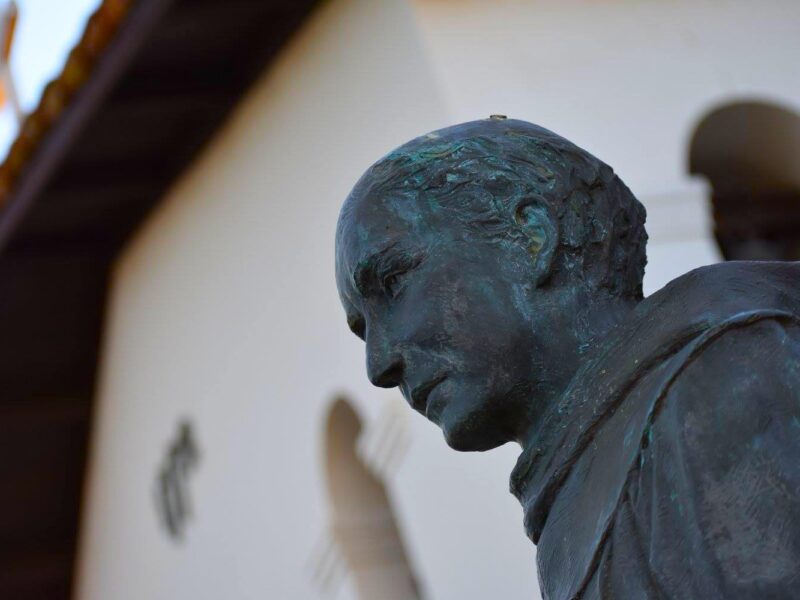
Yet one familiar face that had stood next to Mission San Luis Obispo de Tolosa for decades was noticeably missing: In 2020, amid a backlash about the legacy of Spanish colonialism, the Catholic church removed the statue of the mission’s founder Junipero Serra, who had been named a saint just five years earlier.
“When you put someone’s likeness in a statue, and you place it on a pedestal, you’re basically honoring that person,” said Jonathan Cordero, an Indigenous scholar and co-editor of the forthcoming “Critical Mission Studies Handbook.” “And so what are you honoring? If you examine the actual factual historical narrative, you’re honoring the deliberate genocide of an entire people and culture under the auspices of doing them good and saving their souls, which they never asked for and never needed.”
While the perception of the mission legacy continues to evolve, the popular summer concert series demonstrates how the missions’ impact on California’s culture, history and economy still thrives, forever tied to state’s identity.
“The missions are the centerpiece of early historical California,” said Lee Panich, an archaeologist, historical anthropologist and professor at Santa Clara University. “They can be emotionally charged places, but I think they also offer an opportunity to think through the complex history of California and to think about the origins of our state. And some of it is good and some of it’s not, but it’s worth considering because the missions are meaningful places to a lot of different people.”
The first of California’s 21 missions was founded by Serra in San Diego in 1769. At that time, Spain had a considerable presence in Mexico and wanted to convert Native Americans to Catholicism and expand its territory. While Spain had claimed California as its territory in 1542, it wasn’t until the late 1700s that it decided to occupy the land, with the threat of Russian and English encroachment serving as a motivation. So the Spanish king sent military troops and Franciscan friars to the new land.
Prior to the arrival of Europeans, California’s Indigenous populations consisted of around 300,000 people living in a series of small tribes.
“Prior to colonization, there were probably about 100 different languages spoken in California,” Panich said.
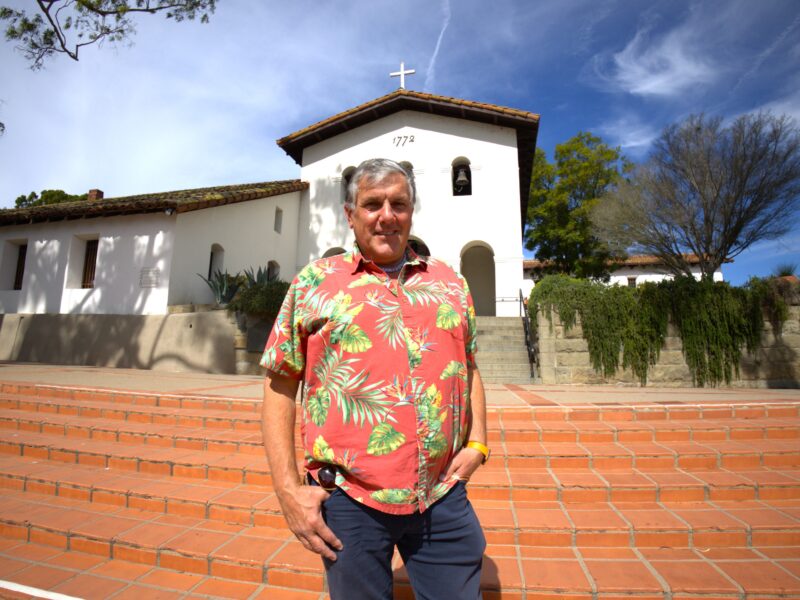
Before the San Luis Obispo mission was built in 1772, the area was dense with trees, which Chumash used to built huts and canoes they would use to fish, said Steve Schmidt, executive director of the History Center of San Luis Obispo County.
“They were hunters and gatherers, but they weren’t nomadic,” Schmidt said. “So unlike the Plains Indians, who had to chase buffalo around, here it was just, ‘We’re going to live on acorns.’”
That simplicity would change when the Spaniards arrived.
The Native people were converted to Christianity, taught Spanish and expected to perform labor such as farming, carpentry, and leather working. They also built the missions, guided in part by a first-century architect.
“The missionaries had a book written by a Roman, Vitruvius — in that way, they had a similar blueprint,” said Julia Costello, an archaeologist and co-author of the book “The California Missions: History, Art and Preservation.” “However, each mission took on the character of the padre who was in charge.”
The European influence would have a lasting legacy.
“For Native people, it was a radical reorientation of the way they lived prior to colonialization,” Panich said. “Most Native people in California, at least in the mission era, did not practice agriculture as we understand it today. And they were taught agricultural pursuits by the Spanish. The introduction of cattle had a huge impact throughout the region.”
The missions became the economic engine of communities, Panich said. Not only were they working churches, but they also featured livestock, vineyards and blacksmith shops.
Because Indigenous populations adopted modern practices, many viewed the Spaniards as more humane colonialists who wanted to help.
“They did believe, as Catholics, that if souls died without being baptized, they’d go to hell,” said Schmidt, who also serves as a docent at the San Luis Obispo mission. “So they wanted to save them from going to hell.”
When industrial civilizations arrived in underdeveloped cultures, Costello said, significant change was bound to occur.
“It’s too attractive, it’s just too enticing,” she said. “This is not done with whips and chains. European world had come to the new world, and it was just inevitable.”
In more recent years, many researchers have adopted a darker view.
“I would definitely say the missions were spaces of compelled labor, which is a form of slavery,” said Martin Rizzo-Martinez, an assistant professor of film and digital media at University of California Santa Cruz who has researched the missions and the history of Indigenous people of California. “The Native people were taken to the missions, they were the ones who did all the labor there. They made their adobe buildings, they managed the livestock, they grew the food, they made shoes and clothing for the settlers.”
Those who resisted, he said, were physically punished. Fugitives were hunted down and returned. Women who couldn’t bear children were humiliated. And the treatment was enforced by military, which eventually grew in numbers.
For decades, most of the mission history was told from the Spanish point of view, which was written down, Rizzo-Martinez said. Much of the indigenous viewpoint was shared via oral histories, which were not viewed with the same credibility by historians.
“There’s an old school way of looking at history that does discredit or doesn’t tend to believe oral histories,” said Rizzo-Martinez, author of the book “We Are Not Animals: Indigenous Politics of Survival, Rebellion, and Reconstitution in 19th Century California.” “But there are a lot of us who understand that oral histories are very important.”
In roughly the past 15 years, Cordero said, the number of California Indian scholars has increased significantly.
“Now we have California Indian scholars who are using both Indigenous and scientific knowledge to revisit the history of the colonial period in California,” said Cordero, who is affiliated with the Ramaytush Ohlone and Chumash tribes.
In 2020, amid a backlash against Confederate statues, Covid isolation and the protests responding to the police killing of George Floyd, many more began to question the history of the missions in California, citing the oppression of minorities. That’s when statues of Serra began to vanish, as the church moved them to storage to prevent vandalism.
“I think that was a moment where, across the country, people were kind of questioning the ways we have elevated certain stories and ignored other stories,” Rizzo-Martinez said. “So it was a bit of a reckoning.”
Hoping to avoid whitewashing the past, historians have attempted to tell the mission story while honoring the Indigenous people. But researchers will likely remain divided.
Less debatable is the lasting impact the missions have had.
When Mexico won independence from Spain in 1821, it abandoned many of the missions in the territory it called Alta California. The United States took over California in 1848 and the Gold Rush brough an influx of people from around the world the following year, offering new influences on the culture of the region. Yet, many missions continued to operate as churches.
And because the missions were often built in the most ideal locations, communities grew around them.

“You’ve got fresh water, you’ve got access to different resources, travel via water or trails,” Panich said. “So Native Americans, the Spanish and we as 21st century people all want to live in the same places for basically the same reasons.”
The mission impact after the Gold Rush was much quieter until the advent of the automobile.
“The missions didn’t really become tourist destinations until the early 20th century with early automobile tourism,” Panich said.
To promote tourism, starting in 1909, hundreds of iron mission-like bells were installed along Highway 101, promoting the highway that connects all 21 missions.
“It ushered in the idea of the missions as kind of romantic places,” said Panich, whose employer, Santa Clara University, grew around Mission Santa Clara de Asis.
That romanticism continues today, as sales of mission books, postcards, art and apparel remain popular. Developers still build mission style homes, and California’s robust wine industry traces back to Franciscan friars who arrived to the region with vines from Spain.
The missions are often aesthetically pleasing, photo-worthy structures, surrounded by beautiful landscaping — another feature of the California mystique that has long drawn dreamers seeking either a new life or a fun vacation.
“California missions offer a deeper understanding of the state’s layered history and communities that grew around these destinations,” Caroline Beteta, president and CEO of Visit California, said in an email. “The missions are woven into California’s identity in ways visitors can still experience today. They are historical landmarks, as well as cultural anchors that helped shape many of the destinations travelers know and love across the state. From architecture to street names to culinary specialties, the influence of the missions is still visible across California.”
Communities in San Luis Obispo, Santa Barbara and San Francisco, she added, purposely modernized around their missions.
In 1970, the city of San Luis Obispo completed its Mission Plaza, which would host both serious and fun community events. This year it will host Pride in the Plaza, the Juneteenth Celebration, Santa’s Workshop, a unicycle championship and a Walk to End Alzheimer’s, to name a few events.
Meanwhile, the mission continues to operate as a Catholic church, with regular services, weddings and funerals, while also offering docent-led tours.
“Visitors aren’t just stepping into history frozen in time when they visit these sites,” Beteta wrote. “They’re experiencing living communities where locals and travelers come together to celebrate, picnic, shop — and have for many generations.”
Today, promotional organizations such as Visit California encourage a full understanding of the Native experiences in the mission era. And reckoning with the past — however troubled it may be — has clearly not damaged the state’s connection to the missions, as evidenced by the 2026 Concerts in the Plaza series in San Luis Obispo.
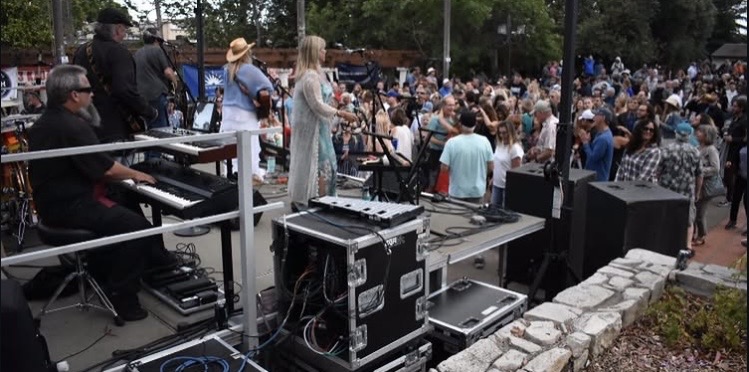
When the 30th season began this year, crowds once again flocked to the plaza for a weekend of dance-friendly music under the setting California sun. And the historic Mission San Luis Obispo de Tolosa — with its founding date 1772 prominently displayed on its belltower — served as the backdrop.
In San Luis Obispo, it is the quintessential summer event in a quintessential location.
“I can’t imagine San Luis without Mission Plaza,” Schmidt said.
But, more than 250 years after the missions were built, the sight of the churches still upsets ancestors of the Indigenous people who built them.
“Why the hell are we celebrating a period of time when whole cultures of people were just totally wiped out and erased?” said Val Lopez, chairman of the Amah Mutsun Tribal Band, who said the colonists had an impact that continues today. “They stole the land. They stole everything from us.”
If it were up to him, missions would no longer represent the state.
“Cover them in black drapes for mourning and turn them into recognition as places of genocide,” he said. “Tell the truth and stop glorifying them, and stop making money off of them and recognize the human beings that were there.”
Given the missions’ association with California, along with its historical, cultural and economic impact, black drapes aren’t likely. But scholars hope to continue the discussion about mission history.
“People do visit the missions — they are big tourist sites,” Rizzo-Martinez said. “But if we can get more accurate stories, and people can actually hear from Native community members more regularly, I think that’s crucial. If you’re going to visit a mission as a tourist, you need to hear from the people whose ancestors built those places and hear what they think of those spaces and what they think is significant.”
Subscribe to our free newsletters
Our weekly newsletter Closing Arguments offers the latest about ongoing trials, major litigation and rulings in courthouses around the U.S. and the world, while the monthly Under the Lights dishes the legal dirt from Hollywood, sports, Big Tech and the arts.
Additional Reads

 Judge halts roundup of wild horses in Arizona July 9, 2026