Search Articles


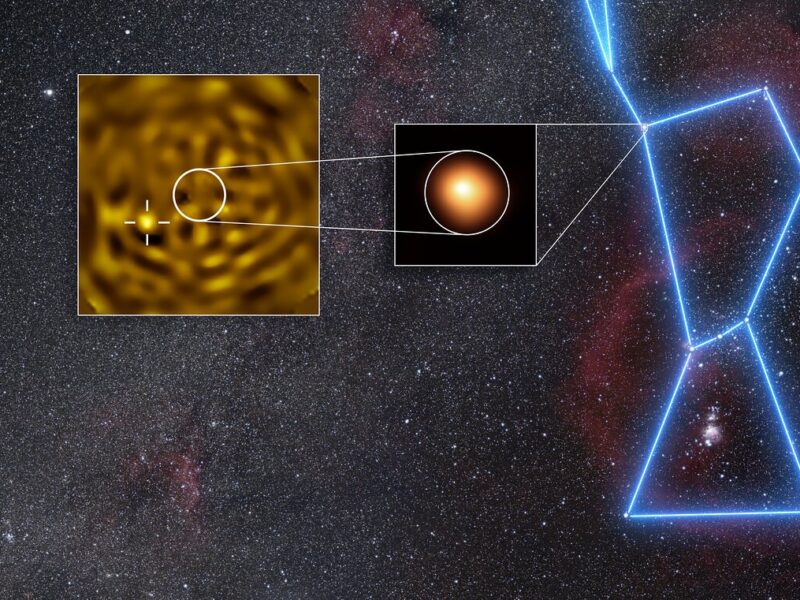
(CN) — One of the night sky’s most familiar stars may not have been alone after all.
Astronomers say they have captured the clearest evidence yet that Betelgeuse, the bright red supergiant in the constellation Orion, has a faint companion star orbiting beside it.
The findings, published Tuesday in Astronomy & Astrophysics, could help solve a mystery that has surrounded Betelgeuse for decades. Although the star has been observed for centuries and is one of the brightest visible from Earth, astronomers have long suspected an unseen companion might help explain some of its unusual behavior, including changes in its brightness.
Using the European Southern Observatory’s Very Large Telescope in Chile, researchers directly detected light from the candidate companion, known as Betelgeuse B.
The observations were made in December 2024, when predictions suggested the companion would be farthest from Betelgeuse and therefore easiest to spot.
Lead author Miguel Montargès said the discovery came as a surprise.
“I jumped from my chair when I saw the processed images,” the Observatoire de Paris astronomer said in a news release.
Astronomers spent several months processing the observations before concluding they had obtained the strongest evidence yet for the companion’s existence.
The newly detected star also turned out to be larger than expected. Previous estimates suggested it would have a mass similar to the sun, but the observations indicate it is roughly two to three times as massive.
“Honestly, I thought we did not have the sensitivity to detect Betelgeuse B as it was predicted,” Montargès said. “Because it is more massive than predicted, we see it!”
The companion was imaged using the SPHERE instrument on the Very Large Telescope, which was originally designed to search for planets around other stars. Researchers say the observations demonstrate the instrument can also reveal faint stellar companions orbiting massive stars.
Although they say there is now little room for doubt, researchers plan to observe the system again next year when the companion appears on the opposite side of Betelgeuse to further confirm the detection.
The discovery could also help scientists better understand what happens when Betelgeuse eventually reaches the end of its life.
The star drew worldwide attention in 2019 and 2020 when it unexpectedly dimmed, prompting speculation that it was about to explode as a supernova. Later observations showed the dimming was caused by a cloud of dust that temporarily obscured the star.
Researchers now hope to determine whether the newly identified companion could influence Betelgeuse’s eventual supernova explosion or its evolution as a red supergiant.
“The fact that we can still discover a nearby companion, more massive and brighter than the sun, around such a well-studied star is remarkable,” Montargès said. “These are among the best moments in science: seeing something new, unexpected.”
Subscribe to our free newsletters
Our weekly newsletter Closing Arguments offers the latest about ongoing trials, major litigation and rulings in courthouses around the U.S. and the world, while the monthly Under the Lights dishes the legal dirt from Hollywood, sports, Big Tech and the arts.