
 Search Articles


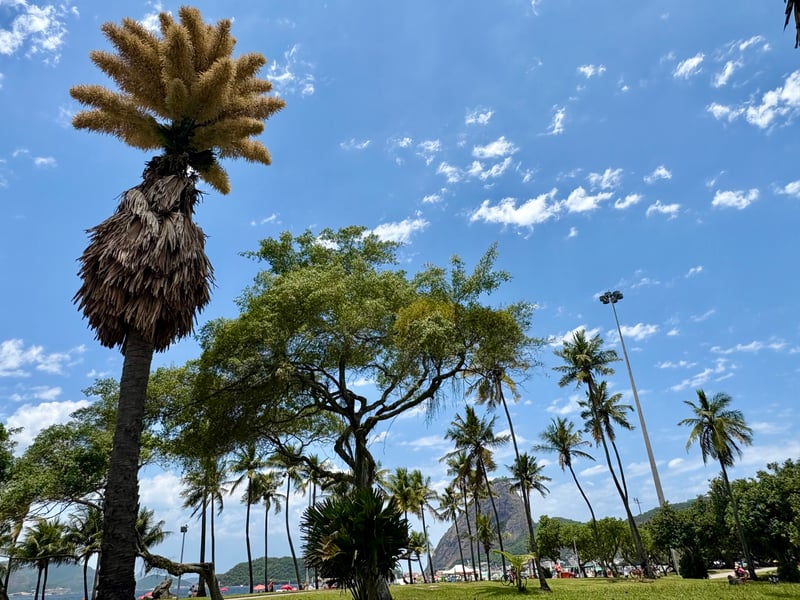
RIO DE JANEIRO (CN) — In the past few weeks, the blooming of talipot palms in Rio de Janeiro’s Aterro do Flamengo has turned an already busy waterfront park into a destination for curious crowds.
The rare event, linked to a life cycle that can span seven decades, has drawn residents, visitors and experts who know they will not see it again in these trees.
After blooming and fruiting, the talipot palm, or Corypha umbraculifera, enters an irreversible process of senescence and dies.
That process is underway in the talipot palms in Aterro do Flamengo and at the Rio de Janeiro Botanical Garden, which were planted in the 1960s and 1970s in landscape projects influenced by Brazilian landscape architect Roberto Burle Marx.
Fábio Bastos Moreira de Souza, a 52-year-old Jiu-Jitsu instructor, said he is a longtime admirer of Burle Marx and on Friday traveled about 31 miles just to see the palms up close.
“I believe plants have their own energy and this is incredible,” he said. “They’re on their way to God, you know? That’s why I dropped everything to come today. If you wait until tomorrow or the day after, you miss it. Only in 70 years.”
Souza said he collected a few seeds, hoping to grow them in his home garden.
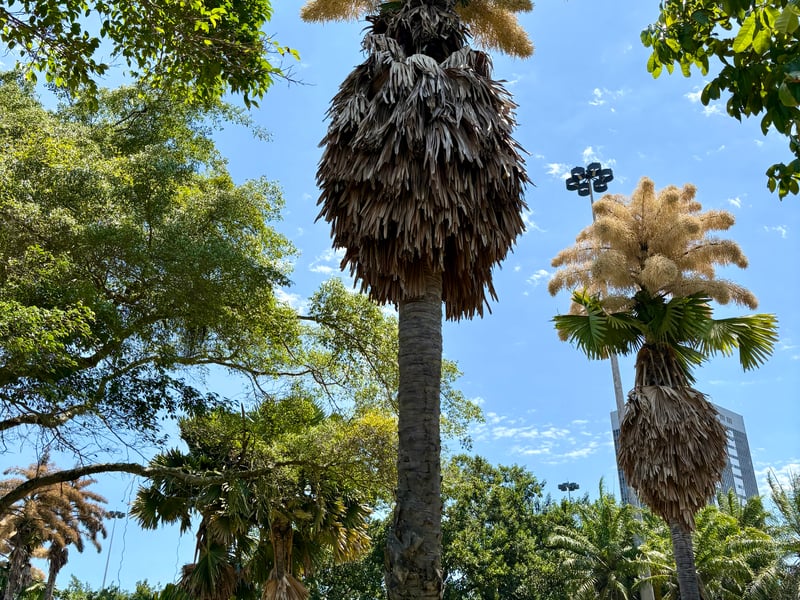
Native to southern India and Sri Lanka, the talipot palm is known for producing one of the largest inflorescences in the world, with millions of tiny flowers spread across several massive branches.
The species also holds cultural significance in its native range: for centuries, its leaves were used as a writing medium for Buddhist religious and literary manuscripts, forming a body of texts known as Talipot Leaf Scriptures.
In the wild, the palm grows in open areas of tropical dry forests, often on well-drained hillsides. Suzana Ursi, a professor in the botany department at the University of São Paulo, said a single tree may produce as many as 20 million flowers.
Adult individuals can reach nearly 100 feet tall, with fan-shaped leaves spanning more than 16 feet. The talipot is monocarpic, meaning it blooms only once in its lifetime and then dies, Ursi explained.
The process has a physiological basis. When the palm reaches reproductive maturity — a stage that can take 50 to 70 years — the tissue responsible for producing new leaves, located at the top of the trunk, is completely converted into floral tissue.
Without that structure, which sustains the plant’s growth, it loses the ability to renew itself and enters a steady decline after fruiting.
All the energy stored over decades is directed to the production of the giant inflorescence and later to the fruits. From that point on, the palm deteriorates until the trunk collapses.
In Rio, the palms in Aterro do Flamengo and at the Botanical Garden appear to have reached maturity at the same time, explaining the simultaneous blooming seen in recent weeks.
“In Brazil, many individuals were planted between the 1950s and 1970s, especially in modernist landscape projects in Rio de Janeiro and São Paulo,” Ursi said.
The synchronized timing may also reflect converging responses to global climate trends, she said, including the gradual rise in minimum temperatures and changes in rainfall patterns over recent decades.
She noted that botanical literature documents similar reproductive synchrony in other monocarpic species, in which plants of different origins but similar physiology respond to the same environmental cues and bloom at the same time, even when they do not belong to the same population.
The entire blooming and fruiting process lasts about a year. After that, the leaves yellow and fall as the trunk becomes vulnerable to fungi and termites, raising the risk of collapse. In urban areas, this stage often requires active management to prevent accidents.
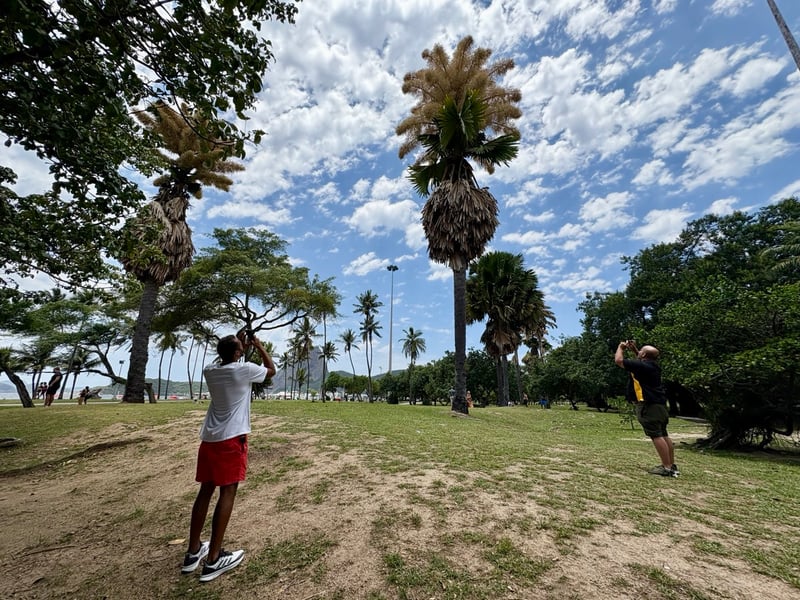
According to Rio’s Public Parks and Gardens Foundation, Aterro do Flamengo currently has 117 talipot palms.
Once the palms complete their cycle and die after fruiting, the city plans to collect seeds to produce new seedlings and replant them. The current plan calls for the replanting of 28 palms in Aterro do Flamengo.
At the Rio de Janeiro Botanical Garden, its two talipot specimens are being closely monitored, said Marcus Nadruz, coordinator of the institution’s Living Collections.
“The Botanical Garden has a long tradition of donating seedlings to public agencies,” he said. “We’ll collect the seeds, grow the seedlings and replant the two palms where they are now. We’ll place their offspring in the same spot and produce additional seedlings for donation.”
Ursi said the talipot bloom offers a rare opportunity for studies in phenology, plant physiology and urban ecology, since each event reflects decades of environmental conditions accumulated over the plant’s life.
She said the palms act as sentinels, signaling gradual shifts in temperature, rainfall and urban vegetation — something especially valuable in a species with such a long cycle.
The public’s interest, she added, helps broaden discussions about plant diversity and reduces what botanists call “plant blindness.”
But she cautioned that, “although it is an impressive species,” the talipot should not become a flagship species or divert attention from the importance of native plants, especially in urban forestry policies.
Among visitors, reactions to the palms’ future vary. Dulce Bueno, a 72-year-old retired professor who has lived for 13 years in a neighborhood near Aterro do Flamengo, said she hopes her granddaughter will be able to see a talipot bloom 60 years from now.
Friends Glayce Kerolin, a 30-year-old who works in international relations, and Glaucia Regina, a 44-year-old digital marketer, said they would like to see new palms planted because witnessing the bloom “is truly a gift.”
Other visitors prefer to let the process unfold naturally. Felipe Bastos Silveira Santos, a 33-year-old events producer, visited Aterro do Flamengo just to watch the trees’ transformation and said part of the experience is observing the full transition — blooming, fruiting and dying.
He believes the fruits falling now may germinate on their own, allowing new talipot palms to appear spontaneously.
“I think a few years from now we’ll be hearing this story again,” he said.
Courthouse News reporter Marília Marasciulo is based in Brazil.
Subscribe to our free newsletters
Our weekly newsletter Closing Arguments offers the latest about ongoing trials, major litigation and rulings in courthouses around the U.S. and the world, while the monthly Under the Lights dishes the legal dirt from Hollywood, sports, Big Tech and the arts.