
 Search Articles


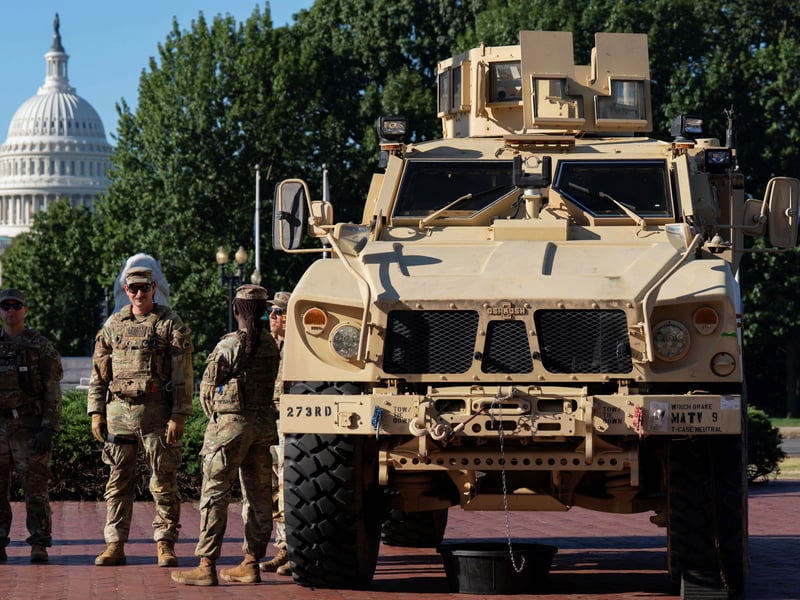
WASHINGTON (CN) — Parts of President Donald Trump’s so-called “emergency” takeover of Washington, D.C., may be winding down, but the federal presence in the nation’s capital appears far from over.
As D.C. residents brace for the possibility that National Guard soldiers and federal agents could become a permanent fixture in the city, congressional Republicans are gearing up to clamp down even harder on the municipal government with a massive tranche of new legislation.
In August, Trump invoked a rarely used provision of the 1973 D.C. Home Rule Act, letting the White House seize control of the city’s police during “special conditions of an emergency nature.” He also ordered in the National Guard and about 500 federal agents, leading to thousands of arrests.
The administration’s authority over Metro Police, however, is limited by law to 30 days — a window set to close this week.
Trump has suggested that he would need “long term” control over D.C. police and has contended that he would not need congressional approval to extend that power. Congress would almost certainly need to greenlight such action.
But, for now, it appears unlikely that the president will attempt to seize extended control over D.C.’s police force.
D.C. Mayor Muriel Bowser established a joint emergency operations center last week to coordinate local government efforts with federal law enforcement agencies, including the FBI and the Drug Enforcement Administration (DEA). The move was seen as paving the way for a long term or even indefinite federal presence in the capital city.
House Speaker Mike Johnson told reporters Tuesday that Congress hadn’t been asked to weigh in on Trump’s D.C. takeover and suggested Bowser’s order made action unnecessary.
“I think if you have an agreement — I understand it as an agreement — between the White House and local leadership, I’m not sure Congress has any necessity to do anything,” he said. “So, we’ll see.”
Johnson added that Bowser had “wisely” welcomed what he contended was an indefinite federal presence in D.C. “We all benefit from that,” the speaker said. “You can walk home safely tonight.”
Trump’s control of D.C.’s police is set to expire, but lawmakers are preparing a broad legislative overhaul of the city’s criminal justice system, including how local judges are selected. On Wednesday, the House Oversight Committee is set to take up more than a dozen Republican-led bills expanding congressional oversight of D.C. governance.
Among those measures is one that would give Congress a 60-day window to review any law passed by the D.C. council and would speed existing mechanisms for lawmakers to overrule legislation approved by the municipal government.
The panel will also weigh bills boosting penalties for certain crimes in D.C., capping “youth offender” status at 18 and letting prosecutors seek adult charges for offenders as young as 14 for some offenses.
Another measure would remove D.C. Attorney General Brian Schwalb and replace him with a presidential appointee. Voters have elected the city’s top local prosecutor since 2010.
House Republicans are also pushing to amend the Home Rule Act to eliminate D.C.’s judicial nominations commission, which for decades has recommended candidates for the city’s superior and appellate courts to the White House. The panel currently includes attorneys representing the president and the D.C. mayor, as well as members of the city council, the D.C. Bar and the chief judge of the U.S. District Court for D.C.
Under the proposed bill, the authority to appoint judges to the capital’s municipal court system would lie solely with the president.
Democrats blasted the Republicans’ push as an attack on D.C.’s tradition of self-governance. Representative Eleanor Holmes Norton, D.C.’s nonvoting House delegate, called it an “escalation in the current wave of extreme attacks on D.C. home rule.”
The Trump administration, meanwhile, has touted its D.C. takeover as a model for other cities across the country, noting crime has fallen since the arrival of federal agents and the National Guard, though prosecutors say the city’s violent crime rate was already at a 30-year low.
The president has nonetheless threatened to send troops to both Chicago and Baltimore, and the Homeland Security Department this week launched immigration enforcement operations in both Chicago and Boston.
House Speaker Johnson, meanwhile, had a direct message on Tuesday for the mayors of cities under threat by the White House.
“Yield, man!” he said. “Let the troops come into your city and show how crime could be reduced.”
 Follow @BenjaminSWeiss
Subscribe to our free newsletters
Our weekly newsletter Closing Arguments offers the latest about ongoing trials, major litigation and rulings in courthouses around the U.S. and the world, while the monthly Under the Lights dishes the legal dirt from Hollywood, sports, Big Tech and the arts.