
 Search Articles


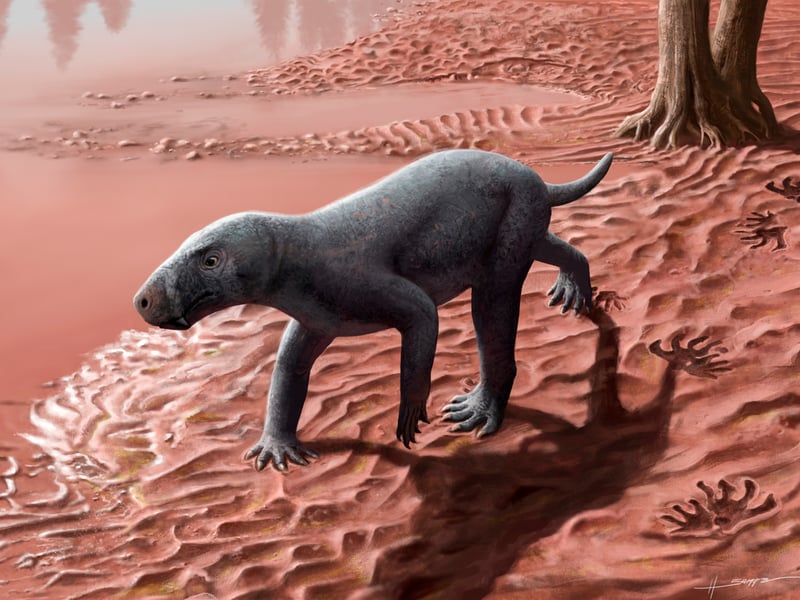
(CN) — Mallorca in Spain’s Balearic Islands is well known as a holiday getaway. And it’s also home to the oldest known remains of a gorgonopsian, an important ancestor of modern mammals — a fact that could change our understanding of their migration and evolutionary history.
Gorgonopsians are now extinct, but 270 to 250 million years ago they were furless, earless, dog-like, saber-toothed super predators stalking the ancient supercontinent of Pangea.
In the past researchers have found remains of gorgonopsians in paleolatitude locations like modern-day Russia and South Africa, but in a study published in Nature Communications on Tuesday, researchers from the Institut Català de Paleontologia Miquel Crusafont in Sabadell, Catalonia, Spain, describe their discovery of the remains of a 270-million-year gorgonopsian in an unlikely place: Mallorca.
“The presence of a derived therapsid at this age and location is unexpected,” the researchers write in the study, referring to the gorgonopsian remains. “[It] indicates that the diversification of the major therapsid subclades may not have been restricted to high paleo latitudes as previously thought.”
The findings suggest that instead of originating in higher latitude areas of Pangea, gorgonopsians might have originated in lower, wetter, more equatorial areas and then expanded into higher latitudes because their rudimentary form of thermoregulation, efficient locomotion, food manipulation and other traits gave them the ability to exploit an ecological opportunity after a mass extinction event called Olson’s Extinction.
Like modern mammals, gorgonopsians were warm-blooded animals. But, unlike most mammals, which give birth to live young, gorgonopsians laid eggs.
Modern mammals belong to a larger group called synapsids. Gorgonospians are one of the extinct groups of synapsids.
“In short, yes, it partially fills gaps in both evolutionary histories of gorgonopsians and mammals,” Josep Fortuny, senior author of the study and leader of the Computational Biomechanics and Evolution of Life History research group at ICP, said in an email.
“It is pretty certain that the new finding is the oldest known gorgonopsian, and likely the oldest known member of a subgroup of synapsids called Therapsida (therapsids include mammals and a subset of non-mammalian synapsids that are relatively closely related to mammals). There is a big time gap in the fossil record of therapsids, between when they are predicted to have evolved based on our knowledge of relationships of synapsids and when they actually show up in the fossil record, and the new specimen helps to fill in part of that gap,” he added.
Fortuny and his team are currently looking for more specimens, analyzing rocks they’ve found them in to more accurately define their age and scanning them with high-resolution imaging to find parts of the animals embedded in them.
In their study, the researchers write that the discovery of the remains “underscores the need for more sampling in poorly studied areas of northern Africa and southern Europe that preserve Permian tropical ecosystems.”
Subscribe to our free newsletters
Our weekly newsletter Closing Arguments offers the latest about ongoing trials, major litigation and rulings in courthouses around the U.S. and the world, while the monthly Under the Lights dishes the legal dirt from Hollywood, sports, Big Tech and the arts.