Search Articles


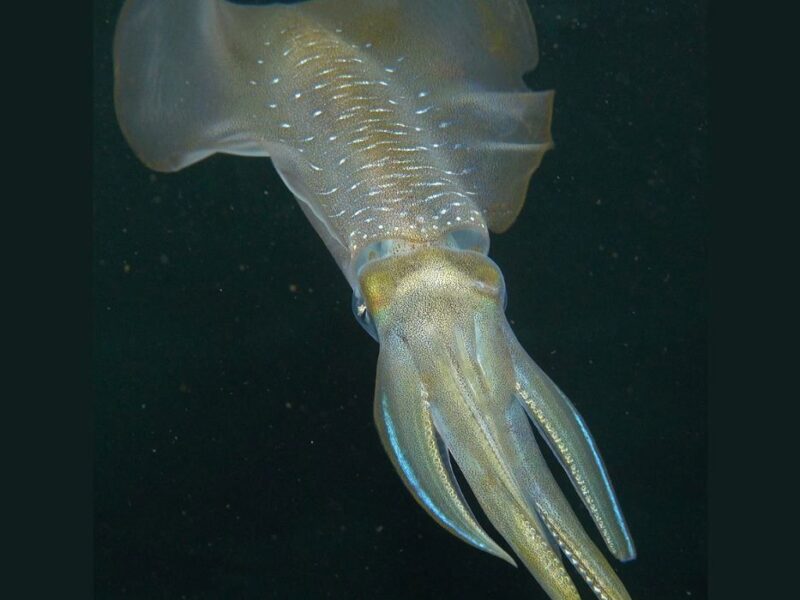
(CN) — Among the incredible quantity of animal life in the ocean, cephalopods — a category that includes squids, octopuses and cuttlefish — are some of the brainiest. But ocean acidification, an often overlooked effect of man-made climate change, could change that fact within decades, according to an ongoing scientific study.Garett Allen, an assistant professor at Acadia University in Nova Scotia, Canada, called the study’s findings “a real surprise” that could foretell a grave threat to the long-term survival of the Earth’s most intelligent invertebrate animals.
Since the 1980s, ocean acidification has been documented at an accelerated rate as large bodies of seawater absorb excessive carbon dioxide (CO2) — a greenhouse gas emitted in high concentration when humans burn fossil fuels — from the atmosphere.
Working with Yung-Che Tseng of Taiwan’s Academia Sinica, Allen conducted research on bigfin reef squid hatched and reared in captivity. Two groups of squid were raised in separate tanks with differing levels of water acidity.
In order to simulate current ocean conditions, the first tank was kept at a pH level of 8.2. The second tank, an approximation of seawater in the year 2100 based on a climate change prediction model, had a pH level of 7.8. Scientists consider a pH of 7 to be neutral, or equally acidic and basic.
After 90 days, the squid were removed for analysis. Using diffusion magnetic resonance imaging — a form of MRI technology focused on the diffusion of water molecules — Tseng and Allen took a look inside the cephalopods’ preserved heads.
What seemed like a fractional difference in pH on paper turned out to be anything but for the squid in the second tank.
“I immediately saw that their brains were half the size and had to check the diagnostic output of the software,” Allen said. “I wasn’t expecting that at all.”
While no difference in body size was observed between the two squid groups, squid in the control tank had, on average, a 49% higher brain volume than squid in the more acidic tank. The sharpest decreases in volume occurred in visually-oriented parts of the brain called the optic lobes and optic tracts, which both saw upwards of a 50% plunge in the second tank’s squid brains.
A prior study found that high CO2 exposure may influence bigfin reef squid to hunt less frequently. It’s not a matter of laziness, but poor sight, according to Allen.
“We think that the reduced willingness to feed may be linked to a decline in visual acuity,” he said. “Not because of the retina itself, which looks to stay the same, but perhaps because the optic lobe is shrinking.”
Allen theorized that the neural shrinkage and changes in hunting behavior seen in tested squid could be caused by an inability in their brains to properly send or receive information.
The researchers are conducting further studies on squid at Academia Sinica’s Marine Research Station, lowering the original experiment’s 90-day time constraint to learn more about when and how CO2-derived brain damage occurs in cephalopods.
“I had expected the shrinking volume to be a progressive event from early development, though our first glance at 30-day-old squid seems to suggest brain volume is stable,” Allen told Courthouse News, adding that the current MRI results are still preliminary.
“Cephalopods are really quite interesting — they’ve captivated folk for centuries and continue to surprise us,” he said. “While I’m excited about our work, it’s bittersweet to think of what this might mean for their future. Hopefully they continue to surprise us in resilience!”
Subscribe to our free newsletters
Our weekly newsletter Closing Arguments offers the latest about ongoing trials, major litigation and rulings in courthouses around the U.S. and the world, while the monthly Under the Lights dishes the legal dirt from Hollywood, sports, Big Tech and the arts.