
 Search Articles


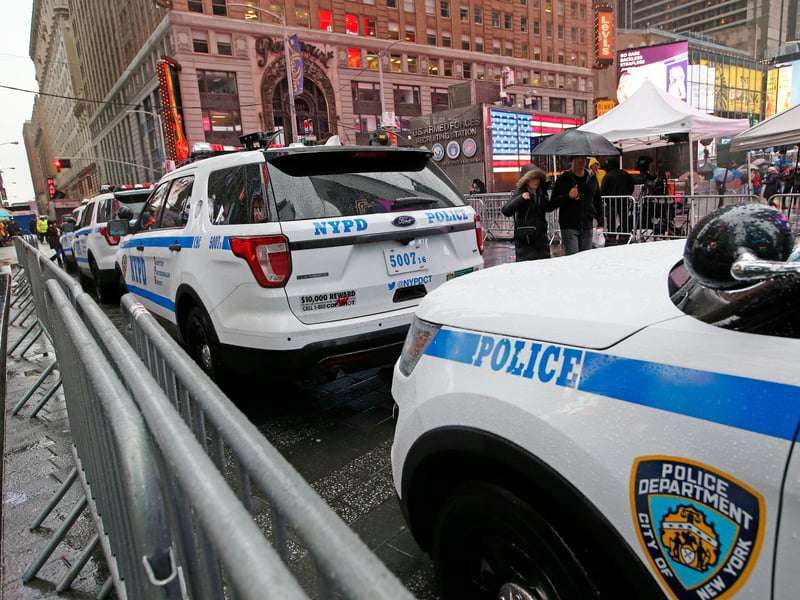
MANHATTAN (CN) — The New York Police Department has failed at every level to punish officers who engage in illegal stop and frisks, according to a retired New York state judge in a comprehensive disciplinary report released Monday.
Former Justice James Yates found in the 503-page report filed in Manhattan federal court that the NYPD have displayed a willful disregard to punishing officers engaging in stop-and-frisk related misconduct.
In particular, Yates says various police commissioners “have demonstrated an inordinate willingness to excuse illegal stops, frisks and searches in the name of ‘good faith’ or ‘lack of mal-intention.’”
The report focuses on the years since a landmark 2013 federal ruling that found stop and frisks constitutionally violated the rights of communities of color.
Yates emphasizes that the department’s systematic failure to punish officers for stop-and-frisk misconduct has persisted under the leadership of multiple police commissioners. Since the ruling, there have been six New York City police commissioners.
According to Yates, police commissioners regularly reduced or dismissed penalties for officers whose misconduct had been substantiated by the review board.
While commissioners are required to submit their reasoning behind a dismissal of an officer’s misconduct, the need for justification is not heavily enforced and is often chalked up to “good faith” or “good intent” on the part of the police officers.
But Yates argues that officers should not be able to evade disciplinary action simply because they had good intentions.
He says the Supreme Court “has never engrafted the doctrine of good faith mistakes of law onto departmental disciplinary proceedings.
“That line of thinking would erase years of careful demarcation of the boundaries of lawful search and seizure,” Yates adds.
In times when police commissioners acknowledge the need to discipline substantiated misconduct, Yates says, they have often delegated the cases to precinct commanders.
“In those cases, imposition of penalty days at the precinct is even more rare,” Yates says.
Meanwhile, sergeants and higher-ranked officers in the precincts regularly ignored when officers conducted inappropriate stops and failed to enforce disciplinary actions.
For instance, disciplinary guidelines instituted in June 2021 are almost never adhered to, Yates says.
Despite the guidelines asserting a three-day penalty of lost vacation time, Yates described the use of that disciplinary action as a “rarity.”
Since the disciplinary guidelines have been released, Yates identifies 224 substantial accusations of stop-and-frisk misconduct involving 91 officers. Of the 61 cases resolved by the time of the report’s publishing, only 10 impose any type of vacation day penalty.
Yates also outlined a series of recommendations for public transparency and accountability in the disciplinary system, along with suggestions for complaint processing and how to measure good faith or mistakes and clarifying what constitutes racial profiling.
Stop-and-frisk tactics used to be a well-established practice among New York City police officers, and were expanded on by former New York City Mayor Michael R. Bloomberg who avidly endorsed the practice during his mayoral term from 2002 to 2013.
The use of such tactics sparked widespread anger in communities of color, leading to a class action that resulted in a two-month nonjury trial and the landmark 2013 court decision that found the long-overlooked policing practice violated the constitutional rights of targeted Black and Latino communities.
U.S. District Judge Shira A. Scheindlin, who has since retired, found then the practice resulted in a “policy of racial profiling,” and pushed for broad reforms such as the use of body cameras for police officers.
As revealed during trial, roughly 4.4 million stops were conducted from January 2004 to June 2012. Of those stops, 52% of the individuals were Black despite only 23% of the resident population being Black.
Yates’ report comes at a time of upheaval for the police department. After federal agents seized his phone as part of a criminal investigation, police commissioner Edward A. Caban resigned on September 12.
The New York Police Department did not respond to a request for comment regarding the report.
U.S. District Judge Analisa Torres, a Barack Obama appointee, ordered the report to assess the “efficacy, fairness and integrity of the city’s policies” with respect to police misconduct. In a letter attached to the report, Torres requests public comment on the report until December 25, 2024, which can be submitted on NYPD Monitor.
 Follow @NikaSchoonover
Subscribe to our free newsletters
Our weekly newsletter Closing Arguments offers the latest about ongoing trials, major litigation and rulings in courthouses around the U.S. and the world, while the monthly Under the Lights dishes the legal dirt from Hollywood, sports, Big Tech and the arts.