
 Search Articles


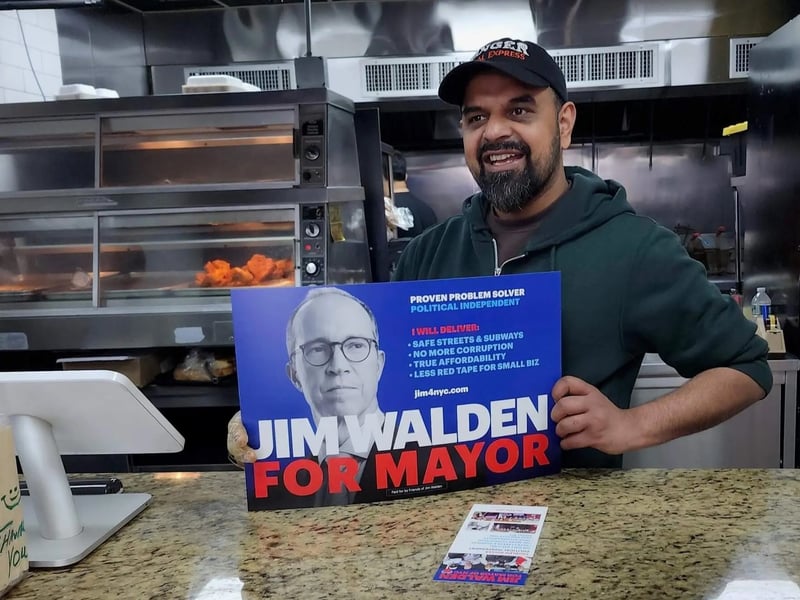
MANHATTAN (CN) — A New York City lawyer running for mayor asked a federal appeals panel on Tuesday to declare unconstitutional the enforcement of a state bill that barred the use of “independence” and “independent” in political party names.
Jim Walden, a candidate for New York City mayor, is challenging New York’s “Independence Ban,” which bans the use of the words “independence” and “independent” from ballot lines to prevent voter confusion, claiming the state’s barring is a “direct content-based restriction on core political speech.”
The legislation, sponsored by state Senator James Skoufis and Assemblyman Jeffrey Dinowitz, was intended to address any confusion that arose when voters who intended to be independents, or unaffiliated with a party, registered as members of the state Independence Party.
Walden, a former prosecutor in the Eastern District of New York from 1993 to 2002, claims this ban, which took effect on Jan. 1, 2023, violates his First and 14th Amendment rights.
The lower federal district court denied Walden’s bid to use the name “Independence Party” on nominating petitions, finding that the ban doesn’t violate the First Amendment guarantee of free speech because it was a reasonable regulation of speech in a nonpublic forum.
The ruling in Brooklyn federal court upheld a state election law prohibiting political parties from using the words “independent” or “independence” in their names because voters experienced problems registering as independent, unaffiliated voters when they enrolled in the since-disbanded Independence Party, which existed from 1991 to 2020.
Walden appealed to the Second Circuit, claiming that the lower court ignored the fact that the ban is not narrowly tailored to further the state’s interest in preventing voter confusion.
During oral arguments on Tuesday, Walden’s lawyer John Cuti said “there’s a long history of the major parties trying to make it difficult for the smaller parties.”
Cuti later cited the Second Circuit’s 1989 decision in Rogers v. Grimaldi , over the 1986 Federico Fellini film “Ginger and Fred,” which established a test — frequently referred to as the “Rogers test” — for litigating whether the use of a trademark in an artistic work violates the Lanham Act.
U.S. Circuit Judge Gerard Lynch cut him off and said the invocation of Rogers v. Grimaldi was “pretty far afield” from the case at hand.
“We’re talking about a word that is going to appear on the ballot,” the Barack Obama-appointed judge said. “The word that appears on the petitions is directly linked to the words that are going to appear on the ballot, and all of the other provisions that you pointed to in the statute are all of a piece. They’re all things that attempt to avoid confusion based on the names of parties so that the names of parties don’t mislead voters as to who’s the Republicans in this race, right?”
Cuti insisted there’s no basis to believe there’s any risk of confusion and that it would be “impossible” for New Yorkers who wish to register as independent voter to think they’re enrolling in the Independence Party.
Walden hasn’t been affiliated with a party for decades, and he’s running as “an alternative to the parties,” Cuti argued. “His whole platform and message is he’s not a party guy.”
Lynch questioned attorneys for New York State Office of the Attorney General representing the state election board on whether Walden would be allowed to campaign as a “true independent” who represents no party.
Assistant Solicitor General Daniel Magy said Walden “absolutely” could and the prohibition does not prevent them from saying that.
“He can say that all he wants. He can say it when he’s circulating the petition. He can say it on his website. He can say it to voters. He can say it, you know, in a debate, if there was a debate," he said.
“What the Supreme Court has said, and what this Court has said, is that that’s really the core political speech, that interactive speech, one on one, with voters,” Nagy continued. “What’s not core political speech is the label that’s going to end up on the bill, and that’s what we have here.”
The board of elections asked the Second Circuit in its appellee brief to affirm the lower court’s conclusion that Walden failed to establish either a likelihood of success on the merits of his First Amendment claim or irreparable harm, and deny his motion for preliminary injunction.
Lynch was joined on the three-judge panel by Joe Biden-appointed U.S. Circuit Judges Alison Nathan and Eunice Lee.
Current New York City Mayor Eric Adams announced in early April that he would be run for reelection on the nonpartisan line as an independent — not a Democrat — following the messy dismissal of his federal corruption case with explicit help from the Trump administration.
New York City is a heavily Democratic electorate, so the winner of the June 24 primary is generally forecast to be the favorite heading into the 2025 general election in November.
Recent polling conducted by AARP New York and the Siena College Research Institute found former Governor Andrew Cuomo leading the field in the Democrat primary race for New York City mayor with 34%, trailed by Assemblymember Zohran Mamdani with 15%, according to a new poll of registered city voters released in mid-April.
The Independence Party lost its ballot status in 2020 because amendments to state election law heightened the requirements to at least 130,000 votes on the party line every two years. Previously, minor parties needed 50,000 votes in a gubernatorial election to achieve automatic status.
 Follow @jruss_jruss
Subscribe to our free newsletters
Our weekly newsletter Closing Arguments offers the latest about ongoing trials, major litigation and rulings in courthouses around the U.S. and the world, while the monthly Under the Lights dishes the legal dirt from Hollywood, sports, Big Tech and the arts.