
 Search Articles


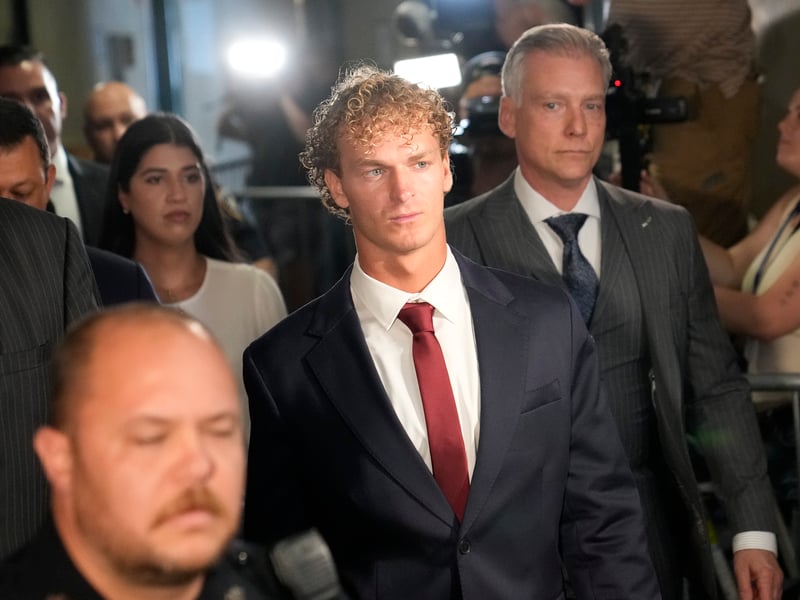
MANHATTAN (CN) — A New York judge on Friday withdrew the top count of second-degree manslaughter against Daniel Penny, the 26-year-old Marine Corps veteran who was seen on video last year fatally choking homeless straphanger Jordan Neely on a Manhattan subway.
At prosecutors’ request, New York Supreme Court Justice Maxwell Wiley pulled the charge after jurors said they were deadlocked on it.
Starting Monday, jurors will instead only consider the lesser charge against Penny: criminally negligent homicide.
According to New York State penal code, a person is guilty of second-degree manslaughter when they “recklessly cause the death of another person.” By contrast, criminally negligent homicide is defined as when a person causes the death of another person “with criminal negligence.”
In some ways, it’s a win for prosecutors, who narrowly dodged a mistrial.
The jurors can only convict Penny on one of the two counts. They were instructed not to consider the lower count of criminally negligent homicide unless they first unanimously ruled out the second-degree manslaughter charge. By Friday, though, they were still unable to do so.
In that way, it’s also a win for Penny, who could have faced up to 15 years in prison for manslaughter in the second degree. He now faces a maximum of four years for criminally negligent homicide. There is no minimum sentence for either charge.
In a note Friday morning, jurors indicated to Wiley that they were struggling to reach a verdict.
“At this time we are unable to come to a unanimous vote on count one — manslaughter in the second degree,” they wrote.
The note prompted Penny’s defense attorney Thomas Kenniff to move for a mistrial.
“The jury has been deliberating for roughly 20 hours over four days on what is, in many ways, a factually uncomplicated case as far as this is an event that transpired for minutes on video,” Kenniff told the judge.
Wiley disagreed, telling Kenniff that he believed the case to be “very factually complicated.” He declined to declare a mistrial and instead brought the jury out to read them an Allen charge — that is, instructions encouraging jurors to continue deliberating.
“It is not uncommon for a jury to have difficulty initially in reaching a unanimous verdict,” the judge assured the jurors.
The 12-person panel sent another note hours later, indicating that they were still deadlocked. That prompted the judge to drop the manslaughter charge, setting the stage for jurors to deliberate whether Penny was guilty of criminally negligent homicide.
The case has been in the jury’s hands since Tuesday afternoon, when prosecutorswrapped up their closing arguments. Since then, the courtroom gallery of press, members of the public, social rights activists and members of Neely’s family has been anticipating the verdict with bated breath.
Penny became a figure of nationwide debate last year when social media videos surfaced of him holding Neely in a chokehold on the floor of a Manhattan F train. Neely died following the struggle, and the city medical examiner pointed to Penny’s hold as the cause of his death.
Penny’s legal team claims that the architecture student was trying to protect his fellow subway riders when Neely boarded the train in an erratic state, threw his jacket on the floor and started shouting threats.
Several of those subway riders testified they were terrified of Neely’s conduct. One witness said she was “really, really nervous” when Neely started yelling, Another said she feared for her life.
Penny’s defense team has also stoked doubt over Neely’s cause of death. They elicited testimony from an independent forensic pathologist, who suggested that Neely’s sickle-cell trait was the true root of his demise — not Penny’s chokehold.
Prosecutors don’t doubt Penny’s intentions, only that he went “way too far” in his bid to restrain Neely and held on to a restrictive chokehold for far too long. They said that Penny held on to the choke for about six minutes, which they found to be more than enough time to cause death by asphyxiation.
 Follow @Uebey
 Follow @uebey.bsky.social
Subscribe to our free newsletters
Our weekly newsletter Closing Arguments offers the latest about ongoing trials, major litigation and rulings in courthouses around the U.S. and the world, while the monthly Under the Lights dishes the legal dirt from Hollywood, sports, Big Tech and the arts.